Connect with us

News

The Stanford freshmen who want to rule the world . . . will probably read this book and try even harder

info

Published

on

Screenshot 2025 12 11 at 4.37.19 PM.png

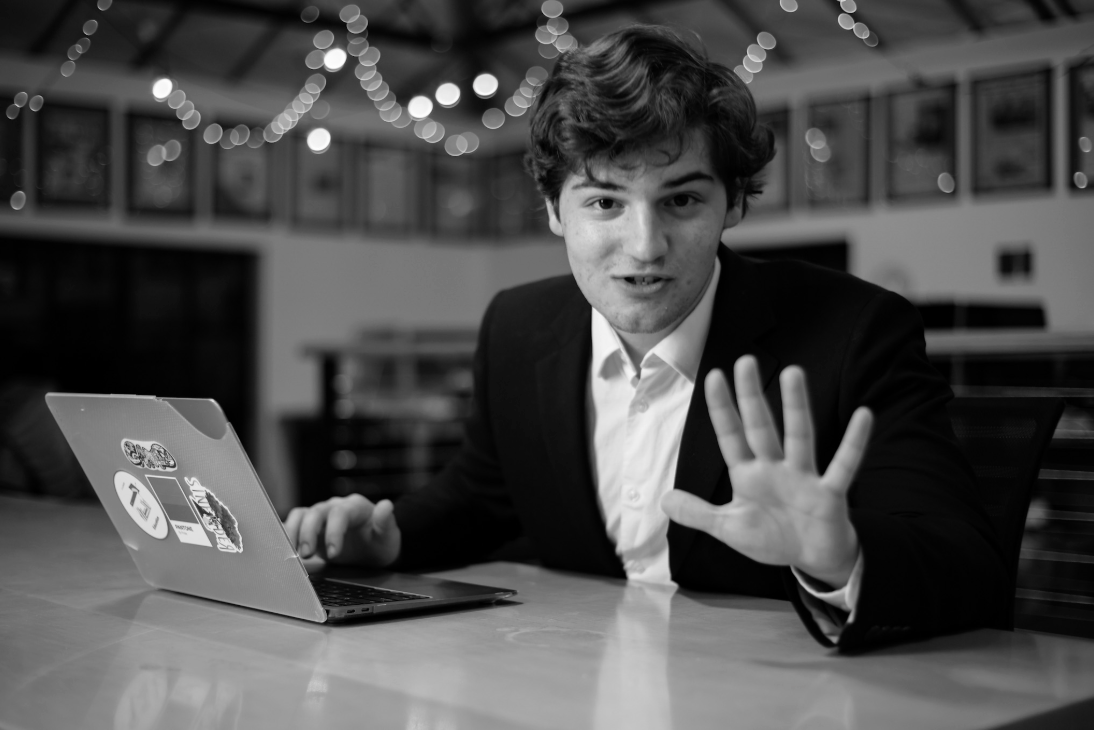
Theo Baker is graduating from Stanford this spring with something most seniors don’t have: a book deal, a George Polk Award that he received for his investigative reporting as a student journalist, and a front-row account of one of the most romanticized institutions in the world.

His forthcoming How to Rule the World: An Education in Power at Stanford University was excerpted Friday in The Atlantic and based on that alone, I can’t wait to see the rest. The only question worth asking is the same one Baker himself might be too close to answer, which is: Can a book like this actually change anything? Or does the spotlight, as it always seems to, send more students racing to the place?

The parallel that keeps coming to my mind is “The Social Network.” Aaron Sorkin wrote a film that was an indictment in many ways of the particular sociopathy that Silicon Valley tends to reward. What it seemingly did was make a generation of young people want to be Mark Zuckerberg. The cautionary tale became a recruitment video. The story of the guy who — in the movie, at least — steamrolled his best friend on his way to billions didn’t discourage ambition; it further glamorized it.

Judging by the excerpt, Baker’s portrait of Stanford is far more granular. He talks with hundreds of people to roundly describe the “Stanford inside Stanford.” “You sort of join it freshman year or you don’t,” one student tells Baker. It’s an invite-only world where venture capitalists wine and dine 18-year-olds, where “pre-idea funding” worth hundreds of thousands of dollars gets handed to students before they’ve had an original idea, and where the boundary between mentorship and predation is nearly impossible to discern. (The shame of chasing teenage founders, if it ever existed, is gone; not chasing them is no longer an option for most VCs.) Steve Blank, who teaches the school’s legendary startup course, tells Baker that “Stanford is an incubator with dorms,” which is not meant as a compliment.

What’s new isn’t that this pressure exists but that it has been fully internalized. There was a time, maybe 10, maybe 15 years ago, when Stanford students felt the weight of Silicon Valley expectation pressing down on them from outside. Now, many of them arrive on campus already expecting, as a matter of course, to launch a startup, to raise money, to become rich.

I think about a friend — I’ll call him D — who dropped out of Stanford a few years ago, partway through his first two years, to launch a startup. He was barely past his teens. The words “I’m thinking of take a leave of absence” had just escaped his mouth before the university, by his own account, gave him its cheerful blessing to dive full bore into the startup. Stanford doesn’t fight this anymore, if it ever did. Departures like his are an expected outcome.

D is now in his mid-twenties. His company has raised what would register in any normal context as an astonishing amount of money. He almost certainly knows more about cap tables, venture dynamics, and product-market fit than most people learn in a decade of conventional careers. By every metric the Valley uses, he’s a success story. But he also doesn’t see his family (no time), has barely dated (no time), and the company, which keeps growing, doesn’t seem inclined to provide him with that kind of balance anytime soon. He is already, in some meaningful sense, behind on his own life.

Techcrunch event

San Francisco, CA
|
October 13-15, 2026

This is the part that Baker’s excerpt hints at without fully landing on, maybe because he’s still inside it himself. The costs of this system aren’t just distributed in the form of fraud — though Baker is direct about this, describing it as pervasive and largely consequence-free. The costs are also more personal: the relationships not formed, the ordinary milestones of early adulthood traded away in exchange for a billion-dollar vision that, statistically, almost certainly won’t materialize. “100% of entrepreneurs think they’re visionaries,” Blank tells Baker. “The data say 99% aren’t.”

What happens to the 99% at age 30? At age 40? These aren’t questions Silicon Valley is set up to answer, and they’re certainly not questions Stanford is about to start asking.

Baker also surfaces something that Sam Altman articulates best. Altman — OpenAI CEO, former Y Combinator head, precisely the kind of person these students aspire to become — tells Baker that the VC dinner circuit has become an “anti-signal” to the people who actually know what talent looks like. The students doing the rounds, performing founder-ness for rooms full of investors, tend not to be the real builders. The real builders, presumably, are somewhere else, building things. The performance of ambition and the thing itself are increasingly hard to tell apart, and the system that was ostensibly designed to find genius has gotten very good at finding people who are good at seeming like geniuses.

How to Rule the World sounds like exactly the right book for this moment in time. But there’s a certain irony in the strong likelihood that this critically minded book about Stanford’s relationship to power and money will be celebrated by the same class of people it critiques, and — if it does well (it has already been optioned for a movie) — used as further evidence that Stanford produces not just founders and fraudsters but important writers and journalists, too.

Continue Reading
Click to comment

Leave a Reply

Your email address will not be published. Required fields are marked *

News

Meta inks deal for solar power at night, beamed from space

info

Published

on

By

Overview satellite rendering.png

The race to secure electricity for AI models has reached new heights: Meta has signed an agreement with the startup Overview Energy that could see a thousand satellites beam infrared light to solar farms that power data centers at night.

In 2024, Meta’s data centers used more than 18,000 gigawatt-hours of electricity—roughly enough to power more than 1.7 million American homes for a year—and its need for compute power is only increasing. The company has committed to building 30 gigawatts of renewable power sources, with a focus on industrial-scale solar power plants.

Typically, data centers turning to solar power must either invest in battery storage or rely on other generation sources to operate at night.

Overview, a four-year-old, Ashburn, Virginia, outfit that emerged from stealth in December, has a different solution: The company is developing spacecraft that collect plentiful solar power in space. It then plans to convert that energy to near-infrared light and beam it at sufficiently large solar farms—on the order of hundreds of megawatts—which can convert that light to electricity.

By using a wide, infrared beam to power existing terrestrial solar infrastructure, Overview thinks it can sidestep the technological challenges and safety and regulatory issues that bedevil plans to transmit power to Earth through high-power lasers or microwave beams. CEO Marc Berte says you’ll be able to stare right into his satellite’s beam with no ill effects.

The technology would increase the return on investment from building solar farms and reduce reliance on fossil fuels — if it can be deployed at scale.

Overview says it has already demonstrated power transmission to the ground from an aircraft, and is planning to launch a satellite to low Earth orbit in January 2028 to perform its first power transmission from space.

Techcrunch event

San Francisco, CA
|
October 13-15, 2026

In today’s announcement, Meta said it signed the first capacity reservation agreement with Overview to receive up to 1 gigawatt of power from the company’s spacecraft, although it’s not clear if any money changed hands. Overview developed a new metric for this contract, megawatt photons, which is the amount of light required to generate a megawatt of electricity.

Berte expects to begin launching the satellites that would fulfill that commitment in 2030, with a goal of flying 1,000 spacecraft in geosynchronous orbit, a high orbit in which each satellite remains fixed above the same point on Earth. He expects each of the company’s spacecraft to provide power from space for more than 10 years.

Once in space, Berte says the fleet of spacecraft will be able to cover about a third of the planet, with an initial deployment that will reach from the West Coast of the United States across to Western Europe. As the Earth rotates below and customer solar farms enter evening and night, Overview’s spacecraft should boost their electrical generation with additional light from space.

Berte sees opportunity in combining both generation and transmission, with the flexibility to deliver power to solar farms wherever and whenever it is most valuable.

“There’s a big difference between being in any one energy market, and being in all of the energy markets,” Berte told TechCrunch.

When you purchase through links in our articles, we may earn a small commission. This doesn’t affect our editorial independence.

Continue Reading

News

Insecurity: Gunmen Kill Pastor, Wife, Children in Fresh Plateau Attack

info

Published

on

By

Bandit gunmen.jpeg

Gunmen on Sunday night attacked Gako Village in Riyom Local Government Area, killing a pastor and three members of his family in what residents described as a renewed wave of violence in the area.

The victims were identified as Rev. Ayuba Choji, his wife, Chundung Ayuba, and their two children, Cyril and Endurance.

Community sources said the attackers stormed the village around 11 p.m., opening fire indiscriminately and forcing residents to flee for safety.

A resident, Martha Dalyop, told Vanguard that the late-night assault caused panic across the community, with many people running into hiding. She lamented that repeated attacks have left residents living in fear, unable to sleep peacefully or tend to their farms.

Confirming the incident, the publicity secretary of the Berom Youths Moulder Association, Rwang Tengwong, said the pattern of attacks has shifted, with assailants now targeting relaxation centres, farming communities, and local vigilantes.

He explained that the attackers often operate in coordinated groups—some attacking residents, others destroying farmlands, while another group blocks roads or monitors movement to prevent escape or intervention.

Tengwong also revealed that within the past 48 hours, large areas of farmland in Kassa, Barkin Ladi Local Government Area, including cabbage, pepper, and maize farms, had been destroyed, worsening the hardship faced by farmers.

The latest attack has heightened tension across Riyom and neighbouring Barkin Ladi communities, with residents calling on security agencies and government authorities to step up efforts to end the killings and protect livelihoods in Plateau State.

Continue Reading

Trending