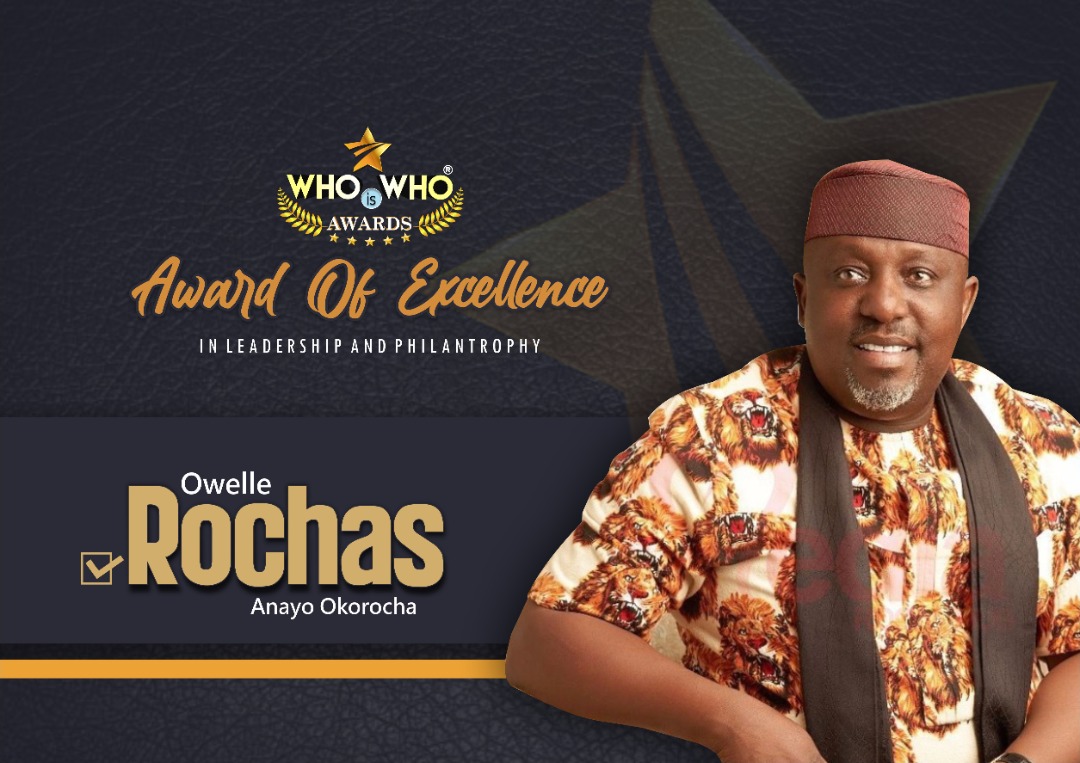
Who Is Who awards and Magazine is set to honor Senator Rochas Okorocha as one of Nigeria’s notable philanthropists in its bid in recognizing top individuals who are positively impacting society and the country at large.
The award organization has in the past awarded Nigeria’s Past President Goodluck Jonathan, Former Governor of Gombe State, Sen Danjuma Goje, Governor Simon Lalong of Plateau state, Prince Ned Nwoko, Amb Rachal Bakam, Chief Obinna Iyiegbu popularly known as Obi Cubana and other worthy Nigerians.
Speaking earlier to Journalist, International President of Who is Who Awards and Magazine, Mrs. Binta Perl Ojoma, said the organization is driven by the passion for showcasing individuals, businesses and organizations. She said the organization has keenly followed the activities of Senator Rochas Okorocha after his name came up severely through their nomination processes.
Mrs. Ojoma said the former Governor and current senator representing Imo West, Imo State, Nigeria has demonstrated that he is indeed is a man with a heart of gold and compassion as his persona is made up of his commitment to philanthropy.
“Owelle Rochas Anayo Okorocha has shown remarkable excellence in all spears of life as one of Nigeria’s multi-billionaire, education philanthropists, politician, an astute businessman, A man who has set his sights on providing free education to 1 million children across the African continent by the year 2030”
“We, therefore, are pleased to award recognize his inculpable efforts in Nation-building with an Award of Excellence in Leadership and Philanthropy,” she said
Who is Who Award and Magazine will deliver the Ceremonious Award of Excellence to Senator Rochas Okorocha in Abuja today with over Seven thousand copies of an exclusive business directory (The Who Is Who Magazine) distributed across the federation. The Award organization will be celebrating Senator Rochas’s irreproachable contributions and achievements which it hopes will encourage others to raise their leadership quality and service standard, hence economic growth.
The Lagos State Government says it has fully digitised its planning permit system, marking a significant shift in how property approvals and land administration are handled in one of Africa’s largest megacities.
The transition is anchored on the Electronic Physical Planning Process System (EPPPS), which according to the state government, serve as an end-to-end digital platform that replaces decades of manual and semi-digital workflows with a unified system designed to improve efficiency, transparency, and regulatory compliance. Under the new regime, all planning permit applications must be processed exclusively through the platform, effectively eliminating manual submissions.
The system covers the full lifecycle of approvals, from planning permission to construction authorisation and stage certification, signalling a move towards integrated digital service delivery in the state’s urban planning ecosystem.
Lagos State deploys EPPPS to digitise planning permits, streamline land administration, and eliminate manual processing across LASPPPA and LASBCA. Image credit: Image FX.
The introduction of EPPPS, launched earlier in 2026, the state government says, is aimed at addressing these inefficiencies by enabling online submissions, real-time application tracking, and standardised workflows. The latest directive to fully eliminate manual processing underscores what officials describe as a structural reform in Lagos’ digital governance framework.
Lagos: EPPPS go-live marks structural reform in digital governance
Planning permits remain a legal requirement for all developments in Lagos, governed by the state’s physical planning laws and enforced through multiple agencies. Historically, the process has been characterised by extensive paperwork, physical inspections, and inter-agency bottlenecks, often resulting in prolonged approval timelines.
The introduction of EPPPS, launched earlier in 2026, the state government says, is aimed at addressing these inefficiencies by enabling online submissions, real-time application tracking, and standardised workflows. The latest directive to fully eliminate manual processing underscores what officials describe as a structural reform in Lagos’ digital governance framework.
Speaking at a press conference in Alausa Ikeja, Olajide Abiodun, Special Adviser to the Governor on e-GIS and Urban Development, described the reform as a turning point in the state’s transition to digital governance.
“Lagos State has entered the dawn of a new era in digital processing of Planning Permissions, Authorisations to Commence Construction Works, Stage Certification, amongst other services,” he said. “Under the leadership of Governor Babajide Olusola Sanwo-Olu, we are actively transitioning from legacy, manual systems toward a highly efficient, transparent, and scalable digital framework.”
Abiodun stressed that manual processing of planning permits has been completely discontinued, warning that any attempt to process permits outside the digital platform would be considered illegal.
According to the state government, the rollout is supported by fully digitised backend infrastructure across key agencies, including the Lagos State Physical Planning Permit Authority (LASPPPA) and the Lagos State Building Control Agency (LASBCA).
“Meanwhile, the State Government has achieved 100% training and retraining of personnel, 100% computer systems deployment across all districts of LASPPPA and LASBCA, and 100% internet deployment across all district offices. The infrastructure is fully ready, tested and running,” according to Abiodun.
At the core of the broader land administration ecosystem is Aumentum Software, which powers digital land records and the processing of Certificates of Occupancy (C of O). The platform enables secure, searchable land records while accelerating processing timelines, factors seen as critical to improving investor confidence in Lagos’ real estate sector.
“Aumentum is a highly robust and secure digital system driving the complete digitisation of our land administration ecosystem, most notably the digital processing of Certificates of Occupancy (C of O),” Abiodun added.
The state is also integrating financial workflows through the Moola Tracker, a digital tool linked with Aumentum to streamline mortgage consent processing. Officials say the system significantly reduces bureaucratic delays.
“Previously, the processing of Mortgage Consent was a tedious journey involving about 29 manual steps, which took an unending number of days. We are happy to announce that with this integrated digital solution, we have reduced it to just eight steps,” Abiodun said.
Beyond digitisation, Lagos is embedding regulatory technology into its building control framework through the Certified Accredited Programme (CAP), a public-private partnership model designed to strengthen compliance with building codes and address risks such as structural failures in a rapidly urbanising environment.
The initiative is expected to improve oversight, accelerate project delivery, and reduce incidents of building collapse by ensuring stricter adherence to regulatory standards.
To enhance accessibility, the state government has also launched a regional e-GIS office in Ikeja, providing a decentralised, customer-facing hub for digitised land administration services. The move is expected to reduce the need for residents to travel to central offices in Alausa for routine land-related inquiries.
Officials say the combined reforms signal Lagos State’s transition from fragmented, paper-based systems to a fully integrated digital governance model for urban development.
Stay ahead with real-time reports, breaking news, and exclusive insights delivered directly to your phone. Don’t settle for outdated information. Join TECHNOLOGYTIMES NEWS on WhatsApp for 24/7 updates.
The Federal Government is advancing plans to integrate digital education into Nigeria’s Almajiri system, in a move to address the country’s rising population of out-of-school children through technology-driven learning and skills development.
The initiative is being driven through a collaboration between the National Information Technology Development Agency (NITDA) and the National Commission for Almajiri and Out-of-School Children’s Education (NCAOOSCE), following a recent high-level engagement at NITDA headquarters in Abuja, according to a statement by the tech agency, NITDA.
Muhammad Sani Idris, Executive Secretary of NCAOOSCE, says the Almajiri system is facing deep-rooted structural challenges affecting children’s welfare and access to education.
According to him, these challenges include parental abdication of responsibility, widespread street begging, vulnerability to exploitation, and the growing number of out-of-school children across the country.
Idris called for stronger institutional collaboration to reposition the system through digital education and structured skills acquisition.
“He requested NITDA’s collaboration to transform the system through digital education and skills acquisition,” the Commission says in a statement.
In response, Kashifu Inuwa, Director-General of NITDA, proposed the deployment of the agency’s Digital Literacy for All initiative through existing Almajiri structures.
The strategy, according to Inuwa, will leverage members of the National Youth Service Corps (NYSC) as digital literacy champions, integrate technology training into Almajiri learning centres, and establish digital hubs to deliver basic to advanced digital skills.
Both agencies say the framework is designed to bridge learning gaps and expand access to modern competencies for vulnerable children who are currently outside the formal education system.
They also reaffirmed their commitment to using technology as a tool for inclusive education and national development, announcing the establishment of a joint implementation committee to coordinate the rollout of the programme.
The collaboration reflects a broader shift in Nigeria’s education policy, where digital literacy is increasingly being positioned as a strategic instrument for tackling exclusion and youth vulnerability.
Nigeria continues to grapple with one of the largest out-of-school children populations globally, driven by poverty, insecurity in parts of Northern Nigeria, and systemic barriers to formal education. The Almajiri system, historically rooted in traditional Islamic learning, has in recent years become associated with street begging and heightened child vulnerability, particularly in urban centres.
The proposed intervention signals a transition from welfare-based responses to a more structured, skills-driven model, where technology serves as both an educational platform and an empowerment tool.
However, stakeholders acknowledge that implementation will require addressing key constraints, including funding, infrastructure readiness, training capacity, and connectivity challenges in underserved communities.
The newly constituted joint committee is expected to define operational guidelines, deployment frameworks, and scale-up pathways for the initiative.
Stay ahead with real-time reports, breaking news, and exclusive insights delivered directly to your phone. Don’t settle for outdated information. Join TECHNOLOGYTIMES NEWS on WhatsApp for 24/7 updates.