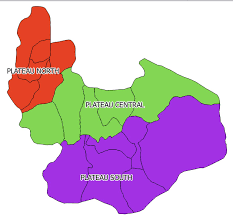
Protesting workers of the Plateau State College of Health Technology, Pankshin, under the auspices of the Joint Union of Plateau State Owned Tertiary Institutions (JUPTI) on Thursday 2nd February shut down the health institution.
According to reports the protest which started on Wednesday resumed on Thursday morning as the workers barricaded the gate and prevented vehicles from going in or leaving the campus.
The situation was said to have grounded activities at the campus and left the students stranded.
Many of the students who had waited in vain for their classes in the morning were seen returning home when news correspondents visited the institution around 1:30 pm on Thursday.
The aggrieved workers were also seen marching through the campus to the gate carrying placards with different inscriptions some of which read
“College of Health Technology, Pankshin is not a welfare ground for politicians”, “The Council position on provost appointment must be respected”, “College of Health Pankshin, Oil well for Plateau state Government functionaries”, “Appointment of Dr. Prince Fwanje: Lalong’s legacy project?”,”Our pension is for life”, The law governing College of Health Technology, Pankshin must be respected”, “Casual and Temporary workers: No allowances over 40 months and no appointment”, among others.
Addressing the workers, the Chairman of the Joint Union of Plateau state Tertiary Owned Tertiary Institution, Gokir Fwenshinen Ayuba, accused Governor Simon Lalong-led administration of working to destroy the health institution without regard to the law governing the college
Ayuba who insisted that the workers would not accept the re-appointment of the college provost, Dr. Prince Fwanje, vowed to continue with the protest until their demands were met.
The union leader said “We are saying it loud to the hearing of the community here in Pankshin and to the hearing of the government that enough is enough. We are tired of the current leadership in the College of Health Technology Pankshin. This administration has stayed for four years and there has not been any reasonable development in the institution. What we have had is only an increment in school fees every year and we have not seen anything that has been done with it.
“As workers of this institution, we are saying that if the government has sympathy for us and for this noble institution which is the oldest College of Health Technology in Nigeria and the West African sub-region, then it must come to our aid because the college is looking more of a pre-primary school and we can’t continue this way. We want to grow and we want the government to intervene in this matter so that we can get leaders who will come and develop the health institution. By the time we allow leaders to keep coming and milking from the institution’s little resources and just be going like that, then our problem will continue. We want a precedent to be set now so that henceforth, any leader who is coming here must know that he must be up and doing.”
The Chairman of the Non-Academic Staff Union in the institution, James Lohnan, who also decried the attitude of the government on the matter added
“As a union, we met with the State Commissioner for Higher Education on the need for a due process to be followed in the appointment of another Provost for the college this time around because the 2003 law of the college which was gazetted in 2005 stipulates in Part 4 Section 12 (2 and 3) that:
“There shall be a provost for the college who shall be appointed from within the college by the governor on the advice of the council or that the governor on the advice of the council may appoint the provost from outside the college if no person within the college is qualified to be so appointed.
“We left from the meeting with the Commissioner with an assurance that they will comply with the law only for us to hear an announcement that the same person who is an outsider and whose leadership is unhelpful to the college has been reappointed as the college provost in contravention to the law
“We are saying that his reappointment is unacceptable to the workers because his appointment was against the recommendation of the governing council and moreover, we have qualified and capable persons within the institution who will head the college. So we, want the government to respect the law”
The PUNCH reports that the Plateau state Commissioner for Higher Education, Prof. Bernard Matur, had last week announced the reappointment of Dr. Prince Fwanje as the Provost of the college following the expiration of his four-year tenure in the first instance.
When contacted to speak on the worker’s protest, the commissioner and the newly appointed Provost could not be reached at the time of filling this report as their phones were switched off.
Japan's immigration act may affect relocation plans
For many Nigerians exploring “japa” options beyond the usual destinations, Japan has become an attractive destination. But with the Japanese government’s new immigration protocol the move will become more expensive.
Authorities in Japan have considered changes to visa and residency fees under amendments to the Immigration Control Act. It proposes increased charges due to administrative costs—meaning more expenses for immigrants, such as Nigerians planning work and study relocation or long-term settlement.
An immediate impact on visa renewals, the cost of renewing a five-year visa could jump from 6,000 yen to about 70,000 yen (roughly $440). Short-term renewals may also increase to around 10,000 yen.
For Nigerians thinking long-term, permanent residency application fees could rise from 10,000 yen to 200,000 yen, with a proposed cap of 300,000 yen. This marks a financial shift for migrants who plan years ahead to transition from temporary stay to permanent status.
As of April 2026, eligibility tightens for foreign nationals who must now live in Japan continuously for at least 10 years before qualifying for citizenship. Twice the previous requirement, this could slow down long-term plans.
For Nigerian students who often use education as a pathway to international work opportunities, these changes may alter decisions about where to study. Japan has been gaining attention for its growing demand for skilled workers and relatively structured immigration pathways. However, higher costs could push many to reconsider options more carefully.
Professionals and skilled workers will likely feel the impact. High residency costs may influence job mobility, contract negotiations, and employer decisions to hire foreign talent.
While the policy is not yet official, the direction is clear: moving to Japan may require deeper financial planning.
For Nigerians considering “japa,” this development reinforces an important reality—migration is no longer just about opportunity, but also about affordability, timing, and long-term sustainability.
Nigerians should watch out for final decision on fees increase, implementation timeline, possible exemptions or reductions for students or low-income applicants, and changes in job sponsorship policies for foreign workers.
The Federal Government has commenced applications for the second batch of its Technical and Vocational Education and Training (TVET) programme, with selected participants set to receive a monthly stipend of N22,500.
This was made known in a statement issued on Monday by Boriowo Folasade, Director of Press and Public Relations at the Federal Ministry of Education.
The initiative is part of ongoing efforts to equip young Nigerians with practical, job-ready skills that can drive employment, entrepreneurship, and economic growth.
Programme details
According to the ministry, applications opened on April 13, 2026, and interested candidates are encouraged to apply for the nationwide training scheme designed to boost technical capacity and reduce unemployment.
Minister of Education, Tunji Alausa, described the programme as a key intervention to prepare youths for opportunities in a rapidly changing economy.
Tunji Alausa, Minister of Education
He noted that the government is investing in skills development to enable self-reliance, innovation, and long-term economic advancement through practical training and certification.
As part of efforts to expand its scope, the Ministry will collaborate with the Federal Ministry of Arts, Culture and Tourism to incorporate creative and cultural skills into the training.
Training structure and benefits
The programme offers intensive hands-on training lasting between six months and one year at accredited centres across all 36 states and the Federal Capital Territory.
Participants will receive monthly stipends throughout the training period and will be awarded nationally recognised certificates upon completion.
Training areas include construction, ICT, automotive technology, agriculture, beekeeping, creative media, fashion, cosmetology, hospitality, catering, tourism, and leather works, among others.
To ensure accountability, attendance will be tracked using biometric verification, and only participants who meet attendance requirements will receive stipends.
Applicants are required to provide their National Identification Number (NIN) and Bank Verification Number (BVN) during registration and must be available for full participation.
Interested individuals can apply via the official TVET portal.
Background
In December 2025, the Federal Government disbursed N4.7 billion as the first tranche of payments to trainees and accredited training centres under the programme.
The TVET initiative, which began rollout in May 2025, is part of a broader strategy to tackle unemployment and strengthen Nigeria’s skilled workforce.
Earlier, the Ministry had invited vocational institutions and master craftsmen to register for accreditation, allowing them to receive funding for training participants.
The programme adopts a practical-focused model, with 80% of training dedicated to hands-on experience and 20% to classroom learning.
Initial response to the scheme was strong, with over 90,000 applications recorded within the first week of launching the portal, while participation in entrance examinations rose significantly from 2024 to 2025.
Additionally, an artisan-led mentorship model has been introduced across upgraded technical colleges, enabling experienced professionals to guide trainees through their learning process.