Connect with us

News

Larry Page’s flying car company Pivotal loses its CEO

info

Published

on

Pivotal helix.jpg

The CEO of a flying car company backed by Larry Page has left the company.

Ken Karklin, who was Pivotal’s CEO for more than four years, left the role this week, according to a press release. Pivotal said Karklin is “pursuing new endeavors” but didn’t offer any other information about the executive’s departure from the electric vertical takeoff and landing (eVTOL) firm.

“Leading Pivotal has been the privilege of my career. Together, we’ve moved beyond the promise of light eVTOL and proved it out in practice,” Karklin said in a statement. “This industry has moved past prototypes and press releases; it’s now operating in the real world, under real constraints, with real consequences for the future of Advanced Air Mobility. As I turn to new endeavors, I do so knowing the foundation we built here will help carry this industry forward.”

Karklin will be replaced on an interim basis by Mike Ross, an aviation executive who joined Pivotal’s board of directors in November 2025. Karklin did not immediately respond to a request for comment.

Karklin’s departure comes two years after Pivotal started sales of Helix, its first lightweight electric personal aircraft. The single-seat aircraft doesn’t require a pilot’s license to fly and starts at around $200,000.

“Ken’s leadership over the past four years has been instrumental in bringing Pivotal to where it is today. Our team, our priorities, and our roadmap remain steady through this transition,” Ross said in a statement. “I’ve had the honor of working closely with Ken as a Board member and watching Pivotal’s disciplined approach to safety, engineering, and accessibility deliver on the vision of electric VTOL flight. I look forward to working with the team and guiding the company forward as we bring our fourth-generation Helix aircraft to market.”

Pivotal has also spent years developing an aircraft called BlackFly that is aimed at defense and first-responder use cases. Last month, BlackFly was used to respond to an emergency in North Carolina for the first time ever. The company says it beat an ambulance responding in parallel to the call by 20 minutes. BlackFly has flown more than 10,000 times, according to Pivotal.

Pivotal is one of a number of companies in the space that was selected for the Federal Aviation Administration’s eVTOL Integration Pilot Program, which was created to increase testing of these types of aircraft around the country.

When you purchase through links in our articles, we may earn a small commission. This doesn’t affect our editorial independence.

Continue Reading
Click to comment

Leave a Reply

Your email address will not be published. Required fields are marked *

Business

PLACCIMA Nominates Bolcit Barshep-Amakiri as Vice President, Commerce

editor

Published

on

By

FB IMG

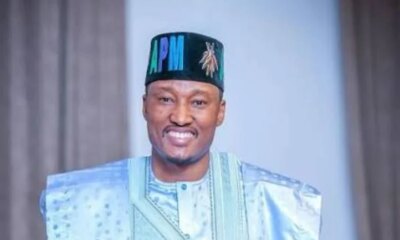
The Plateau Chamber of Commerce, Industry, Mines and Agriculture (PLACCIMA) has nominated Mrs. Bolcit Barshep-Amakiri as its new Vice President, Commerce.

The nomination was approved at the Chamber’s Executive Committee (EXCO) meeting held on August 11, 2026, following the death of Alhaji Yusuf Sarumi, who previously occupied the position.

In a formal letter signed by PLACCIMA’s Executive Director, Dauda Gashi, on behalf of the President, Barshep-Amakiri was congratulated on her nomination and urged to formally accept the responsibility without delay.

Barshep-Amakiri, who is the Managing Director/Chief Executive Officer of Anista Marketing and Events Ltd., Jos, is expected to assume her new role as the Chamber continues efforts to strengthen its leadership and promote commerce, industry, mining and agriculture across Plateau State.

Continue Reading

News

Tinubu Woos North, Claims Region Has Benefited Most From His Reforms

info

Published

on

By

Tinubu 1 1 15938835761362276231 1200x675.jpg

President Bola Tinubu has made a fresh move to woo Northern Nigeria, arguing that the region is positioned to gain the most from the economic reforms and infrastructure projects being pursued by his administration.

The President said the North’s proximity to several African countries would give it a strategic advantage as Nigeria expands trade and develops new transportation and energy networks.

“The biggest beneficiaries of this economy will be the Northern part of Nigeria, because they will now be trading with countries, trading with Niger, trading with Chad, trading with Burkina Faso, trading with Southern Sudan, trading with Northern Cameroon, trading with Central African Republic… The North is the next business destination of Nigeria,” Tinubu said.

He spoke through the National Chairman of the All Progressives Congress, APC, Professor Nentawe Yilwatda, at a policy roundtable organised by the APC Professionals Forum in Abuja.

The event, the second edition of the Asiwaju Scorecard Series, focused on the achievements and challenges of the Renewed Hope administration.

Tinubu used the occasion to defend some of the most difficult economic decisions taken since he assumed office, particularly the removal of petrol subsidy.

According to him, the reforms were introduced against the background of serious economic weaknesses inherited by his administration in May 2023.

He listed the problems as “fuel subsidy distortions, multiple exchange-rate windows, weak revenue mobilisation, foreign-exchange shortages, rising debt-service pressures and years of inadequate investment in critical infrastructure.”

The President argued that the consequences of the reforms should be assessed not only by their immediate effect but also by the economic opportunities they are expected to create in the long term.

He said Nigeria’s external reserves had reached about $52.7 billion by August 2026, while consolidated non-oil revenue increased from roughly N13.63 trillion in 2023 to N16.4 trillion in the first two quarters of 2026.

Tinubu also pointed to a sharp improvement in the country’s merchandise trade position, saying Nigeria moved from a surplus of about N44.8 billion in 2023 to approximately N7.54 trillion in the first quarter of 2026.

He further cited real GDP growth of 4.43 per cent in the second quarter of 2026 and a decline in inflation to about 15.4 per cent.

For the President, the figures are part of the foundation for his plan to grow the Nigerian economy to $1 trillion by 2030.

He said the government’s infrastructure programme would be particularly important to the North because of its potential to connect Nigerian businesses with markets in neighbouring African countries.

Among the projects highlighted were the Ajaokuta-Kaduna-Kano gas pipeline, the Lagos-Abuja-Kaduna-Kano corridor, the Sokoto-Badagry Super Highway and the proposed Calabar-Maiduguri Trans-Sahara Super Highway.

The President also mentioned an integrated maritime and logistics corridor linking Lagos, Ondo, Ibom, Port Harcourt and Calabar.

He said investments in education, vocational training and access to credit were also being used to ensure that the economic changes produced benefits beyond government revenue and other macroeconomic indicators.

NELFUND, technical and vocational training programmes and the CREDICORP credit initiative were among the schemes he cited.

But the President’s assessment of the impact of his reforms has not been universally accepted in the North.

The Arewa Consultative Forum, ACF, challenged the basis of his claim, arguing that the situation on the ground did not support the description of the region as the biggest beneficiary.

Its spokesman, Professor Tukur Muhammad Baba, said the statement was “surreal,” “cynical” and “in sour taste.”

“The statement is so surreal and even cynical and in sour taste. Well, he may be excused because he neither gave concrete and verifiable details nor said how or in what ways. Perhaps he’s mistaking Lagos for the North,” Baba said.

He pointed to insecurity, agriculture, infrastructure, education and poverty as areas where he said the North continued to experience serious difficulties.

Bola Tinubu
Bola Tinubu

Baba particularly questioned how the region could be described as the biggest beneficiary when insecurity continues to affect agricultural production and communities across parts of Northern Nigeria.

He also criticised the condition of roads and the region’s education sector, including the number of children who remain out of school.

The ACF spokesman said the economic hardship experienced by many Northerners was another reason for questioning the President’s assertion.

“By the glaring evidence of rising poverty profile of people in the North, being actually Nigeria’s poverty capital where more and more people are impoverished and traumatised by economic and existential challenges by the day?” he asked.

The Middle Belt Forum, MBF, similarly questioned the regional characterisation of Tinubu’s reforms.

Its National President, Dr Bitrus Pogu, said policies such as petrol subsidy removal and the introduction of Compressed Natural Gas were national measures whose effects could not reasonably be assigned to one part of the country.

“It is unfortunate that a policy that affects the whole of Nigeria would be applied to the benefit, specifically, of a section of the country. Whether it is the North or South, East or West, the policy affects everybody,” Pogu said.

He described the President’s claim that the North was the biggest beneficiary as “a funny assertion,” adding that political arguments should still be based on sincerity.

Pogu also questioned whether the reforms had produced sufficient improvements in the lives of ordinary Nigerians.

“The policies he was talking about, the reforms and removal of fuel subsidy, have they impacted the people positively? Have they impacted the North positively, or the country as a whole? I don’t think so,” he said.

However, another Northern voice offered a more favourable assessment of the administration.

Reverend John Hayab, chairman of the Northern Christian Association, said the region had benefited from federal projects under Tinubu and should acknowledge them while continuing to demand more from the government.

Hayab mentioned major road projects linking different parts of Northern Nigeria, including the Akwanga-Maiduguri and Jos-Jalingo routes.

“Look at the roads from Akwanga that will go as far as Maiduguri. Look at the roads from Jos that will go to Jalingo. These are very serious roads,” he said.

He went further by comparing Tinubu’s performance with that of former President Muhammadu Buhari.

“Buhari didn’t perform and they are doing better than his. So, why don’t you acknowledge it? Because it’s not for free. Huge money has been invested in those projects. At least these ones are trying,” Hayab said.

According to him, Northern Nigerians are also represented in important positions within the ruling party and the Federal Government.

“The North is there. The North is the chairman of his party. The North is the Minister of Information. The North is the Defence Minister,” he said.

Hayab also cited developments in Southern Kaduna, including the Federal University and Federal Medical Centre, as evidence that some communities in the region had benefited from federal intervention.

“For us in Southern Kaduna, we cannot lie that things have not improved. And today, we have it on a platter of gold. And so, we should be able to acknowledge that, at least, things have improved.

“When he is bad, we will tell him. But in this case, I think he is right… But the North cannot pretend to say that it has not benefited from this government,” he said.

Continue Reading

Trending