Connect with us

News

After the midterms, things are looking rocky for Elon Musk and data centers

info

Published

on

GettyImages 2207245107 1.jpg

Democrats’ historic victory in this week’s midterm elections could also have a dramatic effect on the tech industry.

In dozens of local ballot measures, voters rejected data centers. And even when they weren’t voting on the issue directly, they were electing politicians — like Texas’ new governor-elect Gina Hinojosa — who campaigned on the promise of restricting data centers.

On the latest episode of TechCrunch’s Equity podcast, Kirsten Korosec, Sean O’Kane, and I discussed what the midterms mean for the tech industry. Sean kicked it off by noting that Elon Musk “seems to have basically nothing out of donating half a billion dollars” to Republicans, while his companies are now headquartered “in a state that has, remarkably, turned about as blue as it could possibly turn.”

And Kirsten said that while data centers probably weren’t the main cause of the “blue wave,” they’ve become an “an increasingly grassroots issue, in part because of how hyperscalers and companies have gone about” getting their projects approved. And now, “we’re already seeing companies like OpenAI all of a sudden go, ‘Actually, we can change our policies.’”

Keep reading for a preview of our conversation, edited for length and clarity.

Sean O’Kane: First off, let’s talk about the fact that one of the biggest data center builders was also the largest donor to the Republican Party. Elon Musk seems to have gotten basically nothing out of donating half a billion dollars — maybe even more, by the time we see the final count — and in fact is now sitting there with all of his businesses in a state that has, remarkably, turned about as blue as it could possibly turn for the first time in a very long time, if ever.

That, I think, is the biggest thing hanging above a lot of this discussion. But, there were also a bunch of ballot measures up around the country that would have paved the way for data centers to get built faster. Almost all of them got shot down, or voted against. [Actually, many of the ballot measures would have imposed restrictions or moratoriums on data centers, and almost all of those measures passed.]

With [Democrats] in power, there is a consensus view, at least in the tech world, that this is going to mean we have a lot of roadblocks ahead for data centers, especially in places like Texas, where [you have] folks like the governor-elect [Gina] Hinojosa, who has spoken pretty openly about this being a campaign promise and something that she wants to focus on once she takes power, now that she’s beaten Greg Abbott. 

It’s the thing that I think the tech world is maybe a little too focused on. I’m curious what you guys think about that.

Anthony Ha: I don’t necessarily think that they’re too focused on it, but I understand why it would feel a little bit disproportionate — the data center ballot measures, certainly there were a number of them, but it wasn’t something that was on the ballot everywhere.

And in different races, the dynamic might have been a bit different, but there was this undercurrent and sense that it seems to be an issue that reaches across the country, that is bipartisan in a lot of ways, but that the Democrats seem to have been more effective at harnessing that energy. And of course, there’s all kinds of reasons why the Democrats did so well on Tuesday, but it does seem like anti-AI and especially anti-data center sentiment was a big part of it. That seems like a pretty potent political force.

The next two years, [and] potentially beyond that, are going to be more difficult for tech companies in general, and hyperscalers, data center companies in particular. I also imagine that they have to be a little bit worried about: Is this going to continue to be an issue, not just with the people who got elected this year, but potentially in 2028 and beyond?

Kirsten Korosec: Absolutely. I don’t think that the data center issue is what brought everyone to the polls and led to the quote-unquote “blue wave.” However, I will say that data centers have been an increasingly grassroots issue, in part because of how hyperscalers and companies have gone about getting these data centers [approved] — very secretive, oftentimes requiring NDAs of a elected officials or appointed officials, not sharing information about the scale of a project in very environmentally sensitive areas, including in the Southwest, where there’s very much a water scarcity issue. 

So I think that a lot of folks — Republicans, independents, and Democrats —  all saw this as wrong. They were motivated by it, but I don’t think it was a singular issue. 

Now, here’s the interesting thing. There was a lot of waving of hands about how [AI companies] can’t possibly operate under any other circumstances. And we’re already seeing companies like OpenAI all of a sudden go, “Actually, we can change our policies.” They just released what they call a compute campus policy blueprint. And guess what? They’re not going to require NDAs anymore. They’re going to share their plans and supposedly operate in less secrecy.

I think what this shows is that when you put up either a regulatory certainty in the marketplace, or at least signals of going in that direction, then corporations will respond. If you don’t do that, they will not necessarily do the thing that we hope that they will do.

Anthony: One thing I want to emphasize is that they’re calling it this [their] “compute campus policy.” And part of what that’s doing, beyond laying out these policy changes, is also an attempt to rebrand data centers, because they have become such a toxic phrase. So they’re not data centers anymore, they are compute campuses, and I’m curious, whether either of you think that’ll take.

Sean: I mean, this is ridiculous. Come on. It’s not going to change anything. It’s going to cause them more effort. For a company that likes to say that it’s no longer focused on side quests, OpenAI still loves to go in different directions a lot. And this is just the latest kind of thing where it’s just like: Why are you spending time on this at all? It doesn’t really seem like it’s going to move the needle.

Kirsten: I have a great idea for OpenAI. Because in the spirit of making threatening things seem cute, they should 100% create a compute campuses avatar, [a] cutesy thing, and then just present that instead of a power-, energy-sucking, water-sucking data center. 

Anthony: And if these are just lovely compute campuses, they should just build their own offices there or work next door, see how that works out for them.

Something else that I’m wondering about is, to what extent the election is maybe the second part of a one-two punch. [We’ve just seen] a big shift in how Wall Street is reacting to a lot of these hyperscalers and AI companies and this sense that [investors] are not excited about the idea that they should be spending all this money building new data centers, spending all this money on compute. And so there’s a financial incentive not to build all these data centers.

I’m very curious how that’s going to play out. [From a regulatory standpoint,] it’s probably going to be harder to build data centers. Wall Street is probably not going to reward you for building data centers. But at the same time, to get to the scale that they want to get to, they are probably going to need to build data centers somewhere.

When you purchase through links in our articles, we may earn a small commission. This doesn’t affect our editorial independence.

Continue Reading
Click to comment

Leave a Reply

Your email address will not be published. Required fields are marked *

News

CAF Introduces VAR for 2026/27 Champions League and Confederation Cup Group Stages

info

Published

on

WhatsApp Image 2026 11 27 at 9.06.39 PM.jpeg

The Confederation of African Football (CAF) has announced the introduction of Video Assistant Referee (VAR) technology for the group stages of the 2026/27 CAF Interclub Competitions.

READ ALSO: Super Falcons Arrive in Algeria for International Friendlies As Eguavoen Begins Preparations | Sports247 Nigeria

The decision represents a significant development in African club football, as it will mark the first time the technology is deployed during the group phase of both the CAF Champions League and CAF Confederation Cup.

Previously, VAR was only introduced from the knockout stages of the two competitions, meaning clubs competing in the group phase had to play without the additional video-review system.

Sports247 reports that the new arrangement will extend the use of VAR across more matches, providing referees with technological support when reviewing key match incidents and making important decisions.

VAR is designed to assist match officials in reviewing potential goals, penalty decisions, direct red-card incidents and cases of mistaken identity, with the aim of reducing clear and obvious errors.

Its introduction at the group-stage level is expected to strengthen officiating standards and provide additional support for referees as Africa’s leading clubs compete for continental honours.

The 2026/27 campaign will therefore represent a new chapter for CAF’s flagship club competitions, with the technology set to play a more prominent role throughout the tournament.

Continue Reading

News

Super Falcons Arrive in Algeria for International Friendlies As Eguavoen Begins Preparations

info

Published

on

WhatsApp Image 2026 11 27 at 6.31.30 PM.jpeg

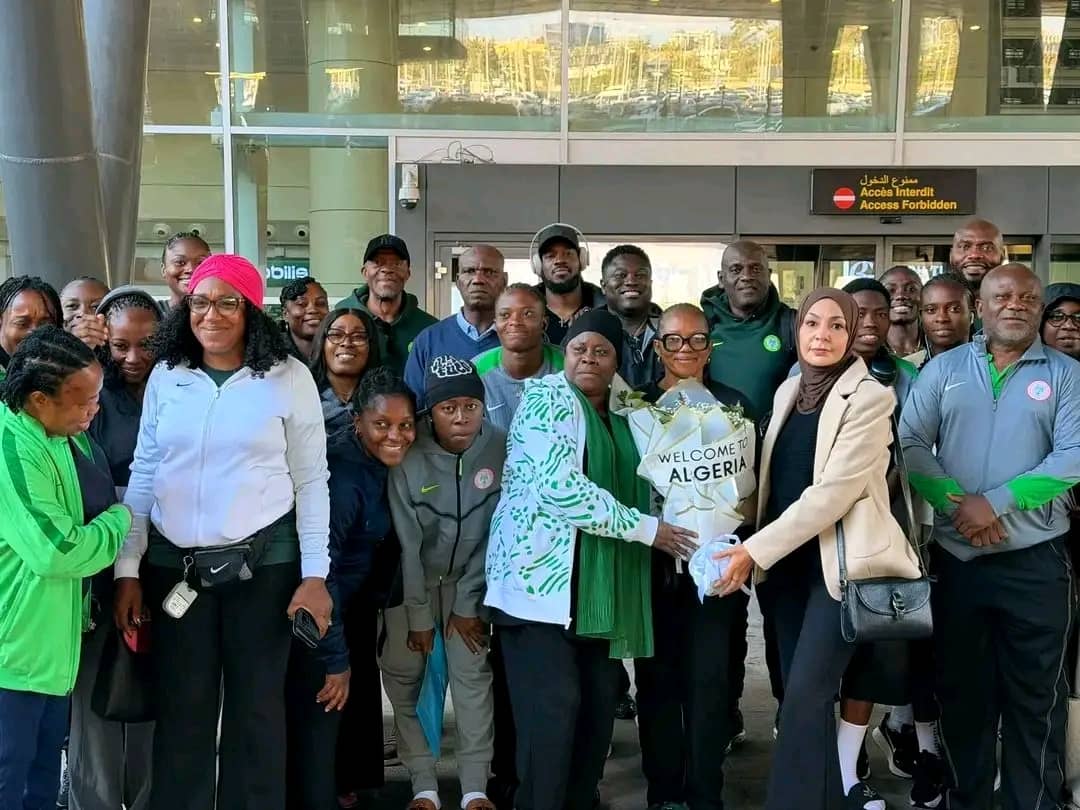
The Super Falcons of Nigeria have arrived in Algeria ahead of their two-legged international friendly encounters against the Fennecs, scheduled for November 30 and December 4.

Sports247 reports that the Interim head coach Augustine Eguavoen, members of his technical crew and six players have arrived at camp as preparations begin for the two fixtures.

READ ALSO: NPFL Matchday 15: Shooting Stars Host Rivers United as League Action Continues Across Three Days | Sports247 Nigeria

The six players currently with the team are Christiana Uzoma and Valentina Uroko of Edo Queens, Glory Edet of Bayelsa Queens, Joy Igbokwe and Fatimoh Solaty of Nasarawa Amazons, alongside Blessing Nkor, who plays for Dynamo Brest in Belarus.

More players are expected to join the squad, with additional arrivals scheduled for this evening as the coaching crew works towards assembling the full team.

The Super Falcons are expected to hold their first training session tomorrow, marking the beginning of their on-pitch preparations ahead of the opening encounter.

The two matches against Algeria will provide Nigeria with an opportunity to assess players, strengthen team combinations and build cohesion under Eguavoen’s interim leadership.

The Fennecs will also be looking to make the most of home advantage as both nations prepare for the first meeting on November 30, before facing each other again on December 4.

With more players expected to arrive, attention will now turn to the Super Falcons’ preparations and how the Nigerian side approaches the two international tests.

Fixture Details

Match: Algeria vs Nigeria (Super Falcons)

First friendly: November 30, 2026
Second friendly: December 4, 2026
Venue: Algeria

Continue Reading

Trending