News
Tinubu Woos North, Claims Region Has Benefited Most From His Reforms


President Bola Tinubu has made a fresh move to woo Northern Nigeria, arguing that the region is positioned to gain the most from the economic reforms and infrastructure projects being pursued by his administration.
The President said the North’s proximity to several African countries would give it a strategic advantage as Nigeria expands trade and develops new transportation and energy networks.
“The biggest beneficiaries of this economy will be the Northern part of Nigeria, because they will now be trading with countries, trading with Niger, trading with Chad, trading with Burkina Faso, trading with Southern Sudan, trading with Northern Cameroon, trading with Central African Republic… The North is the next business destination of Nigeria,” Tinubu said.
He spoke through the National Chairman of the All Progressives Congress, APC, Professor Nentawe Yilwatda, at a policy roundtable organised by the APC Professionals Forum in Abuja.
The event, the second edition of the Asiwaju Scorecard Series, focused on the achievements and challenges of the Renewed Hope administration.
Tinubu used the occasion to defend some of the most difficult economic decisions taken since he assumed office, particularly the removal of petrol subsidy.
According to him, the reforms were introduced against the background of serious economic weaknesses inherited by his administration in May 2023.
He listed the problems as “fuel subsidy distortions, multiple exchange-rate windows, weak revenue mobilisation, foreign-exchange shortages, rising debt-service pressures and years of inadequate investment in critical infrastructure.”
The President argued that the consequences of the reforms should be assessed not only by their immediate effect but also by the economic opportunities they are expected to create in the long term.
He said Nigeria’s external reserves had reached about $52.7 billion by August 2026, while consolidated non-oil revenue increased from roughly N13.63 trillion in 2023 to N16.4 trillion in the first two quarters of 2026.
Tinubu also pointed to a sharp improvement in the country’s merchandise trade position, saying Nigeria moved from a surplus of about N44.8 billion in 2023 to approximately N7.54 trillion in the first quarter of 2026.
He further cited real GDP growth of 4.43 per cent in the second quarter of 2026 and a decline in inflation to about 15.4 per cent.
For the President, the figures are part of the foundation for his plan to grow the Nigerian economy to $1 trillion by 2030.
He said the government’s infrastructure programme would be particularly important to the North because of its potential to connect Nigerian businesses with markets in neighbouring African countries.
Among the projects highlighted were the Ajaokuta-Kaduna-Kano gas pipeline, the Lagos-Abuja-Kaduna-Kano corridor, the Sokoto-Badagry Super Highway and the proposed Calabar-Maiduguri Trans-Sahara Super Highway.
The President also mentioned an integrated maritime and logistics corridor linking Lagos, Ondo, Ibom, Port Harcourt and Calabar.
He said investments in education, vocational training and access to credit were also being used to ensure that the economic changes produced benefits beyond government revenue and other macroeconomic indicators.
NELFUND, technical and vocational training programmes and the CREDICORP credit initiative were among the schemes he cited.
But the President’s assessment of the impact of his reforms has not been universally accepted in the North.
The Arewa Consultative Forum, ACF, challenged the basis of his claim, arguing that the situation on the ground did not support the description of the region as the biggest beneficiary.
Its spokesman, Professor Tukur Muhammad Baba, said the statement was “surreal,” “cynical” and “in sour taste.”
“The statement is so surreal and even cynical and in sour taste. Well, he may be excused because he neither gave concrete and verifiable details nor said how or in what ways. Perhaps he’s mistaking Lagos for the North,” Baba said.
He pointed to insecurity, agriculture, infrastructure, education and poverty as areas where he said the North continued to experience serious difficulties.
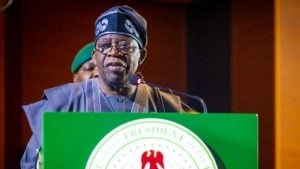
Baba particularly questioned how the region could be described as the biggest beneficiary when insecurity continues to affect agricultural production and communities across parts of Northern Nigeria.
He also criticised the condition of roads and the region’s education sector, including the number of children who remain out of school.
The ACF spokesman said the economic hardship experienced by many Northerners was another reason for questioning the President’s assertion.
“By the glaring evidence of rising poverty profile of people in the North, being actually Nigeria’s poverty capital where more and more people are impoverished and traumatised by economic and existential challenges by the day?” he asked.
The Middle Belt Forum, MBF, similarly questioned the regional characterisation of Tinubu’s reforms.
Its National President, Dr Bitrus Pogu, said policies such as petrol subsidy removal and the introduction of Compressed Natural Gas were national measures whose effects could not reasonably be assigned to one part of the country.
“It is unfortunate that a policy that affects the whole of Nigeria would be applied to the benefit, specifically, of a section of the country. Whether it is the North or South, East or West, the policy affects everybody,” Pogu said.
He described the President’s claim that the North was the biggest beneficiary as “a funny assertion,” adding that political arguments should still be based on sincerity.
Pogu also questioned whether the reforms had produced sufficient improvements in the lives of ordinary Nigerians.
“The policies he was talking about, the reforms and removal of fuel subsidy, have they impacted the people positively? Have they impacted the North positively, or the country as a whole? I don’t think so,” he said.
However, another Northern voice offered a more favourable assessment of the administration.
Reverend John Hayab, chairman of the Northern Christian Association, said the region had benefited from federal projects under Tinubu and should acknowledge them while continuing to demand more from the government.
Hayab mentioned major road projects linking different parts of Northern Nigeria, including the Akwanga-Maiduguri and Jos-Jalingo routes.
“Look at the roads from Akwanga that will go as far as Maiduguri. Look at the roads from Jos that will go to Jalingo. These are very serious roads,” he said.
He went further by comparing Tinubu’s performance with that of former President Muhammadu Buhari.
“Buhari didn’t perform and they are doing better than his. So, why don’t you acknowledge it? Because it’s not for free. Huge money has been invested in those projects. At least these ones are trying,” Hayab said.
According to him, Northern Nigerians are also represented in important positions within the ruling party and the Federal Government.
“The North is there. The North is the chairman of his party. The North is the Minister of Information. The North is the Defence Minister,” he said.
Hayab also cited developments in Southern Kaduna, including the Federal University and Federal Medical Centre, as evidence that some communities in the region had benefited from federal intervention.
“For us in Southern Kaduna, we cannot lie that things have not improved. And today, we have it on a platter of gold. And so, we should be able to acknowledge that, at least, things have improved.
“When he is bad, we will tell him. But in this case, I think he is right… But the North cannot pretend to say that it has not benefited from this government,” he said.



News
Nigeria’s data protection agency’s revenue surges over ₦12b as compliance expands – Technology Times
The Nigeria Data Protection Commission (NDPC) says its revenue has risen from ₦7 billion in 2025 to more than ₦12 billion in 2026, reflecting the rapid expansion of Nigeria’s data protection and privacy ecosystem.
Dr Vincent Olatunji, National Commissioner/Chief Executive Officer of the NDPC, disclosed the revenue growth during a courtesy visit by a delegation of the Commission to the National Salaries, Incomes and Wages Commission (NSIWC), where he held discussions with its Chairman/CEO, Major General Junaid S. Bindawa (rtd.).
Olatunji traced the development of data protection regulation in Nigeria from the establishment of the former regulatory Bureau to the enactment of the Nigeria Data Protection Act, 2023, which transformed the Bureau into the NDPC.

He said the sharp increase in revenue demonstrated the growing scale of activities within Nigeria’s data protection ecosystem, as organisations increasingly seek to comply with regulatory requirements and strengthen the protection of personal data.
NDPC: Data protection ecosystem expands, compliance gains momentum.
He said the sharp increase in revenue demonstrated the growing scale of activities within Nigeria’s data protection ecosystem, as organisations increasingly seek to comply with regulatory requirements and strengthen the protection of personal data.
The NDPC chief also stressed the need for public institutions to comply fully with the Nigeria Data Protection Act, urging the NSIWC to strengthen its compliance measures.
Beyond compliance, Olatunji highlighted the growing demand globally for professionals with expertise in data protection and privacy. He called for equitable remuneration structures capable of attracting and retaining skilled data protection specialists within Nigeria’s public service.
To support the NSIWC’s compliance efforts, he offered free data protection training for its staff and Virtual Privacy Academy vouchers to facilitate further capacity development.
Responding, Bindawa said the engagement had provided him with a clearer understanding of the NDPC’s mandate and commended the Commission for its efforts to strengthen digital trust in Nigeria.
He said the NSIWC had already begun taking steps towards compliance with the Nigeria Data Protection Act, while welcoming the proposed training partnership and capacity-building support from the NDPC.
The meeting ended with both institutions reaffirming their commitment to sustained cooperation, particularly in strengthening data protection compliance and developing the skills required to support Nigeria’s growing digital economy.

Former Nigerian Head of State Abdulsalami Abubakar has been featured in promotional material by an Indian hospital following his knee replacement surgery there.
The video, which has gone viral on social media, shows Mr Abubakar receiving care at Krishna Shalby Hospital in Ahmedabad, India, including footage of him walking and exercising after the procedure.
The hospital has also used images of the former Head of State and Vice President Kashim Shettima in posts promoting its services to international patients.
Hospital’s promotion
In an Instagram post on Monday, the Indian Hospital said Mr Shettima visited the facility and met its management to discuss Mr Abubakar’s progress and wellbeing.
The hospital described the visit as a reflection of the “growing trust in India’s healthcare” and its commitment to caring for patients from across the world.
“When patients travel across borders for specialised care, their trust means everything,” the hospital said.


It is not immediately clear whether Mr Abubakar’s treatment was fully sponsored by the federal government.
However, under the Remuneration of Former Presidents and Heads of State (and Other Ancillary Matters) Act, former Heads of State and their immediate families are entitled to free medical treatment in Nigeria and treatment abroad where necessary at federal government expense.
The law also provides other benefits, including diplomatic passports, protocol privileges, official vehicles, office and residential accommodation, security and annual vacation at federal government expense.
In 2026, the federal government budget provides N2.3 billion for the entitlements of former presidents, Heads of State and their deputies.
Nigerians react
The hospital’s use of Mr Abubakar’s treatment in its promotional material has generated reactions from Nigerians.
Activist and presidential candidate Omoyele Sowore was among those who reacted after sharing the promotional video on X on Tuesday.
“This is former Nigerian Head of State, General Abdulsalami Abubakar, being used in a hospital advert after undergoing knee replacement surgery in India,” Mr Sowore said.
He questioned why Nigerian leaders who had opportunities while in government to develop the country’s healthcare system continue to seek specialised treatment abroad.
Mr Sowore said the development was a reflection of what he described as “decades of failed leadership and neglect of Nigeria’s healthcare system”.
Aloy Ejimafor, a barrister, also criticised the development in a Facebook post.
Mr Ejimafor described it as a “diplomatic insult” for an Indian hospital to use Mr Abubakar’s image in an advert for knee replacement surgery in India.
Medical tourism
Mr Abubakar’s treatment abroad comes amid a long-running pattern of Nigerian political leaders seeking medical care outside the country.
For instance, late President Muhammadu Buhari faced repeated criticism over his medical trips to the United Kingdom during his presidency.
READ ALSO: Three years after doctor’s death, Lagos hospital’s elevator still not operational
Nigerian doctors and other critics argued that the practice undermined confidence in the country’s health system, particularly because political leaders control public investment in healthcare.
In April 2025, Coordinating Minister of Health and Social Welfare, Muhammad Pate, said Nigeria loses an estimated $2 billion annually to medical tourism.
Mr Pate made the statement at the commissioning of a 50-bed specialist hospital in Lagos, where he said the figure reflected gaps in confidence, access and quality in the country’s healthcare system.
“This is not just about stopping medical tourism. It is about building health sovereignty, the ability of a country to care for its own people, develop its institutions, talent, and innovation,” Mr Pate said.
Discover more from Premium Times Nigeria
Subscribe to get the latest posts sent to your email.
-

 Health4 days ago
Nigeria demands fairer pandemic financing, vaccine access at UN meeting
-
News4 days ago
2027: Apologise to Nigerians for hardship, account for loans – Atiku to Tinubu, APC
-
News4 days ago
Insurers claim AI is already increasing healthcare costs
-
News4 days ago
Moses Simon Reveals Three ‘Secret Factors’ That Made His 100 Super Eagles’ Caps Possible