News
Hon. Bagos Gifts Transformer to KT 103.9 FM as Station Relocates to Permanent Site


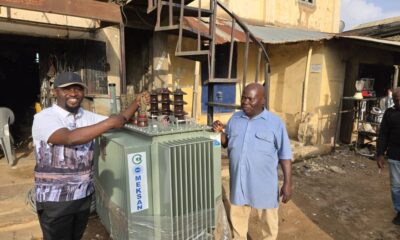
In a demonstration of goodwill and support for community-driven media, a former Member Representing Jos South/Jos East Federal Constituency, Hon. Dachung Musa Bagos, has donated a 50KVA transformer to KT 103.9 FM Jos.
The donation comes as the station transitions to its permanent site—a move that promises to expand its reach and redefine its impact across Plateau State and beyond.
Presenting the transformer on behalf of Hon. Bagos, Dusu Bot said the lawmaker was compelled to act due to the impact the station has made through its rich and engaging content.
Hon. Bagos described KT 103.9 FM as more than just a radio station but a voice for the voiceless, a hub of enlightenment, and a platform that informs, educates and entertains with integrity.
He also congratulated the station on its successful relocation, expressing optimism that the new site and improved infrastructure would further enhance its capacity to deliver impactful content.
Receiving the transformer on behalf of the Board of Trustees and Management, the Head of Station, Tok Morgan, expressed gratitude to the former lawmaker, describing the gesture as not just timely but transformational.
He assured the station’s loyal audience that KT 103.9 FM is returning to the airwaves stronger, with improved content and renewed energy to make a meaningful difference.






Former President of the African Development Bank (AfDB), Akinwumi Adesina, has declared his readiness to serve Nigeria in any capacity, saying he has a duty and responsibility to contribute to the country’s development.
Mr Adesina made the declaration on Tuesday after meeting President Bola Tinubu at the Presidential Villa in Abuja, where he briefed the president on his 10-year tenure at the continental development finance institution.
“I’m fully able to help Nigeria in any capacity. I’ve always had that. You know, my heart is always at home,” he told journalists after the meeting.
Asked what role he could play, Mr Adesina said he would help in any capacity the president considered appropriate, but stressed he was not seeking a government appointment.
“I’m not looking for a job. I’m not looking for anything. I’m just here to help. It’s my country. I have a duty, an obligation, and a responsibility to do so, and I will,” he said.
There was no announcement of a specific role or appointment for the former AfDB president following the meeting.


Adesina’s record in agriculture and development finance
Mr Adesina, an agricultural economist, served as Nigeria’s minister of agriculture and rural development from 2011 to 2015 under former President Goodluck Jonathan before becoming the first Nigerian to lead the AfDB.
He was elected president of the bank in May 2015 and re-elected for a second five-year term in August 2020. His tenure ended in 2025.
As agriculture minister, he championed reforms to the distribution of subsidised farm inputs, including an electronic-wallet system that let farmers receive support for seeds and fertiliser via mobile phones.
The AfDB said the programme reached 15 million farmers within its first four years. The initiative was intended to improve access to agricultural inputs while reducing the role of intermediaries in their distribution.
At the AfDB, Mr Adesina oversaw the institution’s development agenda, which included expanding electricity access, improving food security, industrialising African economies, promoting regional integration and improving living standards.
During his leadership, the bank’s general capital increased from $93 billion to $208 billion in 2019, following a decision by its shareholders, the largest capital increase in the institution’s history at the time.
AfDB provided $7 billion to Nigeria in 10 years
At the meeting, Mr Adesina said the AfDB provided about $7 billion in financing to Nigeria between 2015 and 2025.
He compared this with the $11.1 billion in cumulative financing the bank had provided to Nigeria since it began operations in the country in 1971.
“Within 10 years, we were able to do 63 per cent, literally, of that,” he said, adding that President Tinubu was pleased with the bank’s support to Nigeria during his tenure.
Mr Adesina said he used the meeting to commend the president for his economic reforms, particularly the removal of the petrol subsidy and the harmonisation of the foreign exchange windows.
He described the measures as difficult but said they were beginning to produce results.
He cited increased foreign exchange availability, the return of portfolio investors and a downward trend in inflation as signs of progress. However, he acknowledged that prices remained high for Nigerians.
He also pointed to improved assessments of Nigeria by some international rating agencies, saying the country’s outlook had shifted towards stable or positive assessments.
The comments come amid ongoing debate over the impact of the Tinubu administration’s economic reforms, including higher fuel costs after the removal of the petrol subsidy and changes to the foreign exchange market.
Although the government has defended the measures as necessary to stabilise the economy, the higher cost of living has continued to put pressure on households and businesses.
From economic stabilisation to growth
Mr Adesina said stabilising the economy was only the beginning, arguing that Nigeria must now focus on structural transformation, economic growth and prosperity.
He said President Tinubu recognised the need to move beyond macroeconomic reforms and address the broader challenge of transforming the economy.
“I told the president, I’m back at home, here to help and ready to help. It’s my country. I love my country, and I’m ready to help,” he said.
His offer comes after a decade leading one of Africa’s major development finance institutions, a period during which the bank financed projects and programmes across sectors including agriculture, energy, transport and infrastructure.
READ AlSO: ‘I will forever miss you’ – Toluwanisings’ wife breaks down in tears at night of tributes
Mr Adesina’s meeting with the president also gave him an opportunity to formally brief the president on the completion of his two terms and the achievements recorded during his leadership of the bank.
He said he was honoured to have been received by the president and was pleased with the report he presented.
While Mr Adesina did not specify how he might contribute to Nigeria’s development, he said he was prepared to do so whenever the president believed his experience could be useful.
“It’s my country. I have a duty, an obligation, and a responsibility to do so, and I will,” he said.
Discover more from Premium Times Nigeria
Subscribe to get the latest posts sent to your email.
News
MTN Challenges Nigerians: Compare our data prices with Kenya, South Africa, Zimbabwe – Technology Times

MTN Nigeria has challenged Nigerians to compare mobile data prices with those in other African countries before concluding that internet access is more expensive in Nigeria, as the nation’s leading mobile operator pushes back against persistent complaints over the cost and rapid depletion of data bundles.
Karl Toriola, CEO of MTN Nigeria, said consumers should examine the prices of comparable data bundles in Kenya, South Africa and Zimbabwe before reaching their own conclusions about the affordability of mobile internet services in Nigeria.
Speaking on Monday at MTN’s Data on Trial event held in Abuja, Toriola urged consumers to visit the websites of telecoms operators in those countries, including Safaricom in Kenya, Vodacom in South Africa and Econet in Zimbabwe, to compare the cost of different data packages.

“Don’t trust me. Go to other African countries before you get to Europe and check for the price of 1GB, 5GB, 10GB of data yourself and form your own opinion around it,” he said. The MTN Nigeria CEO challenge comes amid continuing public concerns about the affordability of mobile internet access and complaints from subscribers who say their data allowances disappear faster than expected, sometimes when they believe they have barely used their phones.
MTN Nigeria CEO wants consumers to examine comparable information on mobile internet costs
He specifically encouraged Nigerians to examine 1GB, 5GB, 10GB and 20GB bundles rather than rely on general perceptions about the cost of internet access. “The perception that data in Nigeria is expensive is wrong,” Toriola said.
The MTN Nigeria chief executive said the exercise would allow consumers to assess the company’s position using comparable information rather than simply accepting its claims without verification.
“Don’t trust me. Go to other African countries before you get to Europe and check for the price of 1GB, 5GB, 10GB of data yourself and form your own opinion around it,” he said.
The MTN Nigeria CEO challenge comes amid continuing public concerns about the affordability of mobile internet access and complaints from subscribers who say their data allowances disappear faster than expected, sometimes when they believe they have barely used their phones.
MTN points to Nigeria’s high telecom operating costs
Toriola argued that the cost of operating telecoms infrastructure in Nigeria should be taken into account when comparing local data prices with those in other markets.
According to him, Nigerian operators face substantial expenses providing electricity and transmission services to network sites, with diesel costs adding to the financial burden of maintaining reliable connectivity.
He said these operating conditions differ from those in European countries that are sometimes used as benchmarks for comparing mobile data prices.
Toriola disclosed that MTN spent about N1.05 trillion on power in the previous year, before a subsequent increase in diesel prices linked to the crisis around the Strait of Hormuz.
“We spent about 1.05 trillion Naira last year on power only,” he said. The figure highlights the energy costs MTN says contribute to the expense of running its telecoms infrastructure in Nigeria.
Toriola also said Nigerian operators purchase network equipment supporting fourth-generation (4G) and fifth-generation (5G) services from international suppliers using the same foreign currencies as operators in other markets.
He further pointed to the technology underpinning telecoms billing systems, saying MTN uses Ericsson as its billing system vendor, with similar systems deployed by operators in Western markets.
However, Toriola added, comparing advertised data prices across countries requires more than looking at the headline cost of a bundle. Bundle sizes, validity periods, taxes, exchange rates, average incomes and purchasing power can all affect the relative affordability of internet access.
A lower or higher advertised price alone, therefore, would not establish how much of their income consumers in different countries must spend to remain connected.
Why MTN says data bundles can disappear quickly
MTN’s defence of its pricing was accompanied by explanations from its network and information technology executives about how smartphone settings, video streaming and background applications can contribute to data consumption.
Michael Ndukwe, General Manager, Network Performance and Quality Assurance at MTN, said the growing use of social media and video-based applications has increased demand for mobile data.
He cited figures showing that Nigeria recorded 13.2 million terabytes of data traffic in 2025, while 8.52 million terabytes were recorded in the first half of 2026. Ndukwe described the figures as representing roughly 43% year-on-year growth, although the comparison period for that calculation was not specified in the presentation.
He identified TikTok, YouTube, Facebook, Instagram, WhatsApp and X among the major social media platforms contributing to data usage in Nigeria.
According to him, the amount of data consumed when watching videos depends significantly on their resolution.
He said a 15-second TikTok video can consume approximately two to three megabytes in standard definition, while the same video could use as much as 15 megabytes in high definition. Automatic playback can also increase consumption because another video may begin loading as soon as the previous one finishes.
WhatsApp users may also consume substantial amounts of data through status videos, automatically downloaded media, files shared in groups and chat backups to cloud storage, Ndukwe said.
He advised subscribers to disable automatic media downloads where appropriate, reduce video quality and restrict backups to Wi-Fi networks to avoid unnecessary mobile data consumption.
MTN tells subscribers to monitor their data
Toriola said MTN’s Data on Trial initiative is intended to help customers understand their consumption patterns and examine complaints about disappearing data bundles. He recounted an instance involving a senior MTN employee who suspected the company was taking her data after a large quantity disappeared overnight.
According to Toriola, an examination of the employee’s phone revealed that WhatsApp was backing up data every night. The incident, he said, illustrates how background activity can consume substantial amounts of data without users being fully aware of it.
David Ogunshola, General Manager of IT Operations at MTN Nigeria, also explained that figures displayed on smartphones may differ from network records because devices and telecoms networks can measure or present data consumption differently.
MTN recommends that subscribers use the MyMTN app to monitor real-time data usage and alerts, alongside the data-management tools available on their smartphones.
The operator also promotes its fibre broadband service, MTN FiberX, as an option for customers with high data requirements.
While these measures could help subscribers identify sources of data consumption, the explanations do not independently establish whether every customer complaint about data billing is justified. For consumers, the central questions remain whether the data deducted corresponds accurately with their usage and whether available bundles provide reasonable value for money.
MTN’s challenge to Nigerians to compare prices across African markets has therefore placed its affordability claim up for public scrutiny. For such a comparison to be meaningful, consumers would need to examine equivalent bundles, validity periods, taxes and purchasing power across the different markets.
The debate is consequently no longer only about how much a gigabyte costs. For millions of Nigerian subscribers, the bigger question is how much useful connectivity they actually get for the money they spend.
-

 News3 days ago
Troops rescued 70 abductees, recovered N10 million ransom: DHQ
-
Business3 days ago
CBN grants JP Morgan approval-in-principle to set up merchant bank
-
News3 days ago
Plateau Activates Ebola Preparedness Measures, Urges Residents to Observe Safety Guidelines
-
Business3 days ago
REA Ends 16 Years of Darkness in Two Kano Communities