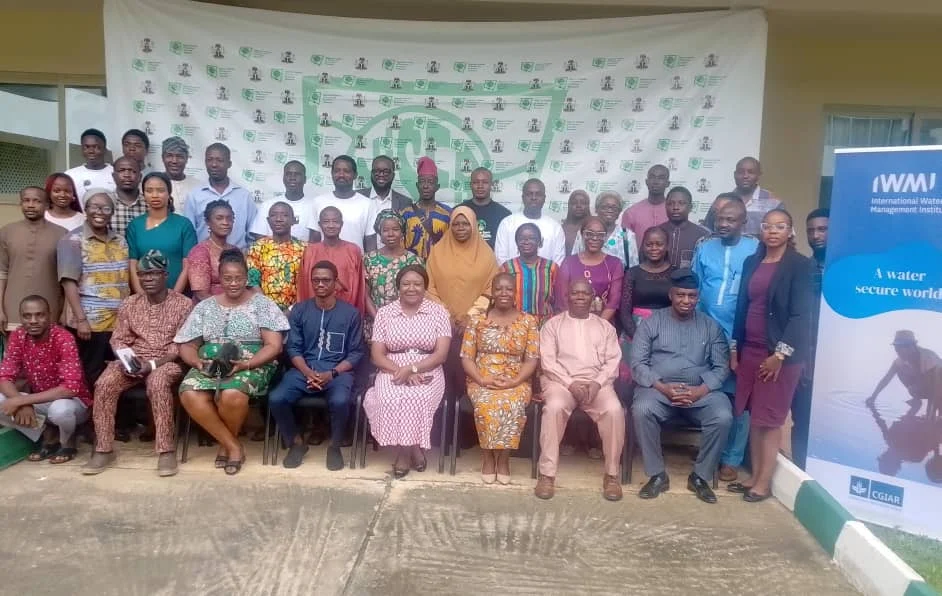
The Nigerian Institute of Social and Economic Research (NISER) and the International Water Management Institute (IWMI) say Nigeria must urgently reform its agriculture to boost productivity and tackle food crises.
The institutions made the call at a stakeholders’ seminar and validation roundtable in Ibadan on Thursday.
The seminar, themed “Strengthening Nigeria’s Agrifood Knowledge and Innovation System for Demand-Driving Scaling (AKIS-DS), was organised by NISER in collaboration with IWMI.
It was organised under the CGIAR’s Scaling for Impact program.
The News Agency of Nigeria (NAN) reports that the AKIS-DS initiative seeks to understand how Nigeria’s agricultural knowledge and innovation system works.
This includes the roles and relationships among research institutions, extension and advisory services, government agencies, private sector and farmer organisations.
NISER Director-General (DG), Prof. Antonia Simbine, said Nigeria’s persistent food inflation and rising food insecurity show the need to reform agricultural knowledge and innovation systems.
Simbine said it was unacceptable that Nigeria’s agriculture continues to face high food inflation and insecurity.
According to her, the sector contributes approximately 28 per cent of Gross Domestic Product (GDP) and employs 50 per cent to 70 per cent of the rural workforce.
Simbine emphasised that Nigeria’s food crises should not be exclusively attributed to prevailing conflicts and global developments, saying longstanding structural weaknesses in the agricultural sector also contribute significantly.
She said the predominance of smallholder farmers cultivating less than two hectares, heavy dependence on rain-fed agriculture, outdated farming technologies and post-harvest losses were among the factors undermining food production.
The DG also identified climate change and insecurity across major food-producing communities as critical challenges confronting the agricultural sector.
She was concerned that insecurity had disrupted farming activities and forced many rural residents to abandon their communities in states such as Plateau and Benue, recognised for their agricultural contributions.
Simbine called for improved agricultural research, modernisation of fertiliser practices, sustainable land management, mechanisation and infrastructural investment to boost productivity.
She emphasised the need to accelerate the adoption of climate-smart and digital agricultural technologies, reminding research institutions of their responsibility to generate relevant innovations and ensure they reach smallholder farmers.
The IWMI Country Focal Point in Nigeria, Dr Charity Osei-Amponsah, said developing agricultural technologies alone without effective mechanisms to ensure innovations reach the intended beneficiaries was inadequate.
Osei-Amponsah said agricultural technologies must reach the right users, particularly smallholder farmers, and be adopted and used effectively to improve productivity and access to markets and finance.
She further stressed the importance of replicating successful innovations across different farming communities and states to expand their impact.
Osei-Amponsah maintained that stronger collaboration among agricultural stakeholders, improved knowledge-sharing mechanisms and institutional reforms were necessary to ensure research findings translated into practical benefits for farmers.
In his presentation, IWMI intern, Mr Mubaraq Owolabi, identified the need to strengthen connections among research institutions, extension services, farmers and financial institutions.
Owolabi further said that ensuring a monitoring and evaluation system would strengthen Nigeria’s agricultural innovation.
“Strengthening these institutional linkages and promoting effective coordination among stakeholders are essential to ensuring that agricultural research translates into practical benefits for farmers in Nigeria,” he said. (NAN)
Fifty innovation teams drawn from 36 states of the federation and the Federal Capital Territory (FCT) have advanced to the regional demonstration stage of the Universal Service Provision Fund (USPF) Changemaker Challenge.
Ubulu Africa, which is delivering the programme, in a statement on Thursday, said that the selected teams were developing technology-driven solutions in education, agriculture, healthcare, financial inclusion and clean energy.
The News Agency of Nigeria (NAN) reports that the Universal Service Provision Fund (USPF) is a Federal Government initiative established to expand access to affordable ICT services, particularly in rural, unserved and underserved communities.
The USPF Changemaker Challenge is one of its initiatives, designed to promote digital inclusion by supporting innovative solutions to challenges across Nigeria.
Meanwhile, the six virtual Regional Demo Days, covering the six geopolitical zones of the country, are holding from Nov. 25 to Nov. 27.
One team from each zone will qualify for the physical National Demo Day in Lagos, where the six finalists will compete for a share of the N10 million prize pool.
A breakdown of the selected innovations shows that 21 teams are focused on education, 14 on agriculture, seven on healthcare, five on financial inclusion and three on clean energy.
The organisers said 46 of the 50 teams had developed working prototypes or more advanced solutions, while 12 already had products in use.
They said several innovations were designed to function offline or through basic mobile phones, USSD, SMS and voice services, including in at least seven Nigerian languages.
In agriculture, the solutions address challenges such as access to market information, crop monitoring, livestock management and weather alerts.
For instance, Chigari AgriConnect provides farmers with market prices through USSD and Hausa voice services, while Albasa Connect offers advice to onion and garlic farmers in Hausa and French.
Clisense, another selected innovation, provides flood warnings up to 72 hours before expected flooding.
In healthcare, the teams are developing solutions covering medical information, laboratory services, maternal health and support for frontline health workers.
MotivAid, for example, is designed to help maternity ward personnel identify and respond to emergencies.
Other innovations include Gorro, which digitises traditional group savings arrangements such as ajo and esusu, and Reklaima, which helps users identify wrongful or excessive bank charges.
The clean energy category features Iron Ore Energy from Edo, GridSense from Imo and CTNApp from Plateau, focusing on energy storage, electricity monitoring and shared solar power management.
The organisers said women lead 12 of the selected teams, representing 24 per cent of the shortlist.
Women-led teams account for three of the seven healthcare innovations and six of the 21 education solutions, with representation across all six geopolitical zones.
The organisers said that the selection process adopted a 37-plus-13 model, allocating one place to the highest-scoring qualifying team from each state and the FCT, while the remaining 13 places went to the next highest-scoring teams nationwide.
Under the arrangement, 27 states have one team each, while Adamawa, Bayelsa, Kaduna, Kano, Nasarawa, Oyo and Plateau have two teams each.
Kebbi, Lagos and the FCT have three teams each.
Entries were assessed based on problem relevance, functionality at their current stage, potential impact and team readiness, with no sector-specific quotas.
Tobiloba Gomes, Programme Manager at Ubulu Africa, said the shortlist demonstrated the importance of designing technology around devices already available to ordinary Nigerians.
“What stood out across the shortlist was how many teams designed for the phones people already own, not the ones we wish they had.
“That is a practical instinct, and it is exactly what the Challenge is here to back,” Gomes said.
Odiong Akpan, Chief Executive Officer of Ubulu Africa, said the innovations showed that technology solutions were emerging from communities beyond major urban centres.
“Many of these solutions run on a basic phone, in a local language, with no internet. Those aren’t compromises. That is what building for Nigeria looks like,” Akpan said.
NAN reports that the top three national winners will receive N5 million, N3 million and N2 million respectively.
All six finalists will also participate in a four-week structured incubation programme beginning in January 2027, while retaining full ownership of their intellectual property. (NAN)
The Amanyanabo of Okochiri Kingdom in Okrika Local Government Area of Rivers State, King Ateke Michael Tom, has declared his political loyalty to the Minister of the Federal Capital Territory, FCT, Nyesom Wike, saying he will follow whatever political direction the minister takes in the state.
The monarch made his position known on Thursday when Wike and members of his political team visited his palace in Okrika.
He also declared support for President Bola Tinubu’s bid for a second term in 2027, with other traditional rulers in the area promising to mobilise votes for the President and candidates of the Rainbow Coalition.
Speaking on behalf of the monarch, Chief Prof. Christ Gberowo said the kingdom had chosen to align itself with Wike’s political decisions and leadership.
He said, "Therefore, he is openly and clearly supporting the second coming of our current President, President Bola Ahmed Tinubu."
Gberowo also dismissed the political relevance of former Rivers State Governor, Rotimi Amaechi, insisting that Wike remained the major political figure whose direction should guide stakeholders in the state.
He added, "He has all that it takes in all states of the federation to exert this influence just for you in support of Chief Barrister Ezenwo Wike. So, be rest assured you are the only way politically, and everybody will look upon you and your direction. It shall come to pass."
Another traditional ruler, the King of Koninju Kingdom, Winston Opuogbeya, also pledged the support of traditional institutions in the area for Tinubu and the Rainbow Coalition in the 2027 elections.
Opuogbeya praised the President's policies, particularly plans to introduce state police and efforts towards resource control, describing them as bold steps towards addressing Nigeria's challenges.
"For the very first time in our history of Nigeria, Mr President has made state policing entrenched. It is a fundamental issue in Nigeria because community policing is the very basis of security issues. They know the communities they are from," he said.
He argued that allowing states to establish their police forces would improve security because people familiar with local communities would be better placed to understand and tackle their security problems.
The monarch expressed confidence that Tinubu's reforms would earn him a place in Nigeria's history, particularly if the proposed creation of additional states becomes a reality.
"I want to reassure you that we will all vote for Mr President and all candidates of the Rainbow Coalition, our able leader, the Minister of the Federal Capital Territory," he declared.
He also commended Wike's performance as FCT minister, describing his appointment as a historic achievement for the southern part of the country.
He said, "No southerner had ever been a Federal Capital Territory minister. You are the first person. You have shown the courage of a lion and the vision of the eagle."
Earlier, Wike said the visit was to seek King Ateke's blessing before meeting residents of Okrika to discuss political developments in Rivers State and the country.
The minister identified himself as the coordinator of Tinubu's re-election campaign in Rivers State and the FCT, adding that his team was working to secure widespread support for the President and APC candidates in 2027.
He said, "My duty is to coordinate and make sure that the people of Rivers State, the people of Okrika, vote massively for Bola Ahmed Tinubu as the President of the Federal Republic of Nigeria."
Wike also urged residents to support the APC governorship candidate in Rivers State, Kingsley Oguochochinda, who is contesting for the Okrika/Ogu-Bolo constituency, and other party candidates.
Explaining the reason for visiting the palace before the town hall meeting, Wike said showing respect to traditional institutions was important.
"It will be out of respect, it will be out of place if we do not come to get your blessing before we go and talk to your people," he said.
He praised King Ateke for maintaining peace and unity in Okochiri, noting that the monarch's influence extended beyond Okrika to other parts of Rivers State.
"We are happy with the way you have kept your people in Okochiri, Okrika. We are aware that your influence extends beyond Okrika Local Government Area. Your influence can be felt all over Rivers State. That is our own interest," he said.
The delegation included APC National Chairman, Tony Okocha; the party's Rivers State governorship candidate, Kingsley Oguochochinda; former Commissioner for Health, Dr Sampson Parker; and other political leaders.
Parker, who leads the Rainbow Coalition in Okrika Local Government Area, also openly described Wike as the Amanyanabo of Okrika, claiming that King Ateke had already identified with the minister.
He said, "I may be controversial, but we have a friend that his people have called Amanyanabo of Okrika. My king has identified him and pointed the association with him. So, I fear nobody to say Amanyanabo of Okrika, welcome."
Parker said the delegation was at the palace to formally welcome Wike.
The visit is part of the minister's ongoing political consultations across Rivers State as the Rainbow Coalition steps up efforts to secure support for Tinubu's second-term bid and APC candidates ahead of the 2027 general elections.