News
Anthropic is working on a system to prove AI models’ identity









The Chairman of the Independent National Electoral Commission, INEC, Prof. Joash Amupitan, has dismissed allegations questioning his political neutrality following claims that his phone number was associated with a controversial account on X, formerly Twitter.
Amupitan insisted that he had never owned or operated an account on a social media platform, adding that an independent forensic examination had been conducted to investigate the claims.
He disclosed that the matter had also been referred to the Department of State Services, DSS, and the Inspector-General of Police for further investigation.
The INEC chairman made this known on Thursday while speaking at a high-level event hosted by Chatham House in London in collaboration with the Kimpact Development Initiative, KDI.
Addressing concerns about his previous involvement in politically sensitive court cases and whether such engagements could affect his impartiality as electoral umpire, Amupitan explained that his participation in those matters was strictly based on his professional responsibilities as a lawyer before assuming office.
He reaffirmed his commitment to upholding the country's Constitution and electoral laws, insisting that his decisions as INEC chairman would not be influenced by political interests.
“My loyalty is solely to the Constitution of the Federal Republic of Nigeria and the Electoral Act,” he affirmed.
“Every constitutional institution—including the Presidency, the National Assembly, and state governors—owes its primary loyalty to the Constitution and the rule of law.”
The electoral commission chairman also addressed allegations of irregularities in the national voter register, including reports claiming that the number of registered voters in a ward in Ebonyi State had increased by 85 per cent.
He said INEC had looked into the complaint and taken steps to resolve the matter in accordance with the provisions of the law.
Amupitan further explained that the Electoral Act gives Nigerians the right to raise objections, submit claims and request certified true copies of the voter register as part of measures to promote transparency and accountability in the electoral process.
Amupitan, while speaking on the importance of youth participation in democracy, urged young Nigerians to become actively involved in shaping the country's political future.
He stressed that the responsibility of building a better Nigeria rests partly on the younger generation, warning that the circulation of false information and digital disinformation could weaken public confidence in democratic institutions.
“This country belongs to young Nigerians, and they must continue working toward the Nigeria they want,” he said.
“Misinformation is among the greatest dangers facing our democracy. Citizens should verify information before acting on it or sharing it, and allow our democracy the opportunity to succeed.”
Nigeria is expected to hold its 2027 general elections in two phases, beginning with the Presidential and National Assembly elections scheduled for January 16, 2027.
The Governorship and State Houses of Assembly elections are subsequently scheduled for February 6, 2027.
2027: Amupitan clarifies alleged bias, ownership of X account, voter register manipulation
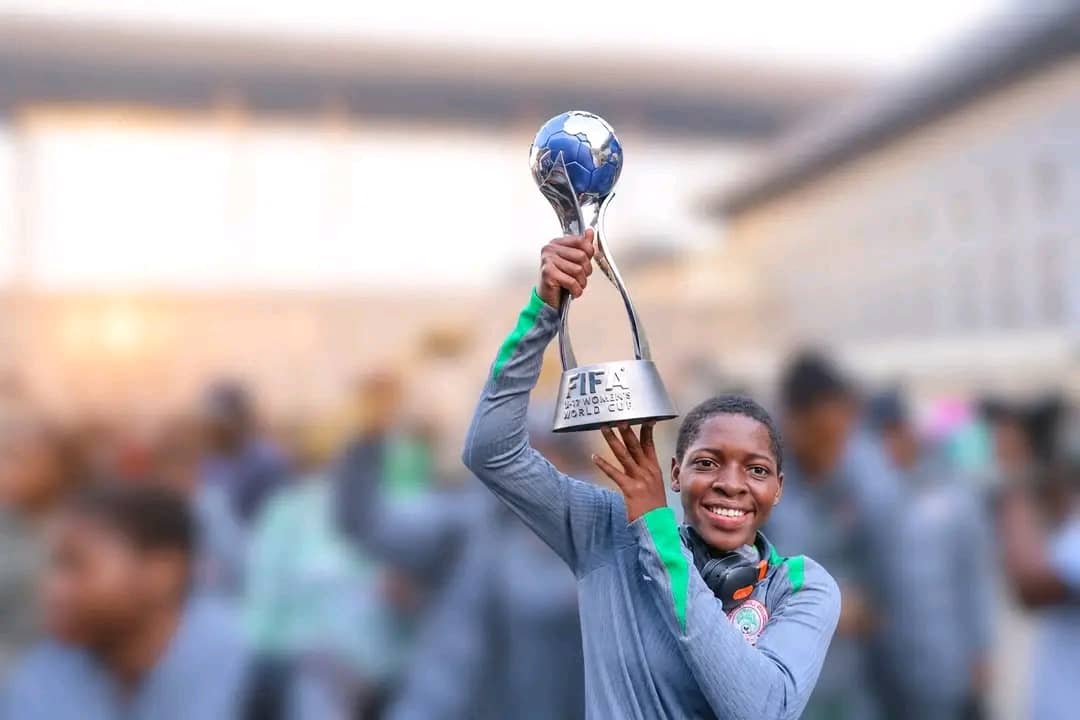
Nigeria U-17 captain Harmony Chidi has shared the personal challenges she faced while pursuing her football career, revealing that her mother initially opposed her decision to play the sport and wanted her to get married instead.
Speaking about her early journey in football, Chidi explained that her grandmother was the only person who encouraged her to keep pursuing her dream despite the lack of support at home, Sports247 gathered.
“When I started football, my mama didn’t allow me play. She didn’t want me playing football; she wanted me to get married. Only my grandma encouraged me, and now my grandma is no more. It’s just me and my mum now,” Chidi said.
Her revelation highlights the personal obstacles she had to overcome in order to pursue a career in football, with her grandmother playing a significant role in encouraging her ambition.
Despite the challenges, the young Nigerian captain remains determined to make her mark in the game and has set herself an ambitious target.
Chidi declared that she hopes to surpass the achievements of Super Falcons legend and former African Footballer of the Year, Asisat Oshoala.
“My dream is to be greater than Asisat Oshoala,” she said.
Her ambition reflects the confidence and determination she carries as she continues her development in the game. Oshoala’s achievements have made her a reference point for aspiring Nigerian female footballers, and Chidi now hopes to carve out a legacy of her own.
For the U-17 captain, the journey is about more than playing football; it is also about pursuing a dream that was not initially supported by those closest to her.
-

 News4 days ago
Troops Arrest Suspected Gunrunner, Neutralise Two Terrorists in Plateau
-
News3 days ago
APM holds Presidential Campaign in Plateau, Pledges Security and Economic Reset
-
News4 days ago
'How many times will you approve Ibom Deep Seaport' – NDC blasts Tinubu over 'endless lies'
-
News4 days ago
APC Legacy Assembly Expresses Confidence in Tinubu Ahead of 2027 Election