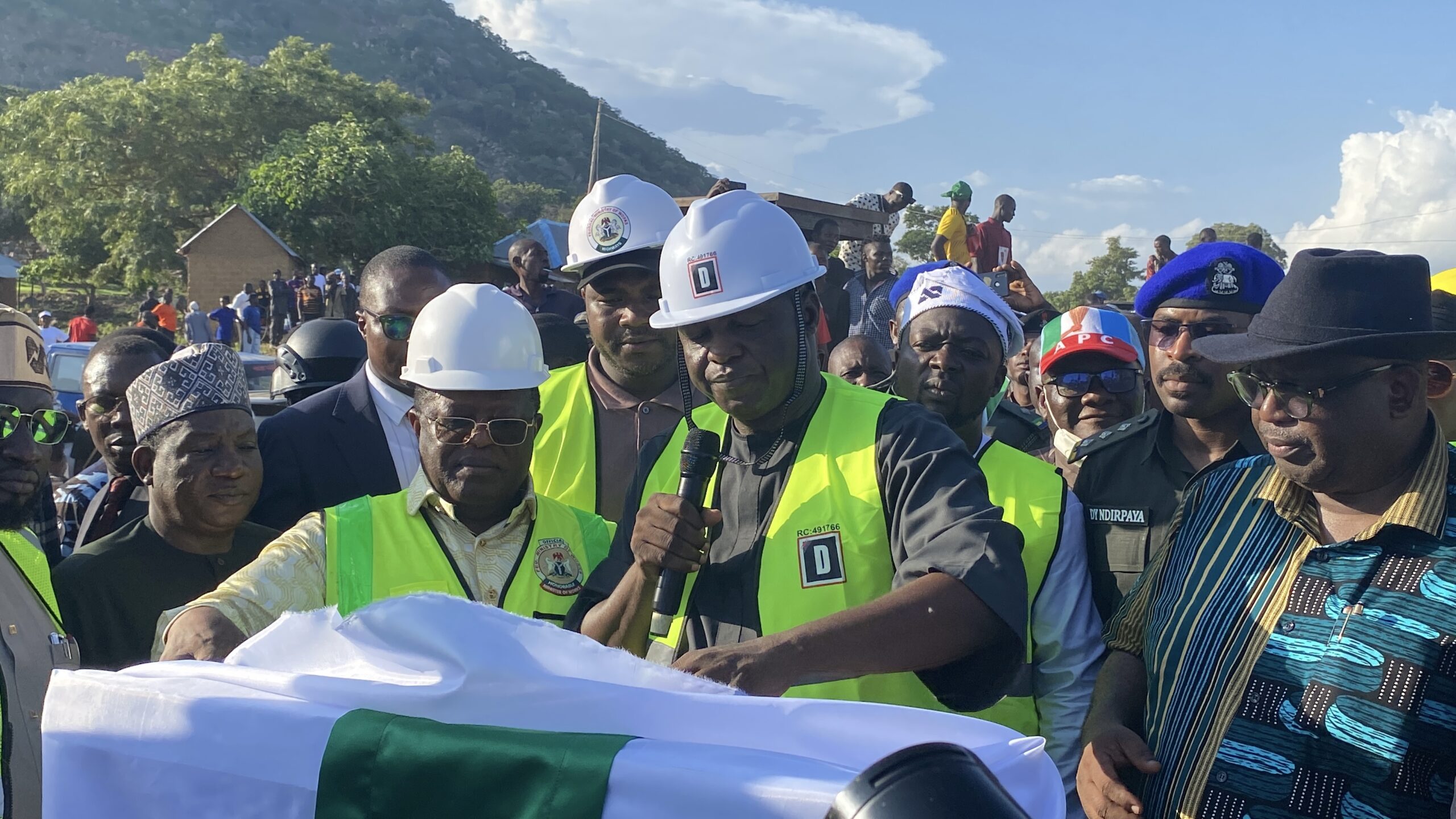
President Bola Ahmed Tinubu has flagged off the Phase II rehabilitation of the Babban Lamba–Sharam Road in Plateau State, reaffirming his administration’s commitment to delivering durable infrastructure that will stimulate economic growth, improve connectivity, and enhance security under the Renewed Hope Agenda.
The flag-off ceremony, held on Thursday at Dungung Community in Kanke Local Government Area, was performed on the President’s behalf by the National Chairman of the All Progressives Congress (APC), Prof. Nentawe Yilwatda. It was attended by the Minister of Works, Senator David Nweze Umahi; Plateau State Governor, Barr. Caleb Manasseh Mutfwang; federal and state lawmakers; traditional rulers; and other dignitaries.
In his welcome address, the Permanent Secretary of the Federal Ministry of Works, Mr. Olufunso Adeladan Rafiu Olarinre, said the project reflects the Federal Government’s commitment to delivering high-quality and long-lasting road infrastructure. He commended President Tinubu’s vision and praised the leadership of the Minister of Works for driving innovative engineering solutions and restoring public confidence in the nation’s road development programme.
Introducing the project, the Director of Highways, Construction and Rehabilitation, Engr. Clement Ogbuagu, explained that the Babban Lamba–Sharam Road is a 46.625-kilometre federal highway linking Babban Lamba to Sharam, including a two-kilometre spur to Kanke Local Government Headquarters.
He disclosed that the project, initially awarded in 2018, was restructured into two phases following poor performance by the original contractor. While Phase I covers a 6.15-kilometre section, the outstanding 40 kilometres have been awarded to Decency Associates Limited for construction using Continuously Reinforced Concrete Pavement (CRCP) technology.
According to Ogbuagu, the project will include a 7.3-metre carriageway, reinforced shoulders, five bridges, drainage systems, traffic safety facilities and other ancillary infrastructure. He described the road as strategically important to Plateau State and neighbouring Nasarawa, Kaduna, Gombe and Adamawa states, noting that it will improve the movement of people, agricultural produce, businesses and security personnel.
Governor Caleb Mutfwang described the flag-off as the fulfilment of a long-awaited aspiration for the people of Plateau State, saying the road would unlock economic opportunities, improve transportation and strengthen social integration.
He thanked President Tinubu for approving the project and expressed optimism that the administration would continue to support the state’s development. The governor also appealed to the President to consider reconstructing another strategic federal road linking Mararaban Jama’a, Mangu, Pankshin, Kanke, Langtang, Shendam and Ibi in Taraba State, describing the corridor as vital to the economic development of the North-Central region.
Goodwill messages from political leaders and lawmakers echoed the significance of the project.
Speaking on behalf of the Speaker of the House of Representatives, Rt. Hon. Tajudeen Abbas, the member representing Pankshin/Kanke/Kanam Federal Constituency and Chairman of the House Committee on Navy, Hon. Yusuf Adamu Gagdi, thanked the President, the Minister of Works, Prof. Yilwatda and the people of Plateau State for their collaboration in bringing development to the constituency. He also expressed appreciation to his constituents for their continued confidence in his representation at the National Assembly.
Former Plateau State Governor and Senator representing Plateau South, Simon Bako Lalong, praised President Tinubu for fulfilling infrastructure promises to Plateau and commended Senator Umahi for introducing reinforced concrete pavement technology, which he said would deliver more durable roads. He also recalled the Federal Government’s swift intervention in rebuilding a collapsed bridge in Shendam during his tenure and urged continued support for the administration.
Chairman of the House Committee on Works, Hon. Akin Alabi, congratulated the people of Plateau State on the commencement of the project and praised Hon. Gagdi’s performance in office, describing him as a leader whose re-election reflected the confidence of his constituents. He also commended the Minister of Works for delivering major infrastructure projects across the country.
Similarly, Chairman of the Senate Committee on Works, Senator Allwell Onyesoh, described the road as a catalyst for agriculture, tourism and economic development. He assured residents that the National Assembly would continue to provide legislative support and adequate funding to ensure the project’s timely completion.
A major highlight of the event was the conferment of a traditional title on Senator David Umahi by the Paramount Ruler of the Ngas Nation, His Royal Majesty Nde Jika Golit Ngolong Ngas. The monarch said the honour was in recognition of the minister’s contributions to infrastructure development and expressed confidence that the road would reconnect communities, improve commerce and enhance socio-economic activities across the Ngas nation and beyond.
Speaking on behalf of the contractor, the Chief Executive Officer of Decency Associates Limited, Abdul-Hakeem A. Smith, thanked the Federal Government and the Ministry of Works for the confidence reposed in the company. He assured stakeholders that the project would be delivered according to approved engineering standards, contractual specifications and safety requirements, while appealing for the support and cooperation of host communities throughout the construction period.
Delivering the keynote address, the Minister of Works, Senator David Umahi, said the Babban Lamba–Sharam Road forms part of President Tinubu’s legacy infrastructure programme aimed at providing roads capable of serving generations of Nigerians.
He explained that the outstanding 40-kilometre section would be constructed using CRCP technology and announced that the project would also feature solar-powered street lighting, surveillance cameras, tree planting and other modern infrastructure to improve safety and security.
Umahi thanked Governor Mutfwang, Prof. Yilwatda, members of the National Assembly and the people of Plateau State for their support. He also disclosed that the Federal Government was considering additional improvements along the Akwanga–Jos corridor and defended the administration’s infrastructure policies, maintaining that ongoing road projects represent one of the most ambitious investments in Nigeria’s history.
Officially flagging off the project on behalf of President Tinubu, Prof. Nentawe Yilwatda assured Plateau residents that Governor Mutfwang’s request for additional federal roads would be conveyed to the President.
He described the Babban Lamba–Sharam Road as a strategic national corridor that would improve trade, agriculture, security and regional integration by linking Plateau with neighbouring states and major economic routes.
Prof. Yilwatda highlighted the administration’s ongoing legacy projects, including major highways, railway expansion, deep seaports and gas infrastructure across the country, saying they demonstrate the Federal Government’s commitment to balanced national development.
He urged Decency Associates Limited to deliver the project within schedule, engage local youths and artisans, and work closely with host communities to ensure quality execution and shared economic benefits.
The APC National Chairman also commended Senator Umahi for his commitment to infrastructure delivery and thanked Governor Mutfwang, traditional rulers and residents of Plateau State for the warm reception accorded to the Federal Government delegation.
The ceremony ended with the official flag-off of the rehabilitation of the remaining 40-kilometre stretch of the Babban Lamba–Sharam Road, a project expected to improve transportation, boost agriculture and commerce, strengthen security, and deepen economic integration between Plateau State and neighbouring states.

The Independent National Electoral Commission, INEC, has restored four previously suppressed State House of Assembly constituencies in Delta and Kogi States, following court judgments directing their restoration.
The commission disclosed this in a press statement issued on Friday, August 14, 2026, and signed by Mohammed Kudu Haruna, National Commissioner and Chairman of the Information and Voter Education Committee.
The restored constituencies are Abraka, Isoko North II and Ughelli South II in Delta State, as well as Yagba West II in Kogi State.
INEC said party primaries for the restored constituencies have been scheduled for August 21 to 25, 2026.
The commission said the primaries will coincide with those scheduled for bye-elections into Gombe/Kwami/Funakaye Federal Constituency of Gombe State, Disina and Sakwa State Constituencies of Bauchi State, Udu State Constituency of Delta State and Dawakin Kudu State Constituency of Kano State.
According to INEC, elections into the listed constituencies have been fixed for September 19, 2026.
The commission also said all other timelines and activities contained in its revised timetable for the 2027 general election would apply to the restored constituencies.
INEC urged political parties to submit notices of their primaries to the commission before the scheduled dates.
“The Commission remains committed to ensuring credible, inclusive, and transparent electoral processes,” Haruna said.
The Office of the Tax Ombud has called on revenue-generating agencies to designate liaison officers to strengthen coordination, resolve taxpayer complaints faster and improve accountability within Nigeria’s tax system.
The Tax Ombud and Chief Executive of the Office of the Tax Ombud, John Nwabueze, made the call on Thursday at a stakeholder engagement in Abuja.
The Tax Ombud and Chief Executive of the Office of the Tax Ombud, John Nwabueze
The engagement, themed “Promoting Fairness, Transparency and Trust in Tax and Revenue Administration in Nigeria,” focused on improving the relationship between taxpayers and government institutions responsible for collecting public revenue.
Mr Nwabueze said the objective of the office was not to undermine revenue collection but to ensure that the exercise of government’s power to collect taxes was matched by fairness, transparency and access to redress.
“Today is not simply about discussing taxation and revenue. It is about strengthening the relationship between the taxpayer and the institutions responsible for administering public revenue,” he said.
He explained that the Tax Ombud mechanism represented an important development in modern tax administration, where the rights and concerns of taxpayers are considered alongside the need for government to generate revenue.
A panel discussion with representatives of the Manufacturers Association of Nigeria, the Nigerian Association of Chambers of Commerce, Industry, Mines and Agriculture, fintech associations and the ICT team of the Office of the Tax Ombud focused on practical measures to improve taxpayer confidence, strengthen dispute resolution, promote digital innovation and foster collaboration between businesses and tax authorities.
From tax collection to taxpayer protection
Mr Nwabueze traced the development of the Ombudsman system to Sweden, where the modern institution originated in 1809, before specialised taxpayer advocacy emerged in other countries.
He said the United States established the Office of the Tax Ombudsman within the Internal Revenue Service in 1979, marking a shift towards specialised protection for taxpayers within tax administration.
According to him, Nigeria is the ninth country globally and the third in Africa to adopt the tax advocacy mechanism.
He said the establishment of the Nigerian Office of the Tax Ombud under the Joint Revenue Board of Nigeria (Establishment) Act, 2025, was therefore part of a broader international evolution in tax administration.
For years, Nigeria’s tax dispute-resolution system was largely built around objections to tax assessments, administrative reviews, the Tax Appeal Tribunal and the courts.
Mr Nwabueze said those mechanisms remained important, particularly in determining substantive tax liabilities, but there had been a gap for taxpayers facing administrative or procedural difficulties in their dealings with revenue authorities.
He added that the Tax Ombud was created to help fill that gap.
The office receives, investigates and resolves complaints relating to taxes, levies, regulatory fees and charges, customs duties and excise matters.
However, he clarified that its mandate does not extend to determining substantive tax assessments, which fall within the jurisdiction of the appropriate tax dispute-resolution institutions, including the Tax Appeal Tribunal.
“Our institution is impartial, accessible, and most importantly, free to all taxpayers. We are committed to timely, professional mediation and to escalating systemic issues to the highest levels for policy remedies,” he said.
According to him, the office has 14 days to resolve a complaint, with a possible seven-day extension where necessary. Unresolved matters may be escalated to the National Assembly in accordance with the law.
Mr Nwabueze said the Tax Ombud had already begun implementing measures to make the institution more accessible to taxpayers.
These include the launch of its website, an interactive contact centre and a case-management portal through which taxpayers can submit complaints, obtain information, track cases and receive assistance.
He said the office was also progressively digitalising its internal processes and service delivery systems to reduce reliance on manual procedures and improve efficiency.
The aim, he said, was not merely to introduce technology but to use it to make taxpayer services faster, more transparent and accountable.
He also announced plans to expand the physical presence of the office beyond Abuja.
According to him, the Tax Ombud is working with state governments to establish zonal offices across the country, with at least three expected to commence operations within the next few weeks.
He said the eventual objective was to take the services of the office closer to taxpayers across the country, including individuals and businesses that may find it difficult to access the institution from the Federal Capital Territory.
Taxpayer rights charter coming
Another major initiative, Mr Nwabueze said, is the development of a Taxpayer Bill of Rights and Obligations Charter, which is expected to be launched in the coming weeks.
He highlighted that the charter would explain the rights and responsibilities of taxpayers and set out the standards of fairness, transparency and accountability they should expect from tax and revenue authorities.
The document, he added, would be published on the office’s digital platforms and other public channels.
Mr Nwabueze urged tax and revenue authorities to support its dissemination through their offices and digital platforms, saying that greater awareness of taxpayer rights could encourage voluntary compliance, prevent disputes and build trust between taxpayers and government institutions.
Tax Ombud seeks stronger collaboration with revenue agencies to protect taxpayers’ rights
Ombud seeks liaison officers
The Tax Ombud also proposed a formal coordination mechanism between his office and revenue-generating agencies.
He urged the agencies to designate liaison officers who would serve as institutional points of contact with the Office of the Tax Ombud.
The officers, he said, would facilitate the timely communication and referral of taxpayer complaints, early resolution and prevention of disputes, information sharing within the limits of the law, and identification of recurring administrative challenges.
They would also help with the implementation and follow-up of recommendations arising from interventions by the Tax Ombud.
Mr Nwabueze noted that such framework would allow individual complaints to be resolved more quickly while helping government identify systemic problems affecting taxpayers.
Stakeholders seek fairer tax administration
Speaking on behalf of the Minister of Finance and Coordinating Minister of the Economy, Taiwo Oyedele, the minister’s representative, Olufemi Olarinde, described the Office of the Tax Ombud as a new and independent institution established to address taxpayer grievances, promote systemic reforms and serve as a bridge between taxpayers and revenue authorities.
Mr Olarinde commended the office’s efforts to deepen collaboration, embrace digital innovation and promote accountability, fairness and trust in Nigeria’s tax administration.
Other stakeholders also called for greater transparency and consultation in the administration of taxes and revenue.
Representing the Corporate Affairs Commission, the Director of Finance and Accounts, Emmanuel Sunday Inyang, said a sustainable tax system depended on taxpayers understanding their obligations and being treated fairly.
He stressed the importance of transparency, efficient business registration processes and collaboration among government agencies, saying the protection of taxpayer rights should go alongside efforts to improve compliance.
The representative of the FCT Internal Revenue Service, Hassan Usman, also emphasised the importance of transparency and accessible services in building confidence in the tax system.
The Director-General of the Nigerian Shippers’ Council, Vivian Chimizia Azubuike, called for greater fairness and transparency in tax policies affecting the maritime sector, particularly small and medium-sized enterprises.
Ms Azubuike also urged revenue authorities to institutionalise consultations with stakeholders before issuing new tax circulars.
She said fairness and swift resolution of disputes should become a standard feature of tax administration.
The engagement also featured a panel discussion involving representatives of the Manufacturers Association of Nigeria, the Nigerian Association of Chambers of Commerce, Industry, Mines and Agriculture, fintech associations and the ICT team of the Office of the Tax Ombud.
The discussions focused on practical measures to improve taxpayer confidence, strengthen dispute resolution, promote digital innovation and improve collaboration between businesses and tax authorities.
The stakeholder engagement brought together representatives of government agencies, private-sector organisations, civil society groups and the media to discuss ways of making Nigeria’s tax administration more responsive, equitable and trusted.
Mr Nwabueze said the success of the institution would ultimately depend on cooperation between taxpayers and revenue authorities.
He urged stakeholders to see taxpayer protection and revenue mobilisation as complementary rather than competing objectives.
“The journey to a trusted tax system is a collective one,” he said.
Discover more from Premium Times Nigeria
Subscribe to get the latest posts sent to your email.