News
The Human Cost Of Jungle Justice

By Martha Agas, News Agency of Nigeria (NAN)
Aliyu Ummulkhairi, 35, left her home in Sabon Gari, Mararaban Jos, Kaduna State, on June 21 to attend an Islamic lecture at Madrasat Tashiyhul Iman.
Unfamiliar with the neighbourhood, she stopped to ask some children for directions. Because local residents were already on high alert over rising kidnapping fears, this harmless exchange quickly drew hostile attention.
Some residents accused her of being a child kidnapper. Within a short time, the allegation sparked mob violence. She was attacked, killed and her body was set ablaze.
The Police Command in Kaduna State condemned the incident in a statement by its Police Public Relations Officer, DSP Mansir Hassan.
Hassan said that at about 10 a.m., the Divisional Police Officer in Mararaban, Jos, received a distress call that a woman was being attacked by a mob over allegations of child theft.
He said officers rescued Ummulkhairi and took her to the station for protection, but a mob allegedly overpowered the officers and forcibly took her away.
Police say so far 17 suspects have been arraigned in addition to 33 other suspects who have been charged with criminal conspiracy and unlawful assembly in relation to the case.
Even though her husband, Aliyu Muhammad, alleged that the police handed her over to the mob. The allegation prompted the Inspector-General of Police to order an investigation by the Force Criminal Investigation Department.
On July 26, Ibrahim Pilasar Mbaya, 25, popularly known as “Ibee” a model and chef, was allegedly tortured to death at an off-campus residence in Jos North Local Government Area of Plateau State.
The suspects, who have since been arrested, allegedly accused Mbaya of stealing an iPhone 12.
Viral videos and photographs showed the victim tied up and suspended while being assaulted. In another clip, he was seen lying on the ground as he was repeatedly beaten with a wooden plank.
The Police Command in Plateau, in a statement issued on July 27 by its spokesperson, Alfred Alabo, said it received information at about 11:20 p.m. from a Good Samaritan at the Jos University Teaching Hospital (JUTH).
The police said Mbaya was confirmed dead while receiving treatment.
The deaths of Ummulkhairi and Ibee illustrate the devastating consequences of jungle justice, where unverified allegations can trigger fatal attacks, deny suspects due process and leave families grieving over preventable deaths.
Beyond the individual decision to attack an accused person, however, lies a complex psychological process that can transform suspicion, fear, and anger into collective violence.
According to a psychologist, Dr Adedotun Ajiboye, a law abiding individual can participate in mob violence because anonymity, group pressure and shared responsibility can weaken personal restraint.
Ajiboye, the Chief Clinical Psychologist at the Department of Mental Health, Ekiti State University Teaching Hospital, Ado-Ekiti, identified de-individuation, conformity, anger, frustration, diffusion of responsibility, and an ‘us-versus-them’ mentality as factors that could fuel such violence.
He said fear could trigger panic and a desire to protect oneself or the community, while anger could create a desire for instant justice or revenge.
Suspicion, he added, could encourage the spread of unverified rumours, making people act before establishing facts.
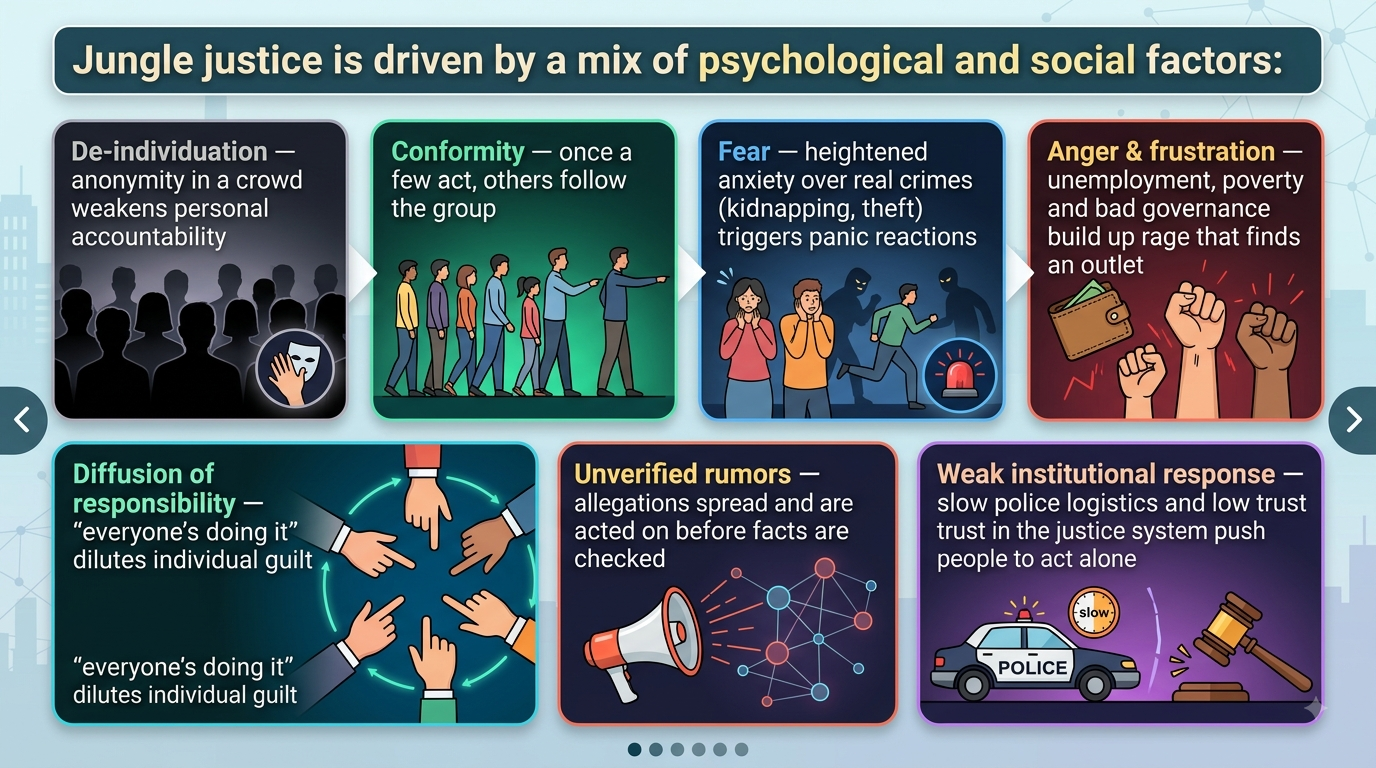
He explained that individuals could shift from personal judgment to collective behaviours, thereby weakening their sense of responsibility and making them more likely to follow the action of others.
Analysts say the pattern has been evident in several high-profile cases across Nigeria, including the 2012 Aluu killings in Rivers, where four students of the University of Port Harcourt were killed.
The victims were Lloyd Toku, Tekena Elkanah, Chiadika Biringa and Ugonna Obuzor, who were accused of theft, attacked by a mob, stripped, beaten, paraded and eventually set ablaze.
In May 2022, Deborah Samuel, a student of Shehu Shagari College of Education, Sokoto State, was lynched and her body set ablaze by a mob over allegations of blasphemy.
The incident drew national and international condemnation and renewed calls for justice, religious tolerance and respect for the rule of law.
Other reported cases have involved minors accused of petty theft, with allegations over basic food items.
For instance, in November 2020, a 10-year-old boy identified as Ifeanyi was severely burnt in Effium, Ebonyi, after traders accused him of stealing a small measure of uncooked rice.
He was tied up, beaten and thrown into a fire before sympathisers intervened.
Amnesty International says no fewer than 555 victims of mob violence were recorded in 363 documented incidents across Nigeria between January 2012 and August 2023.
The organisation said 57 people were killed by violent mobs, 32 were burnt alive, two were buried alive and 23 were tortured to death.
Amnesty’s research also documented at least 13 women, six children and two people with actual or perceived mental health conditions or psychosocial or intellectual disabilities among victims.
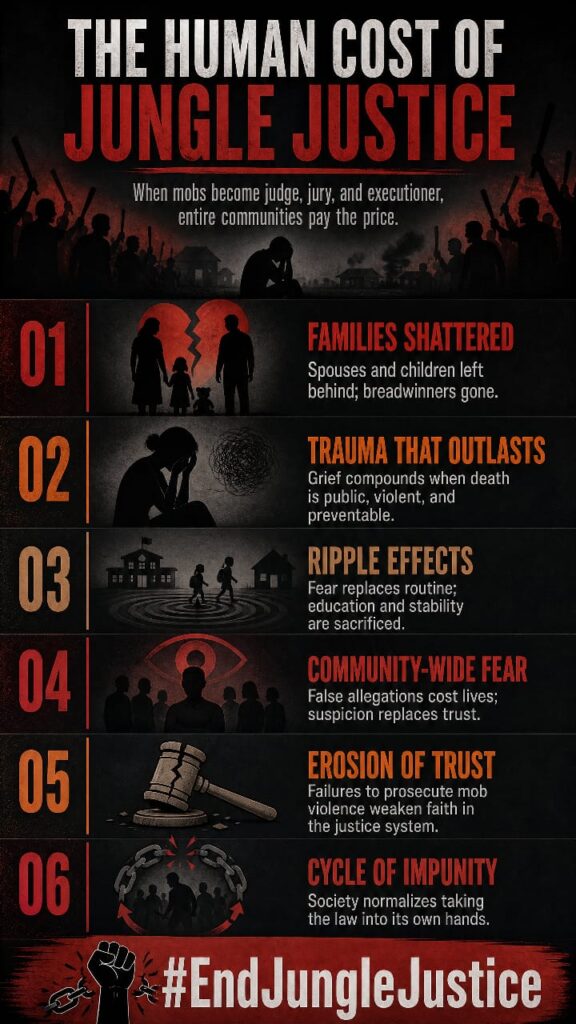
Beyond the immediate loss of life, psychologists say jungle justice leave families grappling with grief, trauma and the consequences of losing loved ones to preventable violence.
Echoing this view, Mrs Naankus Fyaktu, Chairperson of the International Federation of Women Lawyers (FIDA), Plateau Chapter, said women, children and other vulnerable persons remained particularly exposed to wrongful accusations, sexual violence and physical abuse.
She said the consequences extended to families.
“Families are particularly affected when the victim is a breadwinner, as the death can worsen their financial hardship and disrupt their future,” she said.
Ibrahim Mbaya`s younger brother, James, said the killing of the family`s first child devastated his parents and cut short his dreams of owning a fashion house and restaurant while building a modelling career.
For Ummulkhairi`s family, the pain has been compounded by the circumstances surrounding her death.
Her relatives have continued to seek justice while her husband and four children would have to cope with the loss of a wife and mother.
Similarly, after Samuel was killed, the shock affected the health of her mother, Alheri Emmanuel, who said she would no longer send her seven surviving children to school.
Experts say the pattern of trauma is similar and also extends to the wider community, creating fear among residents who worry that an allegation, whether true or false, could expose them to mob violence.
Such consequences also raise broader concerns about the rule of law, as legal experts say jungle justice also violates Nigeria’s constitutional guarantees and undermines the rule of law.
Section 33(1) of the Constitution of the Federal Republic of Nigeria, 1999 (as amended), guarantees every person’s right to life, while Section 34(1)(a) protects individuals from torture and other inhuman or degrading treatment.
Section 36(5) provides that every person accused of a criminal offence is presumed innocent until proven guilty by a court of law.
The Administration of Criminal Justice Act, 2015, provides procedures for the lawful arrest, investigation and prosecution of suspects, leaving criminal allegations to law enforcement agencies and the courts.
Also, the Director, Amnesty International Nigeria, Isa Sanusi, said failures by law enforcement agencies, particularly the Nigeria Police Force, to prevent mob violence, investigate allegations of torture and killings and prosecute suspected perpetrators were empowering mobs to kill.
He said the situation was further compounded by weak and corrupt legal institutions and systems.
Sanusi called for prompt, thorough, impartial, independent, transparent and effective investigations into cases of mob violence and the prosecution of suspected perpetrators through fair trials.
A security expert, Dr Abdullahi Jabi, said gaps in government agencies’ response times create opportunities for youths to engage in violence.
Jabi, Managing Director and Chief Executive Officer of Kudus International Security Nigeria Ltd., also identified logistical challenges confronting the police, including inadequate vehicles, fuel and timely access to information, as factors that could delay intervention.
“It is a logistical problem arising from lack of vehicle, or no fuel or the driver is not available and then before you get there, the case is worse.’’
According to him, such delays can allow mob situations to escalate and expose security personnel and members of the public to danger.
He also linked mob violence to unemployment, poverty and accumulated frustration among young people.
“Most Nigerian youths have graduated from schools, three years, four years, yet no jobs.
“So, this anger bottle up and they take the anger to the state and take vengeance from innocent citizens within the community and the larger society,” he said.
He also identified social media as a factor that could influence young people and compound social problems, calling for measures to address harmful content accessible to children and adolescents.
Jabi urged the National Orientation Agency to intensify campaigns against youths taking the law into their own hands.
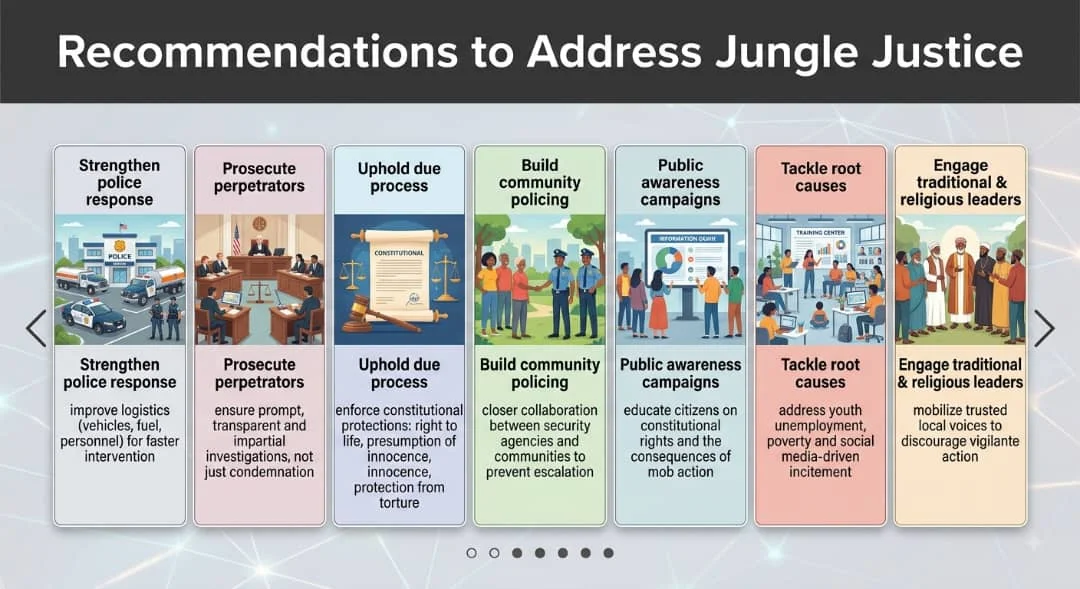
He said addressing jungle justice required improved police capacity, faster response to incidents, stronger community policing, public orientation and measures to improve citizens’ welfare.
Analysts say jungle justice in Nigeria destroys families, traumatises communities, and erodes trust in the legal system.
They say ending this violence requires strengthening public institutions and ensuring fast, fair investigations so suspects face legal trials instead of mob rule. (NAN Features)
Edited by Chijioke Okoronkwo
***if used, please credit the writer and the News Agency of Nigeria.





Kenya has confirmed a third case of Ebola after a 65-year-old woman tested positive while in quarantine.
The woman is a close relative of Kenya’s first confirmed patient, a 40-year-old who died from Ebola on 5 October, two days after arriving in Kenya from the Democratic Republic of the Congo (DRC).
The Associated Press (AP) reported that the woman had been in quarantine since 6 October and developed symptoms before testing positive. She has since been transferred to an infectious disease unit for treatment.
The second patient, a 39-year-old man from the same family, remains stable, according to Kenya’s Ministry of Health.
The ministry said there was no evidence of community transmission, as all three cases were linked to the first patient and the individuals had been in quarantine.
Nigeria’s preparedness
The development comes as Nigeria continues to monitor the regional outbreak and strengthen preparedness against possible importation of the virus.


PREMIUM TIMES reported on 7 October that the Nigeria Centre for Disease Control and Prevention (NCDC) was reviewing the country’s preparedness after Kenya confirmed its first imported case of the Bundibugyo strain of Ebola.
In a statement issued on 6 October, the NCDC said the case highlighted the risk of international importation through travel and population movement, including the possibility of the virus entering Nigeria.
The agency said it was working with the Federal Ministry of Health and Social Welfare, Port Health Services, state governments and other partners to strengthen surveillance, early detection, laboratory diagnosis, isolation, contact tracing and infection prevention.
It also said Nigeria conducted a national Ebola preparedness simulation exercise to assess its readiness to respond to a possible case.
As of 6 October, the NCDC said Nigeria had no confirmed Ebola case.
Contact tracing continues
Kenya’s first case involved a 40-year-old man who had been living in the DRC and travelled through Uganda before arriving in Nairobi. He tested positive for Ebola and died on 5 October.
The confirmation of a second case on 14 October raised concerns about further infections among people exposed to the initial patient.
PREMIUM TIMES reported on 14 October that the second patient, a 39-year-old close relative of the first case, developed symptoms while in quarantine.
At the time, Kenyan authorities had identified 128 contacts linked to the first patient, with 113 located and efforts ongoing to trace the remaining 15.
In its report on Friday, AP said three contacts of the initial patient remained unaccounted for, while authorities continued efforts to trace people who might have been exposed.
The latest case brings the number of confirmed Ebola infections in Kenya to three.
Regional outbreak
The cases in Kenya are linked to the ongoing Ebola outbreak in the DRC, where the Bundibugyo virus has caused thousands of infections and deaths.
The World Health Organisation (WHO) said the DRC had recorded 7,890 confirmed cases and 3,799 deaths as of 23 September.
The outbreak has raised concerns about cross-border transmission, particularly as people travel between affected areas and neighbouring countries.
The Bundibugyo virus is a distinct species of Ebola virus. No vaccine or treatment has been specifically approved for this strain.
Discover more from Premium Times Nigeria
Subscribe to get the latest posts sent to your email.

Former Kaduna Central Senator Shehu Sani has accused supporters of the African Democratic Congress, ADC, of smearing Peter Obi and Rabiu Kwankwaso following their political separation.
Sani was reacting to a recent statement by the ADC accusing Kwankwaso of supporting Obi out of personal ambition and working for President Bola Tinubu.
In a post on his X handle, Sani said the criticism of the two politicians, including allegations that they were working for the ruling All Progressives Congress (APC) or Tinubu, stemmed from bitterness over their political split.
“The ADC guys are still bitter about the Peter and Kwankwaso divorce, hence the smear that they are working for the ruling party or the President,” he wrote.
He argued that both politicians had established independent political records and were entitled to make their own political choices.
“No consideration to the fact that they are all accomplished politicians with their own independent track records, and have the right to associate and disassociate,” Sani added.
According to him, the criticism was a consequence of the politicians’ refusal to be used for the political interests of others.
“This is the price they will continue to pay for refusing to be supplementary, and disposable cargoes in someone’s container.
“They wanted to use them and sacrifice them for ritual in their perennial political expeditions. Political parties shouldn’t be cultish groups where one can’t pull out in peace,” he said.
ADC supporters bitter over Obi, Kwankwaso’s ‘divorce’ — Shehu Sani
-

 News4 days ago
Meta releases its first frontier model, Muse Wonder
-
Health4 days ago
AMR: Livestock uses more antibiotics than human health sector
-
News3 days ago
MTN, Airtel take 90% of Nigeria’s 15m new subscribers as Glo shifts ground – Technology Times
-
News4 days ago
The Stage Is Set, Nairobi Is Ready! Africa’s Business and Sports Power Players Converge for YORA Summit 2026