Connect with us

Business

Rent and Earn: Oscar Danladi’s Bet on Nigeria’s Broken Housing Market

info

Published

on

WhatsApp Image 2026 03 20 at 7.10.43 AM.jpeg

Oscar Danladi founded Rentstay to address Nigeria’s chaotic rental market after becoming frustrated by misleading listings and excessive agency fees. His platform aims to streamline the rental process by enabling direct tenant-landlord interactions, verifying properties, and offering digital caution-fee management. Rentstay seeks to transform how rentals work, ensuring transparency for both parties.

Fwangmun Oscar Danladi had done everything right. He had found a listing, confirmed a price, and arranged a viewing. The apartment, a two-bedroom flat in Jos, had decent road access, reasonable rent, and looked promising on paper. Then he arrived, and the agent asked him to wait.

“He needed to call someone else who knew where the property was,” Danladi recalls.

What followed was a slow unravelling. One agent became two, then three. Each new arrival got into Danladi’s car and directed him further down a road that bore no resemblance to what had been described. By the time they reached the property, Danladi had been in the car for the better part of an hour. The house was nothing close to what he had asked for.

Then came the real surprise: despite all of this, the agents still expected to be paid an amount more than the initial agreement, because “more people had gotten involved.”

Danladi is not the kind of person to write off a bad experience. Instead, he started asking questions. Why does renting in Nigeria require navigating an arduous path laden with unnecessary middlemen and agents? Why is a ₦500,000 apartment so often actually a ₦900,000 apartment, once agency fees, legal fees, and caution fees are piled on? Why is there no system?

“It just dawned on me,” he says. “This is what almost everybody goes through.”

Nigeria has a housing problem that its property market has largely failed to solve. The country’s urban population is expanding at roughly 2.8% to 3% annually, and demand for rental accommodation in cities like Lagos, Abuja, and Jos continues to outpace the supply of quality, verifiable listings. Sadly, this deficit is both physical and structural.

The informal networks that dominate Nigeria’s rental market, where a tenant finds an agent who knows an agent who knows a landlord, with fees accumulating at every handshake, have remained largely unchanged for decades. Technology has made its way into fintech, logistics, agrotech, and healthcare. Rental housing, for the most part, has been left behind.

A handful of startups have tried to close the gap. RentSmallSmall pioneered the rent-in-instalments model in Lagos. PropertyPro.ng built a listings aggregator. But outside the major southern cities, the informal system still holds. In a city like Jos, the kind of multi-agent chaos Danladi experienced is not a bug but a feature.

Danladi’s response was to spend months in research mode, mapping the problem before building a solution. RentStay.

Together with Jonah Onah and Abel Ochika, Danladi co-founded Rentstay, a rental platform designed, as he describes it, not just to list properties but to restructure how the entire rental transaction works.

“The system allows the tenant to go in, create an account, and you can verify your identity during registration. The property owner also has a dashboard where he can create a property listing. We then verify the property by doing background checks on th property to ensure transparency. Tenants can directly chat with the property owner via our platform,” Danladi says.

The most immediate promise is zero agency fees. Rather than paying agents to unlock access to viewings, users interact directly with landlords through the platform, where properties are listed, digitally managed, and verified before they go live.

The verification model is where Rentstay departs from the usual proptech playbook. Rather than relying purely on document checks, the platform uses a network of local affiliates who function a bit like traditional agents but with a different mandate. Their job is to confirm that a property physically exists and matches its description. They are paid for that confirmation, not for closing a deal.

It’s a subtle structural shift, but the incentive change matters. A traditional agent profits when a transaction closes, regardless of whether the tenant is satisfied. Rentstay’s affiliates profit when information is accurate. Whether that holds at scale is a question the platform has not yet had to answer.

The more unusual piece of Rentstay’s model is what it does with the caution fee
The more unusual piece of Rentstay’s model is what it does with the caution fee.

In Nigeria, caution fees, sometimes called cushion fees, are a standard part of the rental process. Tenants pay a lump sum upfront, meant to cover potential damage, and routinely struggle to recover it when they move out. The money sits idle, earns nothing, and is often the subject of disputes.

Rentstay holds caution fees digitally and invests them through what Danladi describes as insured financial channels. Tenants earn a 5% annual return on that deposit. When they leave — assuming the property is in good condition — they get back both the original amount and the interest it accumulated.

“You’re renting, but you’re also earning” – Danladi Oscar

For landlords, the platform offers a different value proposition: structure. Tenant verification, automated payment tracking, and property management tools are bundled together, which is an appealing pitch for landlords who currently manage everything through phone calls and paper receipts. Getting them to actually use it is the harder part.

Danladi is straightforward about this. Older landlords, accustomed to dealing in cash and relationships, will not convert overnight. The strategy is incremental: start with early adopters, let results travel by word of mouth, and where needed, lean on younger family members already comfortable with digital platforms to bring the older generation along.

Rentstay launched in Jos in March 2026, which is a deliberate choice. The platform’s founders are from there, knows its contours, and is realistic about the limits of dropping a new product into a market without roots. And already, the site visits show promise with hundreds of new users indicating interest in RentStay.

The five-year target is 2,500 properties under management. Danladi calls it modest, and it is, relative to the size of Nigeria’s housing market. But he frames the goal less as a number and more as a proof of concept. If Rentstay can shift how tenants and landlords in Jos think about the rental relationship, the larger cities become easier to enter.

The harder questions are still ahead. Fake listings are endemic in Nigerian proptech, and no amount of affiliate verification eliminates the possibility of fraud — it only adds friction. Maintaining landlord engagement on the platform, rather than reverting to direct deals once they’ve found a tenant, is a problem every Nigerian proptech startup has encountered. And the caution fee investment model, while compelling on paper, introduces financial risk that will need regulatory clarity as the platform scales.

None of this makes Rentstay’s ambition unreasonable. It makes it difficult in the specific, familiar ways that building in Nigeria is always difficult.

Danladi drove nearly an hour on a bad road to reach a house that didn’t match its description, and at the end of it, agents still asked for more money. That experience sits at the centre of what Rentstay is trying to solve — not by making housing frictionless, which may be too much to promise, but by making it at least legible. A market where tenants know what they’re paying for, and landlords know who they’re dealing with.

“There are properties, but there’s no system” – Danladi Oscar

Rentstay is his attempt to build one.

Continue Reading
Click to comment

Leave a Reply

Your email address will not be published. Required fields are marked *

Business

SOLAP Enterprise Hub Produces First Winner, Awards N1.5m to Top Pitch Winner

info

Published

on

By

FB IMG 1774690193789.jpg

A young entrepreneur, Magaji Emmanuel, founder of MJ Farms, has emerged winner of the maiden edition of the SOLAP Enterprise Hub, Youth Entrepreneurship Program 2025,  clinching a N1.5 million business investment grant at the grand finale held Friday at Ordlin Event Center, Jos.

Fb img 1774690198096

Emmanuel outperformed nine other finalists in a competitive live pitch session, following a six-week intensive training programme that began with hundreds of applicants drawn from Abuja, Benue, Nasarawa, Plateau and Kaduna States.

The SOLAP Enterprise Hub, Youth Entrepreneurship Program 2025, an initiative of SOLAP Group, is designed to nurture young entrepreneurs into wealth creators, job providers and drivers of community development. From over 100 applications received, 50 entrepreneurs were shortlisted and trained, with only 10 advancing to the final pitch stage.

Fb img 1774690201572

Presenting his business model, Emmanuel, a Quantity Surveying student of Kaduna State University, showcased his integrated poultry farm which not only produces poultry birds but also converts poultry waste into organic hybrid fertilizer. His innovation, aimed at addressing rising fertilizer costs, earned him the top prize.

Speaking after his victory, Emmanuel expressed gratitude to God and dedicated the achievement to his late father, whose initial vision inspired the business. He noted that the grant would help scale production and expand access to affordable fertilizer for farmers.

Group Managing Director of SOLAP Group, Arc. Akosu Paul

Earlier, the Group Managing Director of SOLAP Group, Arc. Akosu Paul, said the initiative forms part of the company’s corporate social responsibility to support young entrepreneurs with viable ideas through training, mentorship and grants.

He explained that the programme aims to raise 100 millionaires within the next 10 years, stressing the importance of investing in youth who possess the energy, vision and fewer distractions needed to grow sustainable businesses.

The event also featured a panel discussion on “Thriving in Uncertainty: Building Resilience and Entrepreneurship,” with experts including Chief Samuel Adetunji, Mrs Theresa Gofwen and Mrs Mary Oyewole, who shared insights on navigating business challenges.

Fb img 1774690212297

In a show of support, Chief Adetunji donated an additional N100,000 each to the top three winners, as well as to the best female contestant and another participant who pitched a fish farming business.

Speaking at the event, Mr Val Okafor of the Val Okafor Company, implementing partner of the initiative, described the programme as a structured intervention aimed at bridging the gap between ideas and sustainable enterprises.

Fb img 1774690270684

According to him, participants underwent practical training in business development, market research, branding and revenue strategies, equipping them with the skills needed to build viable businesses.

Other winners at the event included Ani Nnaemeka Kingsley of NovelArts, who emerged first runner-up with a N1 million grant for his innovative use of waste materials in interior décor and art production.

Mom Terkaa Titus of Jumo Farms secured the second runner-up position, winning N500,000 for his Agri-Rentals concept, a farm mechanization hub for smallholder farmers.

The top female contestant, Egba Agnes of AG’s Creations, also received an additional N500,000 grant to support her fashion design business and training academy for aspiring designers.

Organisers described the maiden edition as a success, noting that the initiative will continue to expand opportunities for young entrepreneurs across Nigeria.

Fb img 1774690208477Fb img 1774690255221Fb img 1774690214960Fb img 1774690193789Fb img 1774690219864Fb img 1774690225843

Continue Reading

Business

Investors Applaud Plateau Government’s Agricultural Drive at Horticultural Festival

info

Published

on

By

FB IMG 1774728957171.jpg

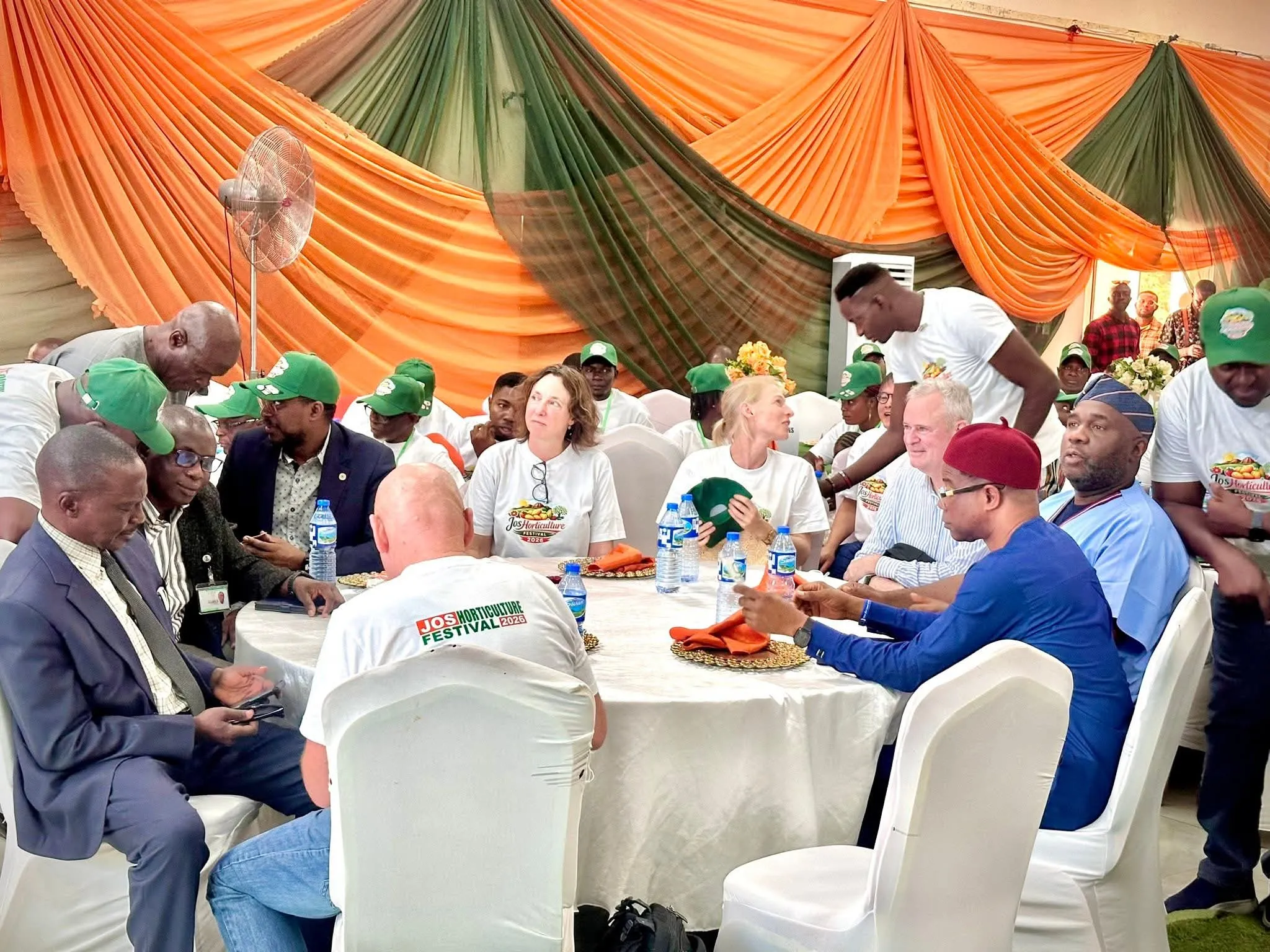
Investors and stakeholders in the agricultural sector have commended the Plateau State Government under Governor Caleb Manasseh Mutfwang for its deliberate efforts to transform agriculture and boost food security.

The commendation came during the 2026 Horticultural Festival held in Jos, organised in collaboration with the Kingdom of the Netherlands, the Federal Ministry of Agriculture and Food Security, and other development partners. The event took place at the Crispan Suites and Event Center and attracted both local and international investors.

Fb img 1774728960724

Leading the delegation of foreign investors, the Ambassador of the Netherlands to Nigeria, Bengt van Loosdrecht, praised the state government’s commitment to agricultural development, particularly in horticulture and potato production.

He noted that Plateau’s climate and soil conditions provide a strong advantage for large-scale agricultural production, especially potatoes, and expressed optimism about ongoing collaborations between Dutch companies and local farmers. He also revealed that new seed varieties are being tested and scaled up to improve productivity.

Representing the governor, the Commissioner for Agriculture and Rural Development, Samson Ishaku Bugama, described the festival as a strategic step toward positioning Plateau as a leading hub for horticulture in Nigeria and beyond.

Fb img 1774728963596

Bugama emphasized that the state government is prioritizing agricultural excellence, improved seed systems, and increased yields, alongside creating investment opportunities across the value chain, including mechanization, processing, storage, and export.

He disclosed that the state is also developing Special Agro-Processing Zones to enhance export potential and attract investors, adding that Plateau aims to tap into a multi-billion-dollar market in potatoes and vegetables over the next decade.

According to him, Plateau produces about 90 percent of Nigeria’s Irish potatoes and possesses significant potential for expansion due to its favorable climate, fertile volcanic soil, and year-round production capacity.

Fb img 1774728998568

Also speaking, the Executive Director of the National Root Crops Research Institute (NRCRI), Chidozie Egesi, highlighted the importance of research and innovation in unlocking the full potential of the potato value chain.

He noted that while Nigeria remains a leading potato producer in West Africa, yields remain below global standards, stressing the need for improved seed systems, mechanization, and stronger partnerships between researchers, investors, and farmers.

The festival featured exhibitions of crop varieties, fruits, vegetables, and ornamental plants, alongside cultural performances showcasing the rich heritage of Plateau communities.

In his remarks, the Permanent Secretary of the Ministry of Agriculture and Rural Development, Yilkudi Nengak Elisha, appreciated partners and participants, assuring investors of sustained collaboration and improved outcomes.

The event reaffirmed the state government’s commitment to agricultural transformation, with stakeholders expressing confidence that Plateau is well-positioned to become a major hub for horticulture and agribusiness in Nigeria.

Fb img 1774729003962  Fb img 1774728979448 Fb img 1774728973283 Fb img 1774728968165   Fb img 1774728957171

Continue Reading

Trending