Business
PHOTO STORY: Keyamo inaugurates waste recycling programme, inspects upgraded pilgrims’ terminal at MMI, Lagos

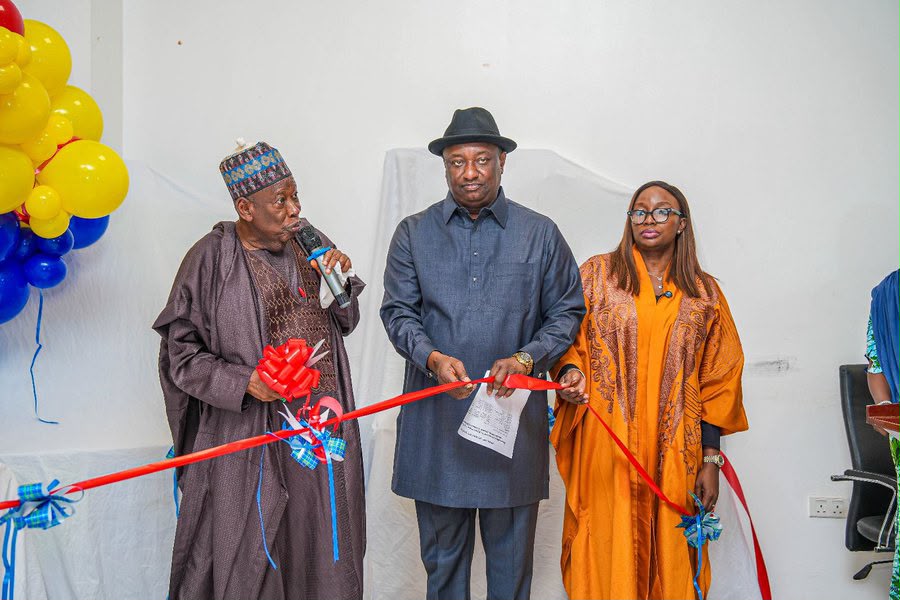

The Minister of Aviation and Aerospace Development, Festus Keyamo, has inaugurated the first phase of the Federal Airports Authority of Nigeria’s (FAAN) Sustainable Waste Management Programme and inspected the upgraded Pilgrims’ Terminal at the Murtala Muhammed International Airport (MMIA), Lagos.
Mr Keyamo disclosed this on Thursday in a post on his official X page following the activities, which he conducted alongside the Chairman of the FAAN Board, Abdullahi Umar Ganduje, and the authority’s Managing Director and Chief Executive Officer, Olubunmi Kuku.
The minister stated that the waste management initiative introduces colour-coded recycling bins to encourage proper waste separation, describing it as the first phase of a nationwide programme to make Nigeria’s airports cleaner and more environmentally sustainable. According to him, the initiative reflects FAAN’s commitment to improving environmental practices across airports nationwide.

Following the inauguration, Mr Keyamo inspected the upgraded Pilgrims’ Terminal, which now features a 300-seat passenger waiting area, modern VIP and VVIP lounges, free high-speed Wi-Fi, a fully air-conditioned mosque, and enhanced screening and security systems.

He commended the management of FAAN for both projects and urged the authority to sustain the momentum.
“I commend the management of FAAN for these initiatives and encourage them to keep up the tempo in line with President Bola Ahmed Tinubu’s Renewed Hope Agenda,” the minister said.
In a separate statement, FAAN described the waste management programme as a significant step towards building cleaner, greener, and more sustainable airports across the country.
The authority urged passengers and other airport users to support the initiative by disposing of waste in the designated recycling bins.

“As you travel, your small actions can make a big difference. Dispose of your waste in the right bin, support recycling, and help us create an airport environment we’re all proud of,” FAAN stated.
These initiatives arrive as the federal government continues efforts to modernise airport infrastructure and improve service delivery across Nigeria’s aviation sector.
The Pilgrims’ Terminal at the Murtala Muhammed International Airport serves as one of the country’s major departure points for Muslim pilgrims travelling to Saudi Arabia for Hajj and Umrah. Upgrading the facility is expected to improve passenger comfort, ease the movement of travellers during peak pilgrimage periods, and enhance security screening and other airport services.
READ ALSO: Keyamo speaks on China-Enugu cargo flights
Similarly, the introduction of the Sustainable Waste Management Programme reflects a growing emphasis on environmental sustainability in airport operations. Globally, airports are increasingly adopting waste segregation and recycling systems as part of broader efforts to improve sanitation, reduce pollution, and align with international sustainability standards.
FAAN stated that the colour-coded recycling bins introduced at MMIA represent the first phase of a nationwide rollout, with the programme expected to encourage responsible waste disposal and foster cleaner airport environments across Nigeria.


The Federal Airports Authority of Nigeria (FAAN) has begun earning revenue from the Murtala Muhammed Airport Terminal Two (MMA2) in Lagos following a settlement between the Federal Government and Bi-Courtney Aviation Services Limited over a dispute that lasted nearly two decades.
The Minister of Aviation and Aerospace Development, Festus Keyamo, disclosed this on Tuesday during the formalisation of the settlement involving the Federal Government, FAAN, Bi-Courtney and Stabilini Visinoni Limited.
“FAAN had not earned a kobo from MMA2 for the last 20 years because of disputes. Today, FAAN begins to earn its money from MMA2,” Mr Keyamo said.
The agreement provides for the resumption of concession fee payments to FAAN and the reciprocal waiver of specified historical financial and other claims by the parties.
Mr Keyamo said the Federal Executive Council (FEC) approved the framework for the negotiated settlement on 30 April 2026, following discussions aimed at resolving the long-running dispute.
What the settlement changes
Under the revised agreement, Bi-Courtney has agreed to waive its outstanding claims against the Federal Government, while the government and FAAN will relinquish specified historical claims against the concessionaire, including accumulated concession fees and related payments arising before the agreement.

The minister said the arrangement was intended to resolve past disagreements and establish clearer contractual obligations for the parties going forward.
The settlement also addresses a dispute over the General Aviation Terminal (GAT), commonly known as the Old Domestic Airport.
According to Mr Keyamo, the revised agreement recognises the terminal as the property of the Federal Government, to be operated by FAAN.
The minister said the government had agreed to allow Bi-Courtney to expand its apron and accommodate regional flights within Africa at MMA2, subject to the terminal’s capacity.
The agreement also restores rights and provides for separate lease arrangements covering a four-star hotel and conference centre near the airport. The facilities have remained unfinished for years.
Mr Keyamo said the government would retain regulatory oversight over security, access, emergencies and maintenance standards, while the parties would work together to implement the revised arrangements.
Background to the dispute
In April, PREMIUM TIMES had reported that the Federal Government had reached a settlement with Bi-Courtney to resolve the long-running dispute over MMA2 after years of litigation and disagreements over the airport concession.
Mr Keyamo at the time said the Federal Executive Council (FEC) had approved the negotiated settlement, which included concessions by both parties, revised operational arrangements and plans to restore government revenue from the terminal.
The dispute originated from a concession agreement signed on 24 April 2003 involving the Federal Government, Bi-Courtney and Stabilini Visinoni Limited for the design, construction, operation and eventual transfer of the domestic terminal.
The agreement initially covered 12 years from 7 May 2007 but was subsequently extended to 36 years.
Disagreements over contractual obligations, financial claims and the scope of the concession led to multiple court cases across successive administrations.
Bi-Courtney maintained that it had been denied benefits under the concession, while FAAN asserted its own financial entitlements and responsibility to protect public airport assets.
READ ALSO: FAAN steps up airport surveillance as Nigeria confirms Ebola case in Abuja
The dispute also involved the ownership of the General Aviation Terminal and financial claims connected to the Asset Management Corporation of Nigeria.
Mr Keyamo said the latest settlement followed negotiations between the government and the chairman of the Bi-Courtney Group, Wale Babalakin, with legal, commercial and technical teams involved in the process.
He added that the agreement would give Bi-Courtney greater certainty to invest in the terminal while allowing the government to resume revenue collection and plan airport development under the revised framework.
He urged FAAN and Bi-Courtney to ensure that the settlement resulted in completed facilities, reliable services and improved airport operations.
“The travelling public should see the result in functioning facilities and dependable service. That is how the value of this settlement will be measured,” he said.
Discover more from Premium Times Nigeria
Subscribe to get the latest posts sent to your email.
-

 News3 days ago
Euromatch NPFL: Matchday 9 results
-
News4 days ago
NUCAP: Nigeria targets 20 million people with 3,700 telecom towers – Technology Times
-
News3 days ago
Meta removes language that raised scraping and AI training concerns
-
News3 days ago
No agenda, no rush, no leaving San Francisco: Benchmark’s partners on investing in a frenzied market