Connect with us

News

PNOE’s new face mask wants to make lab-grade breath testing a self-serve affair

info

Published

on

PNOE 2.0.png

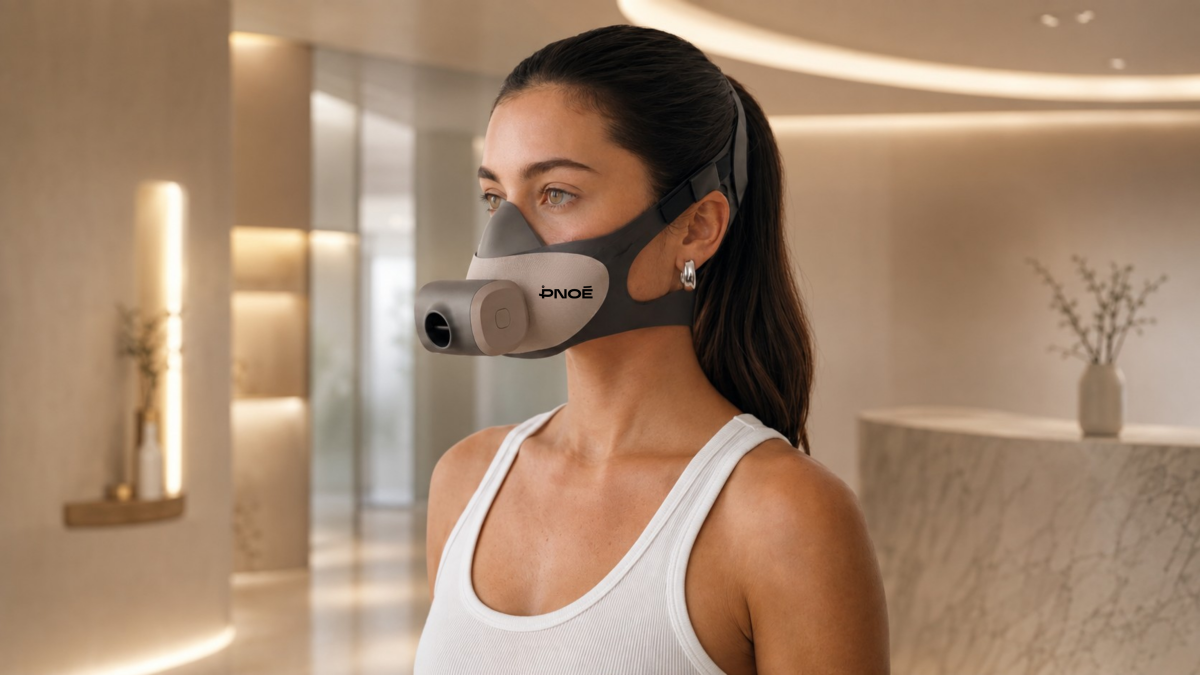
At first glance, the newest device from PNOĒ looks like something a comic-book villain might wear. The mask, which covers the nose and mouth and straps around the back of the head, bears more than a passing resemblance to the one worn by Bane, Batman’s hulking nemesis. But its purpose is far more benign; it measures how much oxygen you consume and how much carbon dioxide you exhale, then turns that data into advice about how to eat, train, and, the company hopes, live longer.

PNOĒ, which is based in Malden, Massachusetts, and has operations in Athens, Greece, is preparing to launch the PNOĒ 2.0 on October 1. The big change from its current device is that users can administer the test themselves. According to co-founder and CEO Apostolos Atsalakis, someone can walk into a gym, “just wear the mask, push the button, sit down,” and breathe for eight minutes. “That’s it. It’s that easy,” he said recently, talking with this editor over a Zoom call from the company’s Athens location.

That matters because PNOĒ’s current device requires a trained operator, which limits where it can be used. A self-serve version could open the door to fitness centers without dedicated staff and potentially even pharmacies, Atsalakis said.

The science behind PNOĒ isn’t new. Metabolic testing, which analyzes the gases in a person’s breath to gauge how their body produces energy, has been around for more than a century. For decades, it has been the gold standard for measuring VO₂ max, the maximum amount of oxygen the body can use during exercise and a widely used measure of cardiorespiratory fitness. But the tests have traditionally required bulky, expensive equipment found mainly in sports labs and hospitals, which is why they’ve largely been the province of elite athletes and executive wellness programs.

What 10-year-old PNOĒ promises is the same accuracy in a portable package, paired with software that translates the results into recommendations. “We made it accessible to everyone,” Atsalakis said.

The company says its test captures 23 biomarkers, including (beyond measuring VO₂ max) one’s resting metabolic rate (how many calories the body burns at rest), and metabolic flexibility (how well the body switches between burning fat and carbohydrates). Atsalakis argues that these metrics answer questions that blood tests can’t, such as how many calories a person needs or how they should train.

The timing is good for PNOĒ. VO₂ max has become a buzzword among longevity enthusiasts, thanks in part to research linking higher cardiorespiratory fitness to lower mortality. Atsalakis calls VO₂ max the strongest predictor of human longevity, and he sees his company’s data as a kind of scorecard for the booming wellness industry.

The new device is smaller and more compact than its predecessor, with fewer parts, which Atsalakis said makes it more reliable. It was designed with Milan-based Design Group Italia over what Atsalakis described as “a lot, a lot, a lot of iterations,” since a self-administered metabolic testing device hadn’t been done before.

It also addresses a question that post-pandemic users are likely to ask: who wore it last? The answer: it doesn’t matter, as the electronics detach from the silicone mask and straps, so multiple people can share the costly hardware while each user keeps their own mask.

For all its clinical ambitions, PNOĒ is careful about what it claims. The device isn’t cleared by the U.S. Food and Drug Administration, and Atsalakis said that “we do not provide medical recommendations.” Instead, PNOĒ considers itself a wellness device. “It’s like a body composition device, like a scale,” he said. “A doctor cannot prescribe medication based on our results.”

That could change down the road. Researchers have long explored whether compounds in human breath can signal diseases such as cancer, and Atsalakis believes the company’s growing trove of data could eventually help it flag health issues. But he acknowledged that full diagnoses are “definitely a couple of years away,” with regulatory hurdles likely stretching that timeline further. “We’re not there yet,” he said.

PNOĒ traces its roots to Atsalakis’s PhD work in sensing technologies at the University of Cambridge, when wearables were taking off and he became fascinated by what the breath could reveal about the body. He co-founded the company with Panos Papadiamantis, a childhood friend who is now the company’s chief product officer.

The startup went through Y Combinator’s Winter 2019 batch, back when “longevity” was not yet the industry it is today. It has since raised about $22 million, including a recently closed $11 million round, from investors including 50 Years and Google Maps co-founder Lars Rasmussen, who is himself now based in Athens.

PNOĒ sells only to businesses, which then offer the test to their customers. Its clients include Equinox, where it’s available at almost all clubs, said Atsalakis, as well as Four Seasons hotels, Red Bull, the NBA, the Mount Sinai Health System, and the med spa chain Restore Hyper Wellness.

About 85% of its business comes from the U.S., which Atsalakis described as “by far the most advanced market globally” for longevity. The company is now expanding in Europe and, through partners, in Latin America and Asia.

Businesses pay a subscription ranging from $400 a month to more than $1,000, which covers the hardware, software, training, and marketing materials, a package Atsalakis calls a “business in a box.” PNOĒ also links its results to the services a business sells, so a gym or spa can recommend specific offerings based on a customer’s test. Many clients use the test during onboarding, Atsalakis said, positioning it somewhere between a full clinical workup and the estimates people get from their smartwatches.

That middle ground is increasingly crowded. Apple, Garmin, and Whoop all estimate VO₂ max from heart-rate data, while consumer devices like Lumen analyze breath to gauge fat and carb burning. At the high end, traditional metabolic carts remain the standard in labs and hospitals.

PNOĒ, which employs 110 people, says it recently turned profitable, while growing more than 100% a year. Atsalakis said the company plans to raise a Series B within the next six to 12 months as it tries to put its mask — Bane comparisons and all — in front of more faces.

When you purchase through links in our articles, we may earn a small commission. This doesn’t affect our editorial independence.

Continue Reading
Click to comment

Leave a Reply

Your email address will not be published. Required fields are marked *

Business

Access Holdings mulls exit from foreign subsidiary to meet CBN rule – Report

info

Published

on

IMG 7961.jpeg

Access Holdings is considering exiting at least one market outside its base in Nigeria to comply with a Central Bank of Nigeria (CBN) rule requiring lenders to limit investment in foreign subsidiaries to no more than one-tenth of shareholders’ funds.

The banking group mentioned one business in which it plans to offload its stake to meet the requirement, Bloomberg reported on Monday, citing Chairman Aigboje Aig-Imoukhuede.

“If a subsidiary cannot meet its cost of capital and the strategic objectives for which it is set up, you should be ready to take a decision to exit,” Mr Aig-Imoukhuede was quoted as saying at an African Financial Industry Summit in Luanda, Angola, last week.

“Do we have one or two troublesome subsidiaries? I can think of one.”

Investment in subsidiaries for Nigeria’s biggest bank by assets stood at N446.6 billion at the end of September, equivalent to 19.3 per cent of its equity, according to Access Holdings’ 9M 2026 Investor Presentation.

That was roughly double the 10 per cent ceiling permitted by the Banks and Other Financial Institutions Act (BOFIA) 2020.


PT WHATSAPP CHANNEL
Dangote Refinery AD

Only in cases of regulatory approval for a higher threshold from the CBN are lenders allowed to exceed that limit, the Act says.

The banking industry watchdog has given Access Holdings 12 months to address the issue.

The potential exit is part of the financial institution’s move to review its international operations to comply with the directive.

In June, Access Bank’s chief executive, Roosevelt Ogbonna, said the lender would reduce its shareholding in some of its foreign subsidiaries to achieve compliance.

According to Innocent Ike, CEO of Access Holdings, the lender will explore three strategies towards that end.

The options include recalling surplus capital from overseas subsidiaries, offloading minority stakes and restructuring some businesses, he said.

He added that the group has already completed one capital repatriation exercise involving its six targeted subsidiaries, and is engaging regulators in five countries to facilitate the return of excess capital to Nigeria.

Access Holdings plans to meet the regulatory requirement ahead of the March 2027 deadline, Mr Ike stated.

READ ALSO: Access Holdings’ nine-month profit jumps 6% to N474.2 billion

“We gave ourselves up till January next year, and I think we’re completing this ahead of schedule,” said Mr Aig-Imoukhuede.

The Access Holdings’ chairman said the group’s international portfolio remains fundamentally strong despite plans to sell interests in some international subsidiaries.

He noted that the group would continue to review the performance of its subsidiaries to ensure they generate sustainable returns and remain aligned with the strategic objectives for which they were established.

“You have to do dynamic portfolio management. Every year, you’re looking for ways to improve,” he said.

Access Bank sold its 97 per cent stake in its loss-making Ivorian subsidiary to Cameroon’s Afriland First Group SA for $1 million in January 2014, after the CBN restricted parent-bank capital for foreign subsidiaries.


Discover more from Premium Times Nigeria

Subscribe to get the latest posts sent to your email.

Continue Reading

News

Nigeria’s ntel wins international MVNO pitch competition in Spain – Technology Times

info

Published

on

D32b4197 c19f 4232 95a2 bc50f7a59ba4 1.avif.avif

ntel emerged winner of The Hunt: Searching for the Next Great MVNO, a Shark Tank-style competition held on November 4, 2026, during the November 3–5 telecoms industry event.

The competition featured aspiring and recently launched MVNO businesses, each given five minutes to present their products and business propositions to a panel of industry judges.

Representing ntel, Kingsley Uwazie, the company’s Chief Technology Officer, presented its Next Frontier relaunch, outlining its approach to connectivity, digital innovation and opportunities in the evolving global telecommunications market.

The company’s victory was announced at the MVNO Nation Awards, marking an international recognition milestone for the Nigerian telecommunications operator as it pursues a new phase of business development.

A central element of ntel’s presentation was WakaGo, its global travel eSIM offering, which reflects the company’s ambition to expand beyond conventional mobile services into digital connectivity solutions for international travellers.

An embedded SIM (eSIM) enables compatible devices to connect to mobile networks without requiring users to insert a physical SIM card. The technology is increasingly relevant to international travellers seeking mobile connectivity across different countries without relying exclusively on conventional roaming arrangements.

Through WakaGo, ntel is positioning itself to participate in the expanding market for travel connectivity services, where eSIM-enabled products offer customers access to mobile networks across international destinations.

The offering forms part of the company’s broader Next Frontier strategy, which seeks to redefine its approach to connectivity and digital services.

The recognition comes as the mobile virtual network operator market attracts growing attention from telecommunications companies and businesses seeking alternative ways to deliver mobile services.

Unlike traditional mobile network operators, MVNOs provide mobile connectivity under their own brands, typically relying on network infrastructure and wholesale capacity supplied by licensed network operators. The model allows businesses to develop differentiated services, target specific customer segments and explore digital-first approaches without necessarily owning the underlying radio access infrastructure.

Uwazie’s presentation at the European event provided ntel with an opportunity to showcase its technology direction to telecommunications executives, industry professionals and other participants in the international MVNO ecosystem.

The competition victory also gives the company’s Next Frontier proposition exposure to a wider international audience, as ntel explores opportunities in digital connectivity and emerging mobile service models.

For Nigeria’s telecommunications industry, the recognition places an indigenous operator among participants attracting attention within the international MVNO ecosystem, highlighting opportunities for Nigerian telecommunications businesses to develop services for markets extending beyond conventional domestic mobile connectivity.

ntel said its participation at MVNO Nation Europe reflects its commitment to engaging with the global telecommunications industry and exploring opportunities to strengthen its position in an increasingly competitive connectivity market.

The company is seeking to build on the international recognition as it advances its Next Frontier ambitions, with digital innovation and alternative connectivity services forming part of its business direction.

Continue Reading

Trending