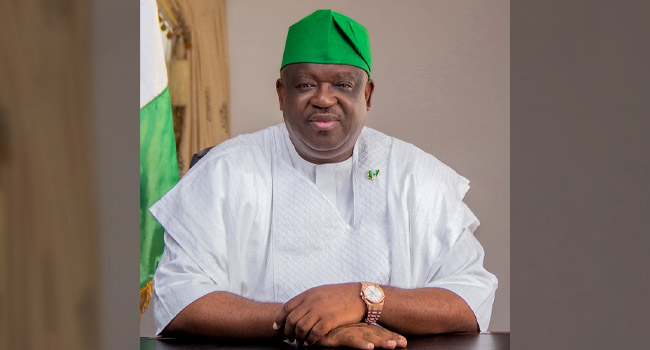
The Nigerian Institute of Public Relations (NIPR) has officially conferred Governor Caleb Manasseh Mutfwang of Plateau State with the title of Patron, recognizing his exemplary leadership and commitment to the state’s development.
The investiture ceremony, which took place at the Twin Theater, New Government House, Rayfield, was conducted by the NIPR President and Chairman of the Governing Council, Dr. Ike Neliaku, FNIPR.
He described Mutfwang as a “chief image-maker” of modern Plateau, carefully chosen for this strategic role due to his impactful leadership and commitment to rapid development across the state.
Neliaku commended the Governor for his inclusive leadership and dedication to restoring public confidence in governance.
He emphasized that Mutfwang’s governance style has renewed the confidence of international organizations in Plateau State, attracting investment and fostering development.
“Not everybody is made a Patron of the NIPR. Public Relations thrive on reputation and perception, and we are deliberate about those we associate with. After assessing your administration’s impact, we confidently confer this patron ship upon you,” Neliaku added.
Responding, Mutfwang expressed gratitude to the Institute for the recognition, stating that he receives the honor on behalf of the people of Plateau State.
“I sincerely appreciate this recognition, which I accept on behalf of the people of Plateau. They entrusted us with the responsibility to serve, and as you have rightly observed, we are striving to justify their trust.”
He reaffirmed his administration’s commitment to maintaining high standards of governance and continuously improving the well-being of Plateau citizens.
“We have set ambitious goals for ourselves, and while we appreciate the progress made, we are not complacent. Our administration remains dedicated to delivering the highest good for the greatest number of people. This recognition serves as a clarion call to do even more,” he stated.
Mutfwang also emphasized the importance of effective communication in governance, assuring Plateau citizens of his commitment to fostering hope and ensuring that the future is brighter than the present.
“We are committed to engaging with our people, listening to them, and ensuring that our governance instills hope, that tomorrow can be better than today. That is the essence of our leadership philosophy.”
The Plateau State Commissioner for Information and Communication, Musa Ibrahim Ashoms, welcomed the NIPR President, Governing Council members from across the 17 states, and all attendees to the investiture ceremony.
He highlighted the transformative agenda of Mutfwang’s administration, noting that Plateau is at the forefront of public awareness, trust-building, and people-centered governance.
He assured the Institute that Plateau remains committed to fostering transparency and accountability, ensuring that government policies and programs align with the needs and aspirations of the people.

The Federal Government has directed regulators to maintain the existing regulatory regime for internet platforms, online intermediaries and other cross-cutting digital economy issues while it develops a harmonised national policy to eliminate regulatory overlap across Nigeria’s technology ecosystem.
The directive signals a major policy shift towards a coordinated digital regulatory framework as the convergence of telecommunications, artificial intelligence (AI), online platforms, data governance and online safety increasingly blurs the traditional boundaries between sector regulators.
Issued by the Federal Ministry of Communications, Innovation and Digital Economy, the directive follows a high-level meeting chaired by Bosun Tijani, Minister of Communications, Innovation and Digital Economy, with the leadership of the Nigerian Communications Commission (NCC), the National Information Technology Development Agency (NITDA) and the Nigeria Data Protection Commission (NDPC).
Bosun Tijani, Minister of Communications, Innovation and Digital Economy. Image credit: Ministry of Communications, Innovation and Digital Economy.
Government freezes new cross-cutting digital regulations
Under the directive, regulators have been instructed to suspend the implementation or enforcement of new regulatory instruments relating to internet platforms, online intermediaries and other cross-cutting digital economy issues while the policy harmonisation exercise is completed.
“The existing regulatory status quo shall be maintained with respect to matters relating to internet platforms, online intermediaries and other cross-cutting digital economy issues currently undergoing inter-agency policy harmonisation under the Ministry’s coordination,” the minister directed.
The ministry explained that while each regulator operates under clearly defined statutory mandates, rapid technological convergence has created overlapping areas of responsibility that require a coordinated whole-of-government approach.
The increasing intersection of telecommunications, digital platforms, AI, online safety and data governance demands regulatory coherence to avoid duplication, conflicting obligations and unnecessary compliance burdens, according to the ministry.
“Regulatory coordination is not only essential to preserving legal certainty but is also fundamental to promoting investment, innovation, consumer confidence and Nigeria’s long-term competitiveness as Africa’s leading digital economy,” he said.
Harmonisation aims to boost investment and innovation
Tijani said regulatory coordination is essential to providing legal certainty for businesses operating in Nigeria’s digital economy.
“Regulatory coordination is not only essential to preserving legal certainty but is also fundamental to promoting investment, innovation, consumer confidence and Nigeria’s long-term competitiveness as Africa’s leading digital economy,” he said.
The ministry clarified that the directive applies only to new regulatory instruments affecting cross-cutting digital economy issues that are currently undergoing harmonisation.
It stressed that regulations falling squarely within the statutory mandates of individual agencies remain fully operational.
“The above direction is without prejudice to the statutory responsibilities of the respective institutions. Accordingly, all other provisions of existing regulations, guidelines, codes and directives that fall squarely within the express mandates of the relevant agencies under extant laws shall remain fully operational and enforceable, provided they are consistent with the policy direction issued,” the ministry said.
Joint committee to develop unified digital policy
As part of the coordination effort, the ministry announced the establishment of a Joint Technical Coordination Committee comprising representatives of the NCC, NITDA and NDPC under the supervision of the Office of the Minister.
The committee will coordinate technical engagements, consult industry stakeholders, civil society organisations and academia, and develop recommendations for a harmonised national policy and governance framework.
According to the ministry, the objective is to improve regulatory coherence rather than reduce the statutory powers of any agency.
“The objective of the harmonisation exercise is not to diminish the statutory mandates of any institution but to ensure that the Government speaks with one coherent voice on cross-cutting digital economy issues through a coordinated, predictable and future-ready regulatory framework,” the ministry said.
The proposed framework is expected to clarify institutional responsibilities, eliminate unnecessary regulatory overlap, reduce compliance uncertainty, strengthen investor confidence and support Nigeria’s ambition to become Africa’s leading digital economy.
Responding to an increasingly complex digital landscape
Nigeria’s digital regulatory environment has become progressively more complex as the mandates of the NCC, NITDA and NDPC have expanded alongside rapid growth in digital services, AI applications and online platforms.
NITDA currently oversees aspects of internet platform regulation through its 2022 Code of Practice for Interactive Computer Service Platforms and Internet Intermediaries, while also implementing broader information technology policies under the NITDA Act.
The NDPC regulates compliance with the Nigeria Data Protection Act, while the NCC oversees telecommunications and communications services, creating areas where regulatory responsibilities increasingly intersect.
Part of broader digital governance reforms
The latest directive builds on the ministry’s wider strategy of strengthening coordination across Nigeria’s digital governance ecosystem.
In April 2026, the ministry announced plans to establish a National Cybersecurity Coordination Council to improve collaboration among government agencies, regulators, the private sector and other stakeholders in responding to emerging cyber threats.
Rather than creating another regulator, the government said that the proposed council is designed as a multi-stakeholder coordination platform to strengthen information sharing, align cybersecurity policies and improve national incident response.
As part of that initiative, Tijani directed the NCC, NITDA, NDPC and Galaxy Backbone to establish a technical coordination secretariat under NITDA to support stakeholder consultations and develop the council’s operational framework.
Together, the regulatory harmonisation initiative and the proposed cybersecurity coordination council reflect the Federal Government’s broader effort to create a more coherent, predictable and innovation-friendly governance framework for Nigeria’s rapidly expanding digital economy.
Stay ahead with real-time reports, breaking news, and exclusive insights delivered directly to your phone. Don’t settle for outdated information. Join TECHNOLOGYTIMES NEWS on WhatsApp for 24/7 updates.
The President of the Nigeria Armwrestling Federation, Engr. Samuel Jackson, has expressed deep disappointment over the elimination of Africa’s leading representatives at the ongoing FIFA World Cup, describing the exits of Egypt, Senegal, South Africa, Ghana, DR Congo, Ivory Coast, Algeria and Cape Verde as heartbreaking despite their outstanding performances.
Jackson said the tournament has proved beyond doubt that African football has reached a new level, with the continent producing some of the most exciting performances of the competition.
His biggest praise went to Egypt, who came within minutes of eliminating defending champions Argentina before suffering a dramatic 3-2 defeat after leading 2-0 late in the game. He described the result as cruel, insisting the Pharaohs deserved more for their courage and quality.
“My heart goes out to Egypt. They showed the world that African football has matured. To push the world champions to the edge of elimination is no small achievement. They may be out, but they have won the admiration of millions.”
He also commended South Africa, whose return to the World Cup after years away ended with a narrow defeat to Canada, describing Bafana Bafana’s campaign as one that has restored belief in Southern African football.
Jackson reserved special praise for Senegal, saying the Teranga Lions once again demonstrated why they remain one of Africa’s football giants despite their narrow knockout defeat to Belgium.
He equally applauded Cape Verde, making its World Cup debut, for taking Argentina into extra time before bowing out in one of the tournament’s most thrilling encounters, while Ghana, Ivory Coast, DR Congo and Algeria were praised for reaching the knockout rounds and competing fearlessly against some of the world’s biggest football nations.
“Africa may not have reached the quarter-finals in the numbers we hoped for, but this World Cup belongs to Africa as much as anyone. Our teams have changed the narrative. The world now respects African football because our players competed with courage, discipline and confidence.”
Jackson added that the performances should encourage African governments, corporate organisations and sports administrators to invest more in grassroots sports, noting that with sustained support, African nations can soon produce a FIFA World Cup champion.
“Africa’s future is bright. Today’s disappointment will become tomorrow’s triumph if we continue to invest in our athletes and believe in their potential.”