News
Governor Mutfwang Reaffirms Commitment to Security, Transparency, and Inclusive Growth at Media Stakeholders’ Forum

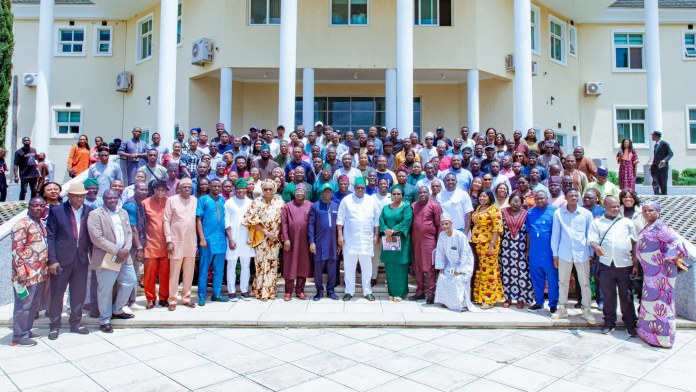
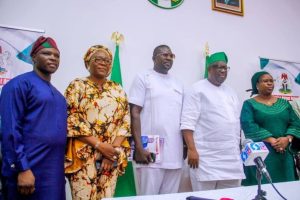
Plateau State Governor, Barr. Caleb Manasseh Mutfwang, has reaffirmed his administration’s dedication to security, inclusive development, and transparent governance during an interactive media engagement held Thursday at the Twin Theatre of the New Government House, Rayfield, Jos.
The high-level session brought together stakeholders from the Nigeria Union of Journalists (NUJ), Plateau Bloggers and Online Media Association, Plateau Publishers Association, civil society actors, and social media influencers. It provided a platform for the Governor to give a comprehensive update on his administration’s achievements since assuming office on May 29, 2023, while responding to questions and concerns raised by the press.
Tackling Insecurity Head-On
Governor Mutfwang opened the session by addressing the security situation across Plateau, especially in conflict-prone areas like Wase. He highlighted that upon assuming office, his government prioritized restructuring the state’s security architecture, including revitalizing the Operation Rainbow security outfit.
“Plateau is safer than many other North Central states today,” the Governor asserted. “We have no local government under the full control of bandits. Opportunistic attacks may still occur, but we are proactively averting worse outcomes.”
He assured continued collaboration with security agencies and maintained that there are currently no permanent bandit camps in any part of the state.
Economic Stability and Strategic Interventions
On the economic front, Governor Mutfwang acknowledged the hardship induced by the removal of fuel subsidy but pointed to measures his administration has taken to cushion the impact—most notably the Metro Bus Scheme, which offers subsidized transportation across Jos.
“Rather than distribute short-term palliatives, we chose a sustainable solution. Our Metro Bus Scheme saves commuters between ₦40,000 to ₦50,000 monthly,” he explained.
The Governor also highlighted renewed intermodal transport access with the resumption of train services and weekly flights between Jos, Abuja, and Lagos. Plans are in motion to upgrade Yakubu Gowon Airport into a cargo hub in partnership with the Federal Airports Authority of Nigeria (FAAN).
Health, Infrastructure, and Agricultural Gains
Governor Mutfwang reported significant progress in healthcare delivery, including the establishment of a diagnostic lab at Plateau Specialist Hospital and strengthened health insurance services under PLASCHEMA. The Drugs and Medical Commodities Agency, he noted, is now more effective in tackling the spread of counterfeit medicines.
In infrastructure, the Governor stated that while the majority of projects were inherited, his administration is ensuring they serve all citizens without bias.
“Our roads serve Christian, Muslim, and mixed communities alike. This is inclusive governance in practice,” he emphasized.
He added that lands and grazing reserves in Wase previously occupied by bandits have now been reclaimed, opening up opportunities for agricultural investment and food security.

Media Relations and Institutional Reforms
Governor Mutfwang stressed that transparency and responsible leadership remain the cornerstones of his administration. He emphasized that salary payments and civil service reforms are being treated as a duty—not achievements—and promised to continue fostering institutional development.
He also praised the media’s role in strengthening democracy, expressing a readiness to collaborate in reshaping the narrative of Plateau State. He cited improvements in tertiary education, with Plateau State Polytechnic and Plateau State University seeing increased enrollment and accreditation achievements.
NUJ Commends Governor, Calls for Media Revamp
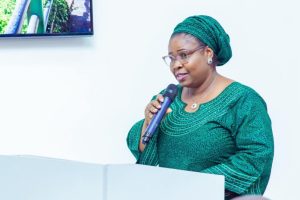
In her remarks, NUJ Plateau State Chairman, Mrs. Ayuku Pwaspo, commended the Governor’s approach to inclusive governance, particularly in the face of violent attacks across local government areas.
“Banditry and terrorism have poisoned community relations and subverted governance. Yet, your leadership has shown empathy and resilience,” she noted.
Mrs. Pwaspo called for increased support to families affected by violence and rebuilding of ravaged communities. She also appealed for urgent attention to Plateau’s state-owned media organizations, lamenting that the Plateau Radio Television Corporation (PRTVC) last employed staff in 2011, and the Plateau Publishing Corporation (PPC) over two decades ago.
“We seek urgent infrastructural and staffing interventions. The media is ready to partner with your government to rewrite Plateau’s story,” she said.
Looking Ahead
Governor Mutfwang closed the session on a hopeful note, thanking citizens and media professionals for their ongoing partnership.
“We are not yet where we want to be, but we are firmly on course,” he said. “Plateau is rising—towards a peaceful, productive, and competitive future.”
The interactive engagement reaffirmed the growing synergy between the Plateau State Government and media stakeholders in promoting accountability, development, and lasting peace across the state.




President Bola Tinubu says Nigeria has significantly reduced its reliance on oil revenue as his administration pushes to diversify the economy and attract more investment into other sectors.
He said the government would continue to develop the petroleum industry but use its resources to support broader economic activity rather than depend on crude oil as the main driver of growth.
The President, represented by Vice President Kashim Shettima, spoke on Tuesday in Abuja at the fifth anniversary of the Nigerian Upstream Petroleum Regulatory Commission (NUPRC).
“We have already reduced our dependence on oil revenue, and we intend to go further,” President Tinubu said.
He said the government’s diversification strategy was focused on agriculture, manufacturing, digital and creative industries, while the oil and gas sector would continue to provide energy, foreign exchange and revenue for the country.
The claim comes as the administration continues to pursue reforms aimed at increasing oil production, improving revenue remittances and attracting fresh investment into the petroleum sector.


In February, President Tinubu issued an executive order directing oil and gas revenues due to the Federation to be paid directly into the Federation Account.
The order also ended certain deductions previously retained by NNPC Limited, including a 30 per cent management fee on profit oil and profit gas.
Oil remains important to Nigeria’s finances
Despite the government’s push to reduce dependence on oil, petroleum remains an important source of public revenue and foreign exchange.
The sector has, however, faced challenges including fluctuations in crude production and oil prices, as well as security and operational problems.
PREMIUM TIMES reported in March that oil and gas revenue remittances had fallen significantly below projections in the first two months of 2026. While N937.10 billion was budgeted as oil and gas revenue for the period, actual remittances stood at N137.41 billion.
President Tinubu said improved security and cooperation among oil producers, host communities, security agencies and the NUPRC had helped stabilise production.
He said the government’s efforts had also helped attract investors who previously left Nigeria, adding that the country had ranked first among Africa’s leading destinations for upstream investment for two consecutive years.
Push for more oil and gas investment
The Minister of State for Petroleum Resources, Oil, Heineken Lokpobiri, said Nigeria currently produces about 1.7 million barrels of crude oil per day and has more than 37 billion barrels of oil reserves.
Mr Lokpobiri said more investment, additional licensing rounds and increased exploration were needed to unlock the country’s petroleum resources.
The NUPRC has also reported increased investment activity in the upstream sector.
In August, the regulator said it had approved more than $57 billion in Field Development Plans since 2024, with 22 major offshore projects expected to come on stream between 2026 and 2030. The projects are estimated to attract between $30 billion and $50 billion in investment.
Nigeria’s oil and condensate reserves stood at 37.01 billion barrels as of January 2026, while gas reserves increased to 215.19 trillion cubic feet, according to NUPRC data.
Tinubu declares decade of gas
President Tinubu said gas would be central to the government’s energy strategy, describing the period ahead as a decade of gas.
“With the largest gas reserves in Africa, we will expand gas supply for power, industry and clean cooking, reduce flaring and methane emissions, and grow renewable energy alongside it,” he said.
READ ALSO: PBAT Door-to-Door Movement mourns officers in crash, suspends campaign activities
He added that the government would pursue an energy transition suited to Nigeria’s circumstances, arguing that the country should meet its climate commitments without compromising energy access and economic development.
He also noted that a stronger upstream industry could create jobs for Nigerian engineers, fabricators and oilfield service companies.
President Tinubu said the Petroleum Industry Act had provided a foundation for reforms in the sector but noted that legislation alone could not guarantee investment.
According to him, investors had raised concerns about high costs, lengthy contracting processes and uncertainty around fiscal terms for complex projects.
He urged the NUPRC to maintain clear regulatory processes, provide reliable timelines and work with other government agencies to reduce overlapping requirements.
The President also said operators benefiting from government incentives must meet their obligations on work programmes, local content, environmental protection and host communities.
He urged the commission to remain independent and accountable in its regulatory decisions.
Discover more from Premium Times Nigeria
Subscribe to get the latest posts sent to your email.
The next discount, giveaway or “limited-time offer” Nigerians see online could be subject to a revised regulatory framework as the Federal Competition and Consumer Protection Commission (FCCPC) moves to update Nigeria’s rules for sales promotions.
The Commission has opened a public consultation on its Draft Sales Promotion Amended Regulations, 2026, proposing changes to the framework governing promotional sales more than two decades after the existing regulations were introduced.
The review comes as the way Nigerians shop has shifted significantly from the physical marketplace to websites, online stores, social media platforms and digital marketplaces, where businesses can launch promotions and reach consumers across the country almost instantly.
For shoppers, the proposed changes could affect the regulatory framework surrounding discounts, giveaways and other promotional campaigns. For businesses, particularly online retailers and technology companies, the review could introduce new compliance considerations for how promotional offers are notified and conducted.

The review comes as the way Nigerians shop has shifted significantly from the physical marketplace to websites, online stores, social media platforms and digital marketplaces, where businesses can launch promotions and reach consumers across the country almost instantly. For shoppers, the proposed changes could affect the regulatory framework surrounding discounts, giveaways and other promotional campaigns. For businesses, particularly online retailers and technology companies, the review could introduce new compliance considerations for how promotional offers are notified and conducted.
The FCCPC published the draft regulations on September 30 and has invited businesses, consumer groups and members of the public to submit comments and recommendations by October 20, 2026.
The Commission said the proposed regulations are intended to amend the Consumer Protection Sales Promotions Regulations, 2005 and include changes to applicable fees for sales promotion notifications.
The proposed rules are not yet in force.
The FCCPC said the draft was prepared pursuant to sections 17, 18 and 163 of the Federal Competition and Consumer Protection Act 2018, with the amendment aimed at protecting consumers and promoting fair conduct in promotional sales activities.
From physical shops to digital promotions
The review comes against a significantly different retail environment from the one that existed when the current sales promotion regulations were introduced in 2005.
Internet access, smartphones, online payments, e-commerce platforms, social commerce and digital advertising have changed how businesses market products and how consumers discover and purchase them.
A retailer can now launch a discount through its website or social media account and potentially reach customers across multiple Nigerian cities without operating physical outlets in each location. Promotional campaigns can also move rapidly between websites, social media platforms, messaging services and online marketplaces.
Smartphone and electronics sellers, online retailers and other technology businesses routinely use discounts, giveaways, special offers and limited-time campaigns to attract customers.
The proposed FCCPC review could therefore become relevant to businesses that use these channels for promotional activity if the amended regulations are eventually adopted.
One of the changes identified by the Commission concerns applicable fees for sales promotion notifications. The FCCPC’s public notice does not set out the fee changes in detail, with the draft regulations instead being made available for stakeholders to examine as part of the consultation process.
The notification framework is significant because promotional campaigns can reach large numbers of consumers across multiple channels. In a digital environment, an offer can be published, shared and acted upon rapidly, increasing the importance of clear information about its terms and conditions.
What the review could mean for consumers
For consumers, the proposed regulatory review concerns the framework under which promotional offers are conducted rather than introducing new rules immediately.
Discounts, prize promotions and limited-time offers can influence purchasing decisions, particularly when consumers are required to act within a specified period. A regulatory framework governing such promotions is therefore relevant to how businesses communicate offers and how consumers understand what they are being offered.
The FCCPC said its consultation is intended to allow stakeholders and members of the public to provide comments, recommendations and other inputs before the regulations are finalised.
This gives businesses conducting promotions, consumer organisations and individual members of the public an opportunity to examine the proposed framework and raise issues or seek clarification before the final regulations are adopted.
2005 rules meet Nigeria’s digital marketplace
The proposed review represents an update to a regulatory framework that dates back to 2005, before the widespread adoption of many of the digital tools now used for commerce in Nigeria.
The growth of online shopping has made promotional activity easier to scale. A business can advertise a promotion to customers in different parts of the country through digital channels, while consumers can discover offers without visiting a physical store.
The same digital environment also means promotional claims and offer conditions can reach a much larger audience in a short period.
For technology companies and online businesses, the consultation therefore provides an opportunity to examine how the proposed framework could apply to promotional campaigns conducted through digital channels and to identify provisions that may require clarification before the regulations are finalised.
The review does not mean that businesses are currently operating under a new sales promotion regime. The FCCPC has not announced that the draft regulations have taken effect, and any changes will depend on the final version adopted following the consultation process.
October 20 deadline
Stakeholders and members of the public have until October 20, 2026, to submit comments, recommendations and other inputs on the draft regulations. The FCCPC said submissions may be made by hard copy or by email at [email protected].
The consultation puts Nigeria’s sales promotion framework under review more than 20 years after the existing regulations were introduced. As commerce continues to move between physical and digital channels, the outcome will determine how the regulatory framework evolves alongside the changing ways Nigerian businesses sell products and consumers shop for them.
-

 News4 days ago
Troops rescue 15 kidnap victims, nab two suspects in nationwide operations
-
 Business3 days ago
Nigeria’s business activity expands as household confidence weakens
-
News2 days ago
Nigerians warned as AI creates new sextortion threat – Technology Times
-
News2 days ago
2027: El-Rufai’s detention could hurt APC, generate sympathy – SEDSAC director, other analysts express views