Connect with us

News

Bauchi APC governorship candidate sacks campaign coordinators in 20 LGAs

info

Published

on

1 2026 07 10T125057.002.jpg

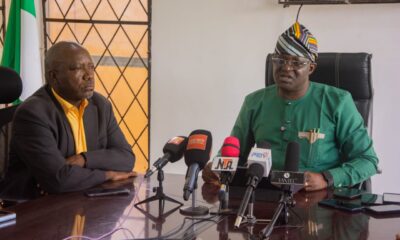
The All Progressives Congress’ governorship candidate for the 2027 election, Mohammed Abubakar (SAN), has dissolved his campaign structure at the local government level, affecting coordinators across the state’s 20 LGAs.
The development was announced in a statement released on Thursday by the M.A. Strategy Committee and signed by its Head of Media, Umar Ibrahim Sade, a former Commissioner for Information.

Although the committee did not state the reason for the decision, it directed all affected coordinators to immediately stop operating in their respective local government areas pending further directives.

The statement also instructed them to hand over all campaign materials, documents and other items in their custody to the committee’s secretariat on or before July 16, 2026.

The committee commended the coordinators, ward mobilisers and volunteers for their contributions to the political movement, describing their efforts across the 323 wards of Bauchi State as invaluable.

It assured supporters that a fresh phase of political engagements would be unveiled soon, saying details of the next line of action would be communicated at the appropriate time.

The committee further appealed to party members and supporters to remain calm, united and committed to Abubakar’s governorship aspiration.

DAILY POST recalls that the State chapter of the All Progressives Congress (APC) is facing internal crisis after its 2027 primaries, with aggrieved members alleging that candidates were imposed rather than elected through direct primaries.

Some political groups have also accused the Coordinating Minister for Health, Prof. Muhammad Ali Pate and former Governor Isa Yuguda of backing the emergence of former Governor, Mohammed Abubakar as the party’s governorship candidate.

Former Governor, Mohammed Abdullahi Abubakar lost his re-election bid in 2019 to the incumbent Governor, Bala Mohammed.

Continue Reading
Click to comment

Leave a Reply

Your email address will not be published. Required fields are marked *

Health

Fidson dominates Nigeria’s Pharma sector first-quarter 2026

info

Published

on

By

Untitled design 17.png

MTN ADVERT

As one of Africa’s largest pharmaceutical markets — trailing only South Africa by value, and among the continent’s largest by population and consumption volume — Nigeria nonetheless leans heavily on imports to bridge a wide domestic supply gap, with roughly 70 per cent of medicines still sourced from overseas to meet its healthcare needs.

However, some local drug manufacturing companies, such as Fidson, May & Baker, and Mecure Industries, continue to overcome local manufacturing challenges to ensure local drug production and even export some of the locally produced drugs.

Yet, even the local drug manufacturing market is at the mercy of importation as it sources more than 90 per cent of its active pharmaceutical ingredients and excipients overseas.

Population growth, the pressure of urbanisation and increasing healthcare awareness are stoking demand for medicines in Nigeria, notably over-the-counter drugs which are seen taking up 69.4 per cent of total market share this year.

From $2 billion to $3.3 billion, estimates diverge as to the size of the Nigerian pharma market, with compound annual growth rate (CAGR) put at 6.5 per cent from 2025 to 2029.

PT WHATSAPP CHANNEL

Fidson’s dominance

On the exit of British multinational biopharma firm GlaxoSmithKline from Nigeria in 2023, the active pharmaceutical companies listed on the Nigerian Exchange are now four, namely Fidson Healthcare, May & Baker, Mecure Industries and Neimeth. That is only a fragment, considering that over 120 functional drugmakers altogether operate in Nigeria.

Fidson, which has a contract manufacturing relationship with Haleon, a British multinational consumer health giant and producer of brands such as Sensodyne, Panadol, Advil and Centrum, has led the publicly quoted pharma market for quite a while.

It holds the biggest slice of that market, alone accounting for well above half of the market share in the quarter to March 2026, when revenue soared to N42.6 billion year on year from N35 billion.

Mecure Industries, May & Baker (where Theophilus Danjuma, a former chief of army staff and minister of defence, is the biggest shareholder) and Neimeth came in tow, recording N20.2 billion, N8.4 billion and N1.8 billion in that order.

Little as it looks, exports by Fidson, at N1.8 billion, constituted only 4.3 per cent of revenue, but was a vast progress over the N146.5 million earned in the same period of the previous year.

Fidson’s topline performance in the period, as in recent years, built on a domestic prescription drug market boom, which Statista forecasted to touch $2.9 billion in sales in 2025 and thereafter advance at an annual growth rate of 3.6 per cent through 2029.

Ethical drugs, which have secured a place for themselves as the lifeblood of revenue, alone contributed 56.3 per cent of turnover.

For the financial year 2025, annual revenue climbed to an all-time peak of N119.1 billion from N84.1 billion, 53.3 per cent higher than that of Mecure, its closest rival.

Revenue of Nigeria's listened Pharma Companies

Investment management firm Cardinal Stone has estimated that revenue for Fidson recorded a CAGR of around 28.5 per cent from FY 2021 to FY2024.

Beyond the favourable market dynamics, sales growth has reaped gains in no small measure from the forward-looking sectoral reforms of a government that is dreaming of ramping up the local share of national drug production to 70 per cent by 2030.

Nigeria’s pharma industry watchdog, the National Agency for Food and Drug Administration and Control, issued a provisional approval in April for R21 Malaria Vaccine to be marketed in Nigeria.

The push cleared the hurdle for a deal between Fidson and Serum Institute of India Pvt Limited, the maker of the vaccine, targeting prevention of clinical malaria in children aged 5 to 36 months and reduction of malaria-related mortality in tropical Africa.

In September 2024, the company reached a joint venture pact with Chinese companies Jiangsu Aidea Pharma, Nanjing PharmaBlock, and the Beijing-based China-Africa Development Fund to set up a facility for the manufacturing of HIV drugs in the Lekki Free Trade Zone in Lagos, aiming for West African pharmaceutical markets.

The management took its international partnership further last September when it had an agreement with Ohara Pharmaceutical Co. Limited.

The move would enable the Tokyo-based company to support Fidson’s capital raise and offer advisory support “based on insights from the Japanese pharmaceutical industry that will expand the capabilities of Fidson to produce more specialised medicines for the management of diverse disease conditions.”

Profit After Tax

Profit after tax in billions of naira

Fidson’s post-tax profit went up by 39.4 per cent to N4.6 billion in Q1 2026, compared to a year ago, helped by a stronger sales expansion and, in part, by cost management. Mecure and May & Baker jointly came second, each reporting N1.3 billion, while Neimeth posted N113.4 million.

After-tax profit for 2025 grew to N9.9 billion from N4.4 billion. The company was followed by Mecure (N6.5 billion), May & Baker (N4.4 billion) and Neimeth (N976.4 million).

“Notably, during the period, the company commenced the export of its products, earning an additional N523.1 million in revenue,” Cardinal Stone stated in a research note in January on the 2025 rreport.

The Financial Times, in its African Fastest Growing Companies’ list for 2024, ranked Fidson 65th at a CAGR of 42.1 per cent. The company took the 67th position the following year with a CAGR of 42.6 per cent.

EBIT Margin

EBIT margin of Nigeria's listed Pharma companies

EBIT margin, which shows the operational profitability of a company by measuring its core profit in proportion to revenue, stood at 19.4 per cent for Fidson in the first quarter of the year, slightly up from Q1 2025 level of 18.9 per cent.

Neimeth led in this performance parameter, scoring 32.4 per cent, followed by Mecure (22.5 per cent) and May & Baker (21.3 per cent).

Fidson reported 18.4 per cent in EBIT margin for 2025, significantly higher than 5.2 per cent in 2024.

NET PROFIT MARGIN

Net profit margin of Nigeria's listed pharma companies

Fidson’s net profit margin stood above all its peers’ but May & Baker’s (15.2 per cent) in the first quarter of 2026 as it jumped to 10.7 per cent from 9.3 per cent a year ago. Mecure reported a net profit margin of 6.7 per cent in the period, while Neimeth recorded 6.5 per cent.

For FY2025, the company posted a net profit margin of 8.3 per cent, up from 5.2 per cent in the corresponding period of the preceding year.

TOTAL ASSETS

Total asserts of Nigeria's listed pharma companies

The company is regarded as Nigeria’s biggest drugmaker on the strength of its asset base, which topped N93.7 billion in the period under review, increasing by 16.7 per cent year on year.

That was spurred largely by a more than twofold surge in trade & other receivables and, in part, by property, plant and equipment, following increased construction work in progress.

Total assets stood at N80.3 billion as of FY2025 and at N73.5 billion at FY2024.

Last December, Fidson launched a N21 billion rights issue, which was oversubscribed by 117 per cent, to raise capital to beef up production capacity, accelerate its pan-African expansion and deleverage its balance sheet.

Mecure Industries’ total assets for the period rose 36.4 per cent to N81.3 billion, May & Baker’s climbed by 1.5 per cent to N26.8 billion, while Neimeth’s jumped by 13.7 per cent to N14.1 billion.

READ ALSO: Drug maker Fidson posts 28% jump in half-year profit

RETURN ON AVERAGE EQUITY (ROAE)

ROAE of Nigeria's listed Pharma companies

Fidson’s ROAE dropped to 7 per cent from 12.8 per cent as its shareholder fund sharply expanded at a rate disproportionate to its net profit during the period, diluting the indicator. As a financial metric, ROAE implies how effectively the shareholder fund of a company has been used in earning profit over a period of time.

For FY2025, ROAE stood at 37.6 per cent, up from 28.9 per cent the year before.

May & Baker recorded an ROAE of 8.9 per cent within the period, down from 10.9 per cent in the first quarter of 2025. Mecure reported 6.5 per cent, up from 4.5 per cent, while Neimeth recorded 4.2 per cent, compared with 6.8 per cent a year earlier.

RETURN ON AVERAGE ASSETS (ROAA)

ROAA of Nigeria's listed Pharma companies

Fidson topped others in terms of ROAA, an indicator of how well a company puts its assets to use in generating profit, scoring 5.2 per cent in Q1 2026, relative to 4.2 per cent a year ago.

It recorded 12.9 per cent for FY2025 and 8.5 per cent for FY2024.

May & Baker came next at 4.9 per cent ROAA in Q1 2026, up from 4.5 per cent, while Mecure fell to 1.6 per cent from 4.1 per cent. Neimeth dropped to 0.8 per cent from 0.9 per cent.

Editor’s Note: This is a Native Advertising story.


Discover more from Premium Times Nigeria

Subscribe to get the latest posts sent to your email.

Continue Reading

News

2027: ‘You’re biased’ – PDP accuses INEC of helping APC weaken opposition

info

Published

on

By

PDP and INEC.jpg

The Peoples Democratic Party, PDP, has accused the Independent National Electoral Commission, INEC, of acting with institutional bias against the party, alleging that the electoral body is contributing to efforts aimed at weakening the opposition ahead of the 2027 general elections.

The allegation was contained in a statement issued on Saturday by the National Publicity Secretary of the party’s Interim National Working Committee, Ini Ememobong, and posted on the official social media page of the PDP.

The party said its allegation followed INEC’s refusal to recognise its Interim National Working Committee despite being formally notified after the Supreme Court’s judgment on the leadership crisis.

The PDP said it subsequently approached the Federal High Court in Abuja to compel the commission to recognise the interim leadership but expressed dissatisfaction with the court’s ruling, describing it as inconsistent with previous judgments of the Supreme Court and the Court of Appeal.

The party disclosed that it has appealed the judgment, insisting that the legal dispute was aimed at protecting the integrity of the PDP from what it described as attempts to reduce Nigeria’s leading opposition party into “an appendage of the ruling party.”

“We approached the court to preserve the integrity of the Peoples Democratic Party from those who seek to reduce Nigeria’s foremost opposition party into an appendage of the ruling party,” the statement said.

The PDP further alleged that INEC’s conduct throughout the legal proceedings had reinforced public concerns about the commission’s neutrality.

“The Commission’s actions have regrettably reinforced the growing public perception that it is no longer acting with the impartiality expected of the nation’s electoral umpire,” the party stated.

It accused INEC of withholding material facts in court proceedings involving the PDP and ignoring congresses conducted under the commission’s supervision whenever such facts contradicted its position before the courts.

“The Commission’s filings, its arguments before the courts, and its refusal to comply with court orders favourable to our Party have collectively created an impression of institutional bias that should concern every Nigerian, irrespective of political affiliation,” the statement added.

The opposition party also claimed that the refusal to recognise its interim leadership forms part of a broader effort to weaken opposition parties and pave the way for what it described as a one-party state in Nigeria.

According to the PDP, it remains confident that the Court of Appeal will clarify the legal issues surrounding the leadership dispute and reaffirm the authority of earlier judgments delivered by higher courts.

Continue Reading

Trending