Connect with us

News

US Embassy in Abuja Cancels Visa Appointments Over Rising Insecurity

info

Published

on

Images 2026 04 10T045406.135.jpeg

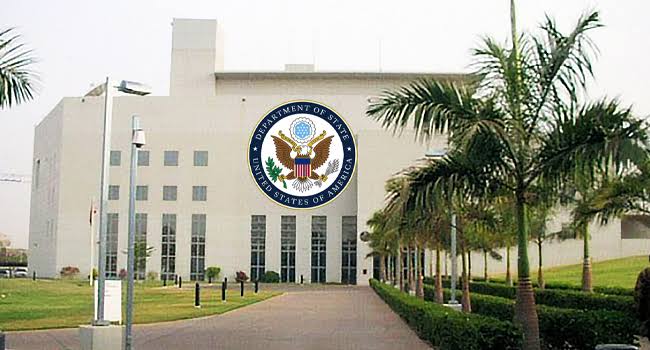
The United States Embassy Abuja has cancelled all visa appointments in the nation’s capital following growing security concerns across parts of the country.

The development has affected hundreds of applicants, with the mission asking them to await further instructions on new dates.

The announcement was made on Thursday through the official X handle of the U.S. mission in Nigeria.

In a short notice, the embassy confirmed that all scheduled visa interviews in Abuja have been suspended for now.

Applicants were told to monitor their emails for updates regarding rescheduling.

The statement reads: “U.S. Embassy Abuja is closed for visa appointments. Applicants should check their email for details on rescheduled appointments.

“Visa operations at U.S. Consulate General Lagos continue. American citizen services are available in emergencies and by appointment.”

While the embassy did not go into full details in its public notice, the decision comes shortly after the United States Department of State authorized the departure of non-essential staff and family members from its Abuja mission. The move followed what officials described as a worsening security situation in parts of Nigeria.

An updated travel advisory released by the Department has also raised fresh concerns among both Nigerians and foreign nationals. The advisory urged American citizens to reconsider travelling to Nigeria due to persistent threats, including crime, terrorism, kidnapping, and civil unrest.

Nigeria remains under a “Level 3: Reconsider Travel” classification, according to the U.S. government. However, several states have been placed under a stricter “Level 4: Do Not Travel” warning.

Among the states listed are Borno, Jigawa, Kogi, Kwara, Niger, Plateau, Taraba, Yobe, and parts of Adamawa, where terrorism and kidnapping risks are said to be high. Other states such as Bauchi, Gombe, Kaduna, Kano, Katsina, Sokoto, and Zamfara were also flagged over security concerns linked to unrest and criminal activities.

The advisory has triggered mixed reactions within Nigeria. The Federal Government of Nigeria has pushed back against the assessment, describing it as “unbalanced.” Authorities insisted that the report does not fully reflect ongoing efforts to address insecurity across the country.

Officials also called on international partners to ensure that travel advisories are based on accurate and updated information, warning that such reports could negatively affect Nigeria’s image and economic activities.

Despite the situation in Abuja, visa processing and other consular services continue at the U.S. Consulate in Lagos, which has not been affected by the latest directive.

The development is expected to cause delays for many Nigerians seeking travel to the United States, especially those with urgent appointments or time-sensitive applications.

Continue Reading
Click to comment

Leave a Reply

Your email address will not be published. Required fields are marked *

News

NPFL: Kun Khalifat FC won’t give up on survival battle – Uzoho

info

Published

on

By

1776703008 Kun Khalifat FC 1.jpg

Kun Khalifat FC technical adviser, Obinna Uzoho has insisted that his team won’t give up on their relegation battle after the stalemate against Plateau United.

The Owerri-based club held Plateau United to a 1-1 draw in their away fixture in Lafia on Sunday.

Uzoho commended the display of Plateau United players in the game.

He expressed satisfaction with the outcome of the game.

“We played against a good side and we are going home with something,” Uzoho was quoted by Puyaka.

“We won’t give up in our fight to move up on our position on the league table. I don’t believe in home and away, we will come out and play our part.”

Continue Reading

News

Deezer says 44% of songs uploaded to its platform daily are AI-generated

info

Published

on

By

Copy of 2000x1000 EN 1240x600 1.jpg

Deezer announced on Monday that AI-generated tracks now represent 44% of all new music uploaded to its platform. The company said it’s receiving almost 75,000 AI-generated tracks per day and more than two million per month.

The consumption of AI-generated music on the platform is still very low, at 1-3% of total streams, and 85% of these streams are detected as fraudulent and demonetized by the company.

The latest figure from Deezer highlights a continuous surge in AI-generated music uploads to the platform. Deezer reported receiving around 60,000 AI tracks per day in January, up from 50,000 in November, 30,000 in September, and just 10,000 in January 2025, when it first launched its AI-music detection tool.

Songs tagged as AI-generated on Deezer are automatically removed from algorithmic recommendations and not included in editorial playlists. The company announced today that it will no longer store hi-res versions of AI tracks.

The updated figure comes as an AI-generated track topped the iTunes charts last week in the United States, United Kingdom, France, Canada, and New Zealand.

“AI-generated music is now far from a marginal phenomenon and as daily deliveries keep increasing, we hope the whole music ecosystem will join us in taking action to help safeguard artists’ rights and promote transparency for fans,” said Deezer CEO Alexis Lanternier in a press release. “Thanks to our technology and the proactive measures we put in place more than a year ago, we have shown that it’s possible to reduce AI-related fraud and payment dilution in streaming to a minimum.”

Today’s announcement comes as Deezer conducted a survey last November that found that 97% of participants couldn’t tell the difference between fully AI-generated music and human-made music.

Techcrunch event

San Francisco, CA
|
October 13-15, 2026

The survey also found that 52% of respondents said 100% AI-generated songs shouldn’t be included in charts alongside human-made songs in the main charts. Meanwhile, 80% said 100% AI-generated music should be clearly labeled for listeners.

Deezer first started tagging AI tracks at the platform level in June 2025, becoming the first streaming platform to do so. Over the course of 2025, Deezer tagged more than 13.4 million AI tracks on its platform.

In February, French streaming service Qobuz announced plans to tag AI-generated content on its platform. Other major streaming services, such as Spotify and Apple Music, take different approaches to AI-generated music, often combining the use of filters to identify low-quality AI music with other transparency efforts left up to the distributors.

Continue Reading

Trending