News
Tinubu directs states to reduce transportation costs with CNG


President Bola Tinubu has restated his government’s resolve to focus on efforts to implement the newly established National Affordable CNG Transit Programme, rather than return to fuel subsidy, which caused a strain on the economy.
Mr Tinubu, in a statement on Saturday, stated that the resolve was made after he met with the 36 state governors on August 27, when they agreed that from October 1, measurable reductions in transportation costs must be experienced across the country.
Mr Tinubu said, “On August 27, I met with the governors of our 36 states, and we agreed on a clear objective. From October 1, more Nigerians should begin to see measurable reductions in transportation costs.
“We subsequently established an implementation committee for the National Affordable CNG Transit Programme under the auspices of the Nigeria Governors’ Forum, chaired by Governor AbdulRahman AbdulRazaq.
“Over the last three years, my administration has deliberately invested in building a CNG transportation ecosystem across Nigeria. Today, more than 120,000 vehicles have been converted; we have over 400 certified conversion centres and more than 90 CNG refuelling stations across the country, and these figures are increasing daily.
“At a time like this, our answer cannot be to return to the ruinous petrol subsidy regime that consumed trillions of naira and left our economy exposed to every movement in international oil prices, as some have suggested. We must accelerate the cheaper alternatives we have been building at home.”
Mr Tinubu acknowledged the ongoing efforts by the committee, PI-CNG & EV, the states and other critical stakeholders to identify priority transport corridors, determine appropriate interventions and put the necessary arrangements in place, especially amid the current global energy crisis.
The president stated that Nigerians in Borno, Kaduna, Oyo, Adamawa, Enugu, Plateau, Niger, Delta, Kwara and Lagos states, as well as Abuja, were already experiencing evidence of possible cheaper transportation from cheaper energy sources.
He stated that as disruptions to global energy supplies were again putting pressure on petrol and diesel prices, as well as increasing transportation costs worldwide, Nigeria, although unable to control events in global energy markets, must, as a gas-rich nation, reduce its exposure to global energy challenges.
Mr Tinubu encouraged each state to maintain the momentum towards October 1 by working with transport unions and commercial operators, supporting conversion and fleet deployment, facilitating the infrastructure required, and ensuring that savings from cheaper energy reach Nigerians through lower fares.
He vowed that his government would keep supporting “the scaling of CNG infrastructure and access, expand conversion capacity, and create the enabling environment for states, transport operators, manufacturers and private investors to participate.”
He stated that Nigeria, with its gas, current building of infrastructure and financial savings, must move faster and scale it so that more Nigerians would also feel the savings in the daily fares they pay.



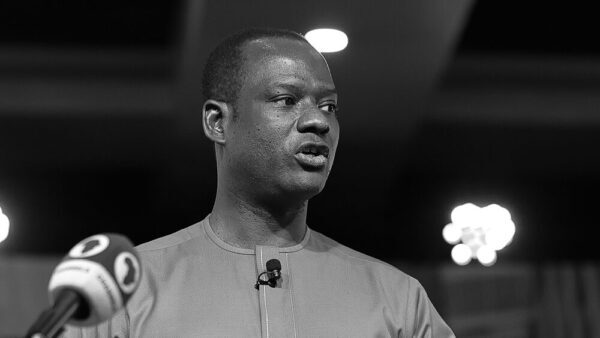
Nigeria’s Finance Minister and the Coordinating Minister of the Economy, Taiwo Oyedele, on Wednesday said the country is fortunate to have President Bola Tinubu at the helm of affairs at a time of economic challenges and global uncertainty.
Mr Oyedele made the remark on Wednesday on the sidelines of the World Bank/International Monetary Fund (IMF) meetings in Bangkok, Thailand, where he praised the president for his willingness to implement difficult economic reforms and his understanding of economic and monetary policy issues.
“I say to myself every time that Nigeria is lucky to have a leader like Mr President,” the minister said.
“A leader that says ‘I’ll do the right thing, even when it’s not popular’. There are so very few of them, and our president is not saying it; he’s doing it, he’s doing it even with pre-election (concerns),” he added.
Since assuming office in May 2023, the Tinubu administration has introduced a series of economic reforms, the impact of which international institutions like the World Bank and the IMF have acknowledged
The reforms include the removal of costly petrol subsidies, which had been a major drain on public finance for years, the unification of the foreign exchange rates and the sharp devaluation of the naira to attract foreign capital.


Although abolishing fuel subsidies has boosted government revenue and is seen as an investor-friendly move, it has triggered a cost-of-living crisis and spurred inflationary pressures.
Reforms in the foreign exchange market have helped increase accretion to external reserves, which stood at $55.1 billion as of 9 October, its peak level in over 18 years.
The banking sector also underwent a recapitalisation exercise that ended in March and helped Nigerian banks raise N4.7 trillion in new capital.
According to the Central Bank of Nigeria, the recapitalisation strengthened banks’ capital adequacy ratios, keeping the sector above international Basel benchmarks.
Mr Oyedele said President Tinubu possesses two attributes uncommon among leaders, notably those of democratic governments.
READ ALSO: AFC appoints Cardoso as board chairman
The first is his willingness to do what he considers right, even when the decision is unpopular or politically difficult.
“I remember at least three issues that were discussed with him recently, and on my own I would offer to say ‘maybe we wait until after the election’. And his question is always, ‘Is it the right thing to do?’ Yes, yes, it is. Why do we have to wait?” Mr Oyedele said.
“Number two attribute is that our President gets it. It’s not easy to understand issues to do with the economy, finance, monetary policy, like respect for the independence of the monetary authority. For Mr President, it’s 100 per cent,” he added.
The minister added that the president’s position on such matters has made it unnecessary for officials to discuss the issue with him repeatedly.
“We don’t even talk about it. So, I feel like we are so blessed, we cannot afford to wait even one minute,” he said.
Discover more from Premium Times Nigeria
Subscribe to get the latest posts sent to your email.

Ricursive Intelligence founders Anna Goldie and Azalia Mirhoseini believe more efficient AI chip design could help solve the compute crisis. The founders took the stage at TechCrunch Disrupt on Wednesday to detail how their startup is developing AI that can design chips, learn from each iteration, and improve subsequent designs, all with the goal of automating and accelerating the chip design process.
“There is this understanding that in the next five years we are going to have at least 10,000x more demand for compute, and that’s somewhat potentially conservative,” Goldie said on stage. “So we don’t want to build 10,000 times more data centers. We think that we need to help by making chips that are more efficient, that use the bandwidth in those data centers more efficiently, that use the wafers and fabs more efficiently, because even if we make [data centers] in space or something, I don’t know, you won’t see the sun anymore.”
While some may be scared by the thought of AI designing its own chips, Goldie argues that letting AI handle chip design will allow humans can focus on developing applications and exploring new possibilities that can expand what they can accomplish with computing.

“I think the way everything is shifting is that humans come bring their great ideas and creative thoughts, and execution is handled by AI,” Goldie said. “And this is happening in chip design, software development, and other places. And that’s something that recursive does for chip design.”
The founders say AI is challenging traditional chip design methods by discovering unconventional layouts that can outperform traditional ones. For example, AlphaChip, the AI system the founders previously developed, produced a circular, “donut-shaped” arrangement of chip components that initially surprised engineers but ultimately proved to be successful.
They explained that they are optimizing entire chips rather than following the traditional approach of partitioning them into dozens of smaller blocks. This approach allows AI to create intricate patterns, including wave-like designs, which the pair said they plan to share more about in the future.
The founders also argued that AI-designed chips will make it possible to create all sorts of chips that might not have been possible before.
“If it takes six months or a year or two years to design a new chip, then you really have to be extremely selective about the chips that you design,” Goldie said. “But if you can design a chip in like a week, and then say for manufacturing, you can design custom chips for all sorts of different types of applications in like space and AR, VR, and you biological computing, and it makes sense financially to do that, and we can be more energy efficient.”
When you purchase through links in our articles, we may earn a small commission. This doesn’t affect our editorial independence.
-
Business4 days ago
Veritas Kapital CEO Nwakuche Joins Coal City University Governing Council
-

 News2 days ago
Meta releases its first frontier model, Muse Wonder
-
News4 days ago
2027: INEC publishes final names of governorship candidates across states [FULL LIST]
-
News4 days ago
Arokodare Nets Seventh Goal of Season as Ajax Drop Points Against NEC Nijmegen