News
Presidency Debunks Viral Images Linking Scarred Children to Abducted Oyo Pupils

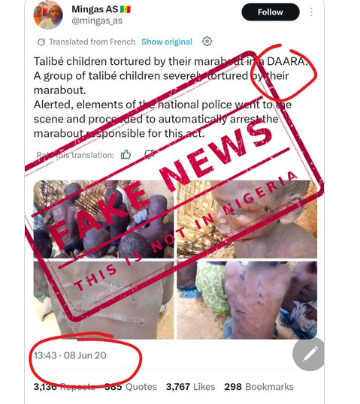
The Presidency has dismissed claims circulating on social media that graphic images of scarred children are connected to the recent abduction of school pupils in Oyo State, describing the posts as false and misleading.
Special Adviser to President Bola Tinubu on Information and Strategy, Bayo Onanuga, clarified the matter in a statement shared on X, formerly Twitter.
According to Onanuga, the viral photographs showing children with severe scars did not originate from Nigeria and have no connection to the abducted Oyo schoolchildren.
He explained that the images were taken in Mali in June 2020 following an incident in which a local teacher allegedly subjected pupils to severe flogging.
The presidential aide accused those circulating the images of deliberately spreading misinformation to create fear and undermine public confidence in the government and security agencies.
According to him, the false claims are intended to inflame public emotions and distort facts surrounding the ongoing efforts to secure the release of abducted schoolchildren.
Onanuga urged members of the public to verify information before sharing it online and cautioned against the spread of unverified content, particularly on sensitive security matters.
The clarification comes amid heightened public concern over school abductions and insecurity in parts of the country, with authorities continuing efforts to secure the safe return of victims and combat the spread of misinformation.





Social commentator, Isaac Fayose, has claimed that the ruling All Progressives Congress, APC, stands no chance of winning in three of Nigeria’s 10 states with the highest number of registered voters without rigging.
In a video shared on his official Facebook page on Tuesday, Fayose listed the states as Lagos, Kano, Kaduna, Katsina, Rivers, Oyo, Delta, Benue, Ogun and Bauchi.
Describing the ruling party as a bully, Fayose further claimed that the APC lacks grassroots popularity, insisting that it is relying solely on its control of federal power.
The businessman also questioned why the ruling party allegedly failed to allow the opposition to campaign in states as the January election approaches.
He said, “These are the states with the highest votes, Lagos, Kano, Kaduna, Katsina, Rivers, Oyo, Delta, Benue, Ogun and Bauchi States. APC can’t win three out of them without rigging yet they said they are strong.
“You are strong because you have the police, the army and the rich people but you are not strong on the street. You all are bullies.
“If you people are sure of yourself, why not allow free and fair elections? Why are you stopping us from campaigning.
“Allow free, fair and credible elections and we will know who is the boss and who is a bully.”

The leader of INRI Evangelical Spiritual Church, Primate Elijah Ayodele, has warned that Nigeria could experience political crises and ethnic tensions if President Bola Tinubu loses the 2027 presidential election.
Ayodele said the aftermath of such a defeat could trigger prolonged instability and uncertainty over the transfer of power.
Politics Nigeria reports that the cleric made the prediction in a statement signed by his media aide, Osho Oluwatosin, in which he questioned the ruling All Progressives Congress (APC)’s confidence in securing victory in the election.
He warned that an unexpected defeat for Tinubu could provoke serious political reactions, with consequences that might take a long time to resolve.
“If Tinubu loses this election, there will be so many crises, and it will take a long time to settle down; it will be an unimaginable manifestation because he believes he will win already. If he loses the election, it will be bloody because a lot of politicians will go into oblivion,” Ayodele said.
He also predicted attempts to prevent the announcement of election results, warning that the outcome could heighten ethnic tensions and complicate the transfer of power.
“There will be several attempts to stop the announcement of results. The election can cause an ethnic crisis; it will take time for him to decide if he will release power or not,” he added.
Ayodele further cautioned that the APC’s prospects in the 2027 election were uncertain, despite the confidence he attributed to the party’s members and supporters.
According to him, the possibility of losing the election was not being adequately considered by the ruling party, leaving its supporters vulnerable to disappointment.
“APC victory is shaking, but they don’t believe anyone can defeat them, and Tinubu doesn’t see beyond the presidency. A lot of people will cry if he loses the election. It will be unbelievable and painful to so many,” the cleric said.
He added that a defeat for Tinubu could have implications beyond the immediate political contest, potentially leading to changes in Nigeria’s electoral process.
“If Tinubu loses the election, it can change the electoral process in Nigeria,” he said.
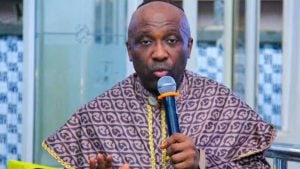
Meanwhile, the Regional Chairman of the Church of Christ in Nations (COCIN) for Barkin Ladi Local Government Area of Plateau State, Rev. Ezekiel Dachomo, has denied allegations that he campaigned for Tinubu and the APC ahead of the 2027 election.
The denial followed allegations by social media activist Martins Vincent Otse, popularly known as VeryDarkMan (VDM), who accused the cleric of shifting his position on the president and his administration.
Dachomo insisted that his prayers in Israel were not intended to secure electoral victory for Tinubu, Vice President Kashim Shettima or the APC.
In a statement shared on his social media accounts, the cleric described the alleged use of his name for political campaigns as an injustice to the president.
He said his prayers focused on national peace, divine intervention against evil plans and the protection of persecuted communities. He also maintained that he had prayed against electoral rigging and had never supported the Muslim-Muslim presidential ticket.
Dachomo accused those promoting the allegations of misrepresenting the substance of his prayers, insisting that he wanted justice and peaceful coexistence between Christians and Muslims.
He said he had prayed for anyone planning to rig the 2027 election to fail, adding that his position was rooted in the need for a credible electoral process.
“We need justice. We need the fear of God in both Muslims and Christians so that we can live lives of love and protect one another. That is what my heart desires,” the cleric said.
-

 Business4 days ago
Communications Ministry made ₦345.5 million duplicate payment for Abuja ICT Park project
-
News4 days ago
LumenUs helps automate tedious paperwork in times of grief
-
News4 days ago
Inside INEC’s AI and cybersecurity plans to secure Nigeria’s 2027 Elections – Technology Times
-
News3 days ago
EuroMatch NPFL: Ikorodu City Return to Winning Ways as Salami, Ikechukwu Sink Kwara United in Lagos