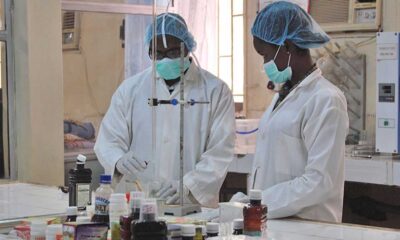
The Plateau State University, Bokkos, has appointed Prof. Pyefa Galadima Deputy Vice Chancellor Academic and Dr. Jurji Gomos, as its Deputy Vice Chancellor Administration.
Mr. John Agam, the Public Relations Officer (PRO) of the institution, who disclosed this in a statement on Tuesday 27th September in Jos, said the appointment was announced shortly after the special Senate meeting of the university, on Monda 26th September 2022.
He explained that the appointment of the two principal officers, which would run for two years, took immediate effect.
The PRO also said the Senate approved Oct. 10, as the resumption date for newly admitted students for the 2020/2021 and 2021/2022 academic sessions.
He explained that new students would return to campus to conclude their registration process and prepare for the commencement of lectures.
He said Prof. Yohanna Izam, the Vice Chancellor of the institution, congratulated the new deputy vice-chancellors and urged them to live above board and be diligent in duty.
The presidential candidate of the African Democratic Congress, Atiku Abubakar, has pledged to make the rehabilitation and maintenance of Nigeria’s major economic road corridors a national priority if elected in the 2027 presidential election.
Atiku made the commitment in a response to a message from one Hassan Yakubu, who urged him to make the state of Nigeria’s deteriorating roads a major issue in his campaign.
Yakubu, drawing from his experience transporting goods across the country, listed several major routes, including Numan-Jalingo, Dukku-Darazo, Dikko-Minna, Pambegua-Zaria, Akwanga-Jos, Abuja-Lokoja, Bida-Lapai, Kontagora-Makera, East-West Road, Onitsha-Owerri, Abeokuta-Ibadan, Benin-Ore and Benin-Auchi.
He argued that the roads serve as critical links between farms, markets, factories and consumers, warning that their poor condition was increasing transport costs and contributing to higher prices of goods.
Responding, Atiku said he understood the impact of deteriorating infrastructure, noting that he had personally travelled on some of the affected roads and was also a farmer.
“I am a farmer myself, so this is personal to me too. I also developed an interest in mass transportation early in life, and over the decades I have watched our transport infrastructure deteriorate significantly,” he said.
According to him, the consequences of bad roads extend beyond motorists and transport operators, as the additional costs eventually affect consumers.
“The driver pays. The trader pays. The farmer pays. But ultimately, the ordinary Nigerian buying food in the market pays,” Atiku said.
He described transport infrastructure as a critical component of economic activity, arguing that its condition determines how quickly agricultural produce reaches markets, the profitability of businesses and the cost of moving people and goods.
Atiku also said poor roads could have security implications, as stranded or slow-moving vehicles on isolated routes could leave travellers more vulnerable to criminal attacks.
He pledged that, if elected, his administration would identify roads carrying significant volumes of agricultural produce, manufactured goods, raw materials and passengers and prioritise their rehabilitation.
“Let me state my commitment clearly: if elected President, the rehabilitation and maintenance of Nigeria’s critical economic corridors will be treated as a national economic priority, not as an afterthought,” he said.
The former vice president also criticised what he described as the continued abandonment of existing infrastructure while governments announce new and expensive projects.
He said his proposed approach would involve building new infrastructure where necessary, urgently rehabilitating deteriorating facilities and maintaining existing assets.
“Infrastructure under my leadership will not be about monuments to government. It will be about making life easier for Nigerians,” Atiku said.
He added that every public infrastructure expenditure should be assessed by its impact on production, transportation, earnings and the welfare of citizens.
“Every naira we spend must answer a simple question: does this investment help Nigerians produce more, move more easily, earn more and live better?” he said.
Atiku further pledged to prioritise infrastructure that reconnects farms with markets, factories with consumers and communities with economic opportunities.
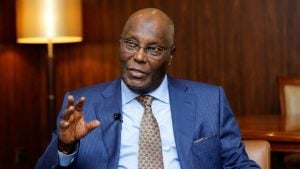
Former Vice President Atiku Abubakar
The ADC candidate also endorsed Yakubu’s appeal for his campaign to focus on national issues rather than ethnic or regional divisions.
“I do not want a Nigeria reduced to Fulani versus Yoruba, North versus South, Muslim versus Christian, or one tribe against another,” he said.
Atiku argued that economic hardship affects Nigerians regardless of their ethnic or regional backgrounds, adding that the country’s challenges require national solutions.
“Our problems are Nigerian problems. Our solutions must be Nigerian solutions,” he said.
Nigeria has begun its campaign at the 46th FIDE World Chess Olympiad in Samarkand, Uzbekistan, with a 10-player national delegation combining experienced international players with some of the country’s most promising young chess talents.
The prestigious biennial competition officially opened on Tuesday, September 15, with the first round taking place on Wednesday. The tournament runs until September 27 at the Silk Road International Tourist Centre and brings together hundreds of national teams in the Open and Women’s sections.
Nigeria fields 10 players
Nigeria is represented by five players in the Open section and five in the Women’s section.
The men’s team comprises Abdulrahman Abdulraheem, Bomo Kigigha, Ekunke Goodness, Bartholomew Okhipo and Odion Aikhoje. The women’s team features Deborah Quickpen, Michelle Nwankwo, Sandra Omoruyi, Bridget Michael and Joy Iyefu.
The Open team has a significant mix of experience. Bomo Kigigha is set to make his eighth Olympiad appearance, giving the younger members of the squad an experienced campaigner to draw from.
Another player attracting attention is 15-year-old Ekunke Goodness, who is making his debut at the Chess Olympiad after winning the World Rapid Amateur Chess Championship in Abuja in August.
Abdulrahman leads Nigeria’s charge
Nigeria’s number-one player, Abdulrahman Abdulraheem, heads the men’s contingent and has set his sights on producing a strong individual performance in Samarkand.
Speaking ahead of the tournament, Abdulraheem said his immediate objective was to play the best chess possible while hoping to compete for a medal in his category. He also expressed confidence in the overall strength of the Nigerian team, pointing to the combination of experienced players and young talents.
His comments reflect the balance within the Nigerian delegation: established players providing experience while teenagers such as Ekunke and Michelle Nwankwo gain exposure at one of the biggest stages in international chess.
Youngsters bring fresh energy
Ekunke’s inclusion is particularly significant. At just 15, he is among the youngest members of Nigeria’s delegation and arrives in Samarkand following an impressive run in Abuja.
His confidence is equally notable. Ahead of the tournament, the teenager said the Nigerian team would aim to perform better than it had previously and avoid poor performances.
On the women’s side, teenage player Michelle Nwankwo is also experiencing the excitement of competing at the Olympiad, while Deborah Quickpen said her preparations had helped strengthen her confidence ahead of the competition.
Nigeria’s opening matches
The Nigerian men opened their campaign against New Caledonia, while the women’s team faced Mali in the first round.
The Olympiad features 11 rounds, giving both Nigerian teams several opportunities to accumulate points and test themselves against players from different chess-playing nations. The tournament’s format also means consistency across the rounds will be important as the competition progresses.
Nigeria’s participation comes as the country’s chess community continues to develop a new generation of players, with recent national competitions providing opportunities for younger competitors to challenge more established names.
A stage for Nigerian chess
For Team Nigeria, the Samarkand Olympiad is more than another international tournament. It provides an opportunity for the country’s players to compete against some of the world’s strongest chess nations while giving emerging talents valuable experience at elite international level.
With veterans such as Kigigha and Aikhoje alongside rising players including Ekunke and Nwankwo, Nigeria’s delegation represents a mixture of experience, ambition and youth.
As the games continue through September 27, attention will be on how far the Nigerian teams can progress and how the country’s individual players perform against international opposition.