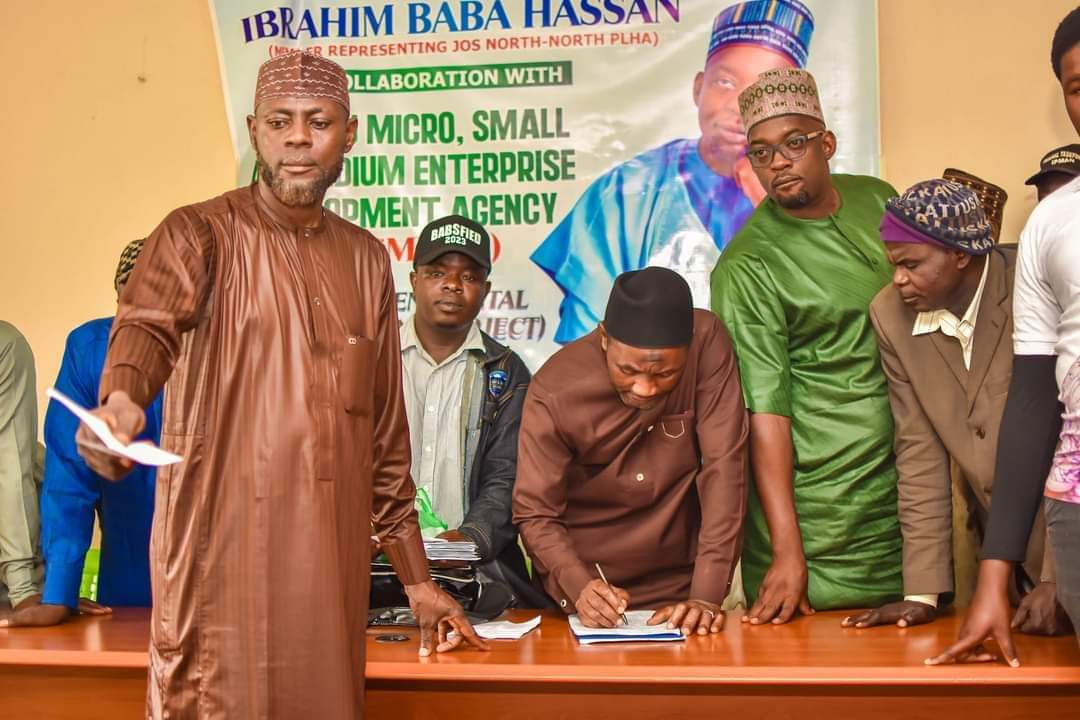
In his efforts to curb poverty and assist women in a distressed economy, The Former Deputy Speaker of Plateau State House of Assembly and current Member Representing Jos North-North Constituency, Hon. Ibrahim Baba Hassan, through the Plateau Micro, Small and Medium Enterprise Development Agency (PLASMEDA), has officially kicked off the Women Capital Empowerment Program by giving 100 women 10,000 Naira in the 1st face of the empowerment scheme which is targeting 1500 women from his constituency.
While delivering cash to the women on Thursday 1st September 2022 at the complex of the Plateau State House of Assembly, Hon. Ibrahim Baba Hassan, said the women were selected randomly across the constituency without discrimination on tribe or religion, He said he was specifically focused on empowering the women because of their role in taking care of the family.
The Honorable Member urged the various beneficiaries to put the money given into judicious use as most of them were selected based on them being SMEs, He said he recalled from the first batch of women empowered one particular woman made a huge turnover of the money and is now doing well for herself.
He stated that through the same initiative, he empowered 1500 persons last year and is stepping up the initiative to empower 2500 women this year and this is only the first face of the initiative starting off with 100 women.
In their remarks, fellow house members from Shandam, Wase and kwanpan North constituencies appreciated his efforts and called on the beneficiaries not to look down on the little that has been given to put it to judicious use.
Abuse Dang Izang, one of the beneficiaries expressed her heartfelt gratitude and full support for the Hon. member, she said that “if all politicians could replicate the same it will go a long way in reducing the rate of poverty in our communities”
A former women leader, Mrs. Rose Aji who also benefited from the initiative expressed her appreciation for the honorable saying “he is a man that takes everyone along either you’re a Christian or a Muslim” she prays that he will continue to do such great things even as he goes higher in office.
Another beneficiary, Mrs. Taye Ayinde shared how she was surprised when she and her sister Kehinde Ayinde were selected as beneficiaries. She said “honorable Ibrahim has been a blessing to my family, so he will be blessed”
While speaking to members of the press honorable Ibrahim promised that such initiative would not be the last as subsequently more women and men will be empowered. He noted that he was also embarking on further projects within his constituency which includes, the building of a school, a police outpost and motorized water boreholes.
The current Member Representing Jos North-North Constituency, Hon. Ibrahim Baba Hassan, earlier picked the House of Representatives primary elections ticket of The ruling All Progressives Congress (APC) for Jos North/Bassa Federal constituency in the 2023 elections.
A new assessment of 1,480 Primary Healthcare Centres (PHCs) across 16 Nigerian states has found that 97 per cent failed to meet the national minimum staffing requirement, raising fresh concerns about the capacity of the country’s frontline health facilities to provide essential services.
The PHC Operational Capability Report, produced by Orodata Science and Civic Tech, assessed facilities across 277 local government areas in Nigeria’s six geopolitical zones.
The assessment, conducted between October 2023 and June 2025, examined staffing, infrastructure, equipment, electricity, water supply and accessibility using the CheckMyPHC Digital Scorecard.
According to the report, only three per cent of the facilities assessed met the national minimum staffing requirement, while 11 of the 16 states had no assessed PHC that met the standard.
What the staffing standard requires
The national PHC framework recognises adequate staffing as essential to the delivery of quality primary healthcare.
The National Primary Health Care Development Agency’s (NPHCDA) Ward Minimum Health Care Package, developed with the World Health Organisation (WHO), outlines minimum manpower requirements for ward-level PHCs.
For a PHC, the proposed workforce includes a community health officer, public health nurse, three community health extension workers, six junior community health extension workers and four nurse/midwives, with a medical assistant listed as optional.
The same framework recommends that basic essential obstetric care centres be adequately staffed with four midwives or nurse/midwives to provide 24-hour coverage for maternal and newborn care.
Against this staffing framework, the Orodata assessment found that only three per cent of the facilities surveyed met the national minimum requirement.
The report said the shortage was particularly concerning because about 75 per cent of the assessed PHCs were located in rural communities, where such facilities often serve as the first and sometimes only formal source of healthcare for residents.
Staffing gaps, other deficiencies
The staffing problem was not isolated.
The assessment found that many of the facilities struggling to meet staffing requirements were also dealing with inadequate infrastructure and unreliable basic utilities.
According to the report, 40 per cent of the PHCs had broken ceilings or leaking roofs, while 38 per cent operated without electricity.
Water supply was another major concern, with 39 per cent of the facilities relying on unsafe water sources.
Orodata said the deficiencies were interconnected, with poor infrastructure, inadequate staffing, unreliable electricity and water supplies, limited equipment and accessibility barriers often occurring within the same facilities.
The report said the combination could increase risks for patients while placing additional pressure on the health workers available at the facilities.
Newborn care faces major equipment gaps
The assessment also exposed gaps in the capacity of PHCs to respond to complications during childbirth.
It found that 75 per cent of the facilities lacked essential neonatal resuscitation equipment.
Such equipment is required to support emergency interventions for newborns experiencing complications during or immediately after delivery.
The report said the absence of essential newborn-care equipment, alongside staffing shortages and other infrastructure deficiencies, could limit the ability of facilities to provide safe maternal and newborn services.
Accessibility was also a major concern.
According to the assessment, 66 per cent of the PHCs lacked provisions for persons with disabilities and people with mobility challenges.
State-level differences emerge
While the overall findings showed widespread deficiencies, the severity varied across the states assessed.
The report identified Kano and Sokoto as having particularly serious gaps in safe water, reliable electricity and essential newborn-care equipment.
In Gombe, 80 per cent of the assessed PHCs lacked accessibility provisions for persons with disabilities and people with mobility challenges.
The assessment also sought to establish how residents viewed the services provided by their local facilities.
It found that 51 per cent of surveyed community members rated services at their local PHCs as poor.
PHC challenges
The findings are consistent with concerns documented by PREMIUM TIMES in a recent investigation into rural PHCs in Osun State.
The investigation found that despite government investments in the health sector and efforts to revitalise primary healthcare facilities, challenges including inadequate staffing, deteriorating infrastructure, limited equipment and gaps in essential services persisted at some rural facilities.
At one of the facilities visited by PREMIUM TIMES, a single health worker was responsible for attending to pregnant women, children and other patients, while also responding to emergencies outside normal working hours. The facility also lacked a functional laboratory and had inadequate delivery equipment.
The investigation further found that some patients had to travel outside their communities for basic services because the facilities could not provide them.
Orodata said improving PHCs would require coordinated interventions beyond isolated renovations.
It urged state governments to develop facility-specific plans with clear targets, responsibilities, resources and timelines, alongside regular monitoring.
The organisation also recommended repairs to damaged infrastructure, provision of safe water and reliable electricity, solar or hybrid power systems, recruitment and retention of health workers, and essential neonatal resuscitation equipment for PHCs offering delivery services.
The assessment involved facility visits, direct observation, interviews with health workers and community members, photographs, GPS coordinates and facility records.
Orodata said its CheckMyPHC Digital Scorecard was based on NPHCDA minimum standards and inclusion requirements, and urged authorities to use verified facility-level evidence to guide resource allocation and interventions.
Discover more from Premium Times Nigeria
Subscribe to get the latest posts sent to your email.
The journey for a sweet coffee experience took Jos Events to a beautiful village called Laminga in Jos East, where cultivation, harvesting, processing, roasting and marketing of coffee are creating opportunities and adding value to coffee production in Plateau State
From the careful planting of coffee seedlings to harvesting, processing, roasting and marketing, Lingzhi Global Coffee is taking a comprehensive approach to developing the coffee value chain in Plateau State.
Located in Laminga, Jos East Local Government Area, the company’s coffee farm is part of a growing agricultural initiative aimed at producing quality coffee while creating economic opportunities for people involved at different stages of production.
The operation brings together farmers, harvesters, processors, roasters, marketers and other workers, demonstrating how agricultural production can create employment far beyond the farm itself.
Responding from our questions due to our inquisitiveness to learn during an interview with Saminu Musa Santana at the Lingzhi Global Coffee farm in Laminga, the Farm Manager, explained that the farm currently covers approximately four hectares and is focused on cultivating healthy coffee plants and producing quality coffee.
Where the Journey Begins: The Coffee Farm
According to Mr Santana, producing quality coffee begins long before the beans reach the roasting stage.
The process starts with the careful cultivation and nurturing of coffee seedlings. Soil management is an important part of the operation, with the farm applying organic manure and appropriate agricultural inputs to provide the plants with the nutrients required for healthy growth.
The coffee plants are then carefully maintained throughout their growth cycle until they mature and begin producing cherries.
For Santana, every stage of production matters because the quality of the final coffee is influenced by what happens from the beginning of the cultivation process.
From Coffee Cherries to Coffee Beans
Once the coffee cherries mature, the farm moves into the harvesting stage.
The ripe cherries are carefully collected before undergoing a series of processing activities designed to prepare the coffee beans for the next stage of production.
The process includes harvesting, processing, washing, preparation and drying of the beans.
After drying and preparation, the beans are taken through the roasting process, where they develop the characteristics associated with roasted coffee.
The roasted beans are subsequently processed into coffee suitable for consumption.
This transformation from a crop grown on the farm into a finished consumer product highlights the importance of value addition in agriculture.
Rather than limiting agricultural activity to the production and sale of raw materials, Lingzhi Global Coffee is building a chain that extends from cultivation through to processing and marketing.
Creating Jobs Beyond the Farm
One of the significant opportunities presented by the coffee value chain is employment.
Coffee production requires people at virtually every stage—from nursery management and farming to harvesting, transportation, processing, roasting, packaging, marketing and distribution.
As the industry expands, each of these stages has the potential to support livelihoods.
For communities around Laminga and other coffee-growing areas in Plateau State, the development of the coffee industry could therefore provide opportunities for farmers and young people interested in agriculture, processing, agribusiness and related services.
Santana acknowledged that coffee production is not without its challenges.
According to him, farmers and operators in the sector continue to deal with challenges relating to farming, labour and the broader production process.
However, he believes sustained investment in coffee cultivation and processing can unlock greater opportunities for local communities.
Quality and Sustainability at the Centre
Beyond production, quality and responsible agricultural practices remain important aspects of the operation.
Santana said the farm’s operations follow the European Union Deforestation Regulation (EUDR) compliance requirements, particularly in relation to responsible and traceable coffee production.
The European Union Deforestation Regulation is designed to ensure that certain commodities entering the EU market are not associated with recent deforestation or forest degradation.
For coffee producers and exporters seeking access to the European market, meeting relevant traceability and sustainability requirements is increasingly important.
At Lingzhi Global Coffee, adherence to such standards is presented as part of the company’s effort to work with farmers and other stakeholders while maintaining quality and sustainability throughout the production chain.
Positioning Plateau as a Coffee-Producing Destination
Plateau State is widely recognised for its agricultural potential, favourable climate in several areas and diverse farming activities.
The development of coffee production adds another dimension to the state’s agricultural economy.
The Lingzhi Global Coffee farm in Laminga demonstrates how a locally developed agricultural value chain can extend beyond cultivation into processing, roasting and marketing.
With every stage creating demand for labour, skills, services and investment, coffee has the potential to become more than just an agricultural commodity—it can become an important economic activity for communities and businesses across the state.
The opportunity also extends to farmers.
As demand for quality coffee grows, more farmers could potentially participate in the supply chain, while processors and other agribusiness operators can develop businesses around the crop.
Building From Farm to Cup
The story of Lingzhi Global Coffee is ultimately about value addition.
Instead of simply growing coffee and selling it as a raw agricultural product, the company is involved in a broader process that seeks to take coffee from the farm through harvesting, processing, drying, roasting and ultimately to the consumer.
That approach creates opportunities at multiple points in the value chain and demonstrates the economic potential of developing agricultural products locally.
For Plateau State, the continued investment in coffee cultivation, processing and quality standards could help strengthen the state’s position within Nigeria’s growing agricultural and agribusiness landscape.
From a small coffee seedling in the soil of Laminga to a roasted product ready for the consumer’s cup, every stage represents an opportunity—for farmers, workers, entrepreneurs, processors and the wider economy.
Lingzhi Global Coffee and the Future
As Lingzhi Global Coffee continues to develop its farm and wider coffee value chain, its operations in Laminga offer an example of how agricultural investment can connect farming, employment, processing, manufacturing and commerce.
With greater investment in infrastructure, farmer support, technical expertise, processing capacity and access to markets, Plateau State has the potential to build a stronger coffee ecosystem.
The journey may begin with a seedling, but the ultimate goal is much bigger: to build a sustainable coffee value chain that creates jobs, adds value locally and puts Plateau-grown coffee on a wider market.