Business
Dangote, Ruto to launch $16 billion Kenya refinery amid land protests

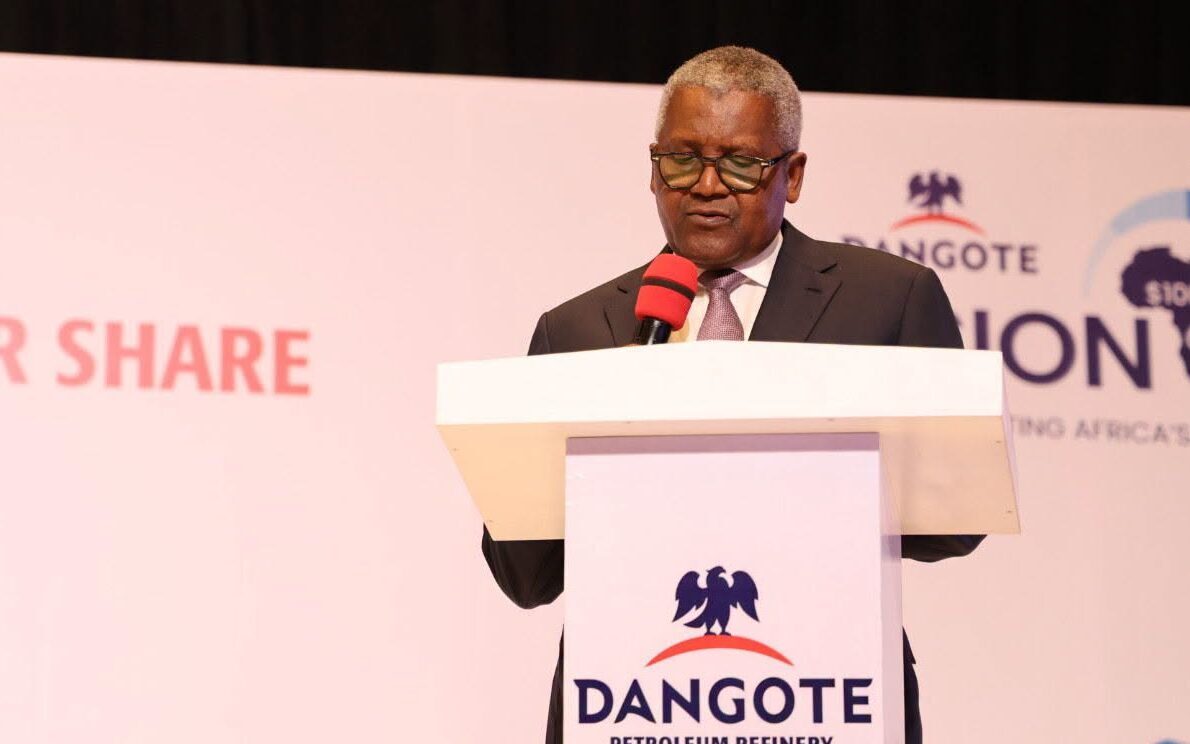
Africa’s richest man and president/CEO of Dangote Industries Limited, Aliko Dangote, and Kenya’s President, William Ruto, are set to break ground on a $16 billion oil refinery in Lamu County, on Kenya’s northern coast.
This is against the backdrop of protests and legal challenges over land acquisition and compensation.
The proposed Dangote East Africa Petroleum Refinery has raised concerns among residents, activists and economic experts over its potential environmental and social impacts, particularly the displacement of communities and the adequacy of compensation for affected landowners.
Ahead of the groundbreaking ceremony, some residents took to the streets to demand better compensation for land earmarked for the project.
Farmers and residents of Chandavai have also filed a lawsuit alleging forced eviction and property destruction without adequate compensation or a proper resettlement plan.
The petitioners argued that the land designated for the refinery is part of their ancestral heritage and provides essential livelihoods for their families.


In response to the legal challenge, the Malindi Environment and Land Court ordered a temporary halt to construction activities pending a hearing.
Environmental activists have also questioned whether the project complied with mandatory public participation requirements and comprehensive environmental impact assessments under Kenyan law.
According to the BBC, Mr Dangote has dismissed the protests as manoeuvres by local marketers and international players, while insisting the refinery would proceed as planned and be ready by 2030.
In an interview with the BBC’s Focus on Africa programme, Mr Dangote disputed claims of inadequate compensation, saying his company had acquired only the portion of land it required from the area made available by the government.
“To come and say some people are demonstrating, demonstrating about what? Have you ever seen people demonstrating against themselves in terms of development?” he asked, indicating that the protests would not derail the project.
Mr Dangote said the refinery would create about 60,000 jobs at the peak of construction, with the benefits extending beyond those directly employed by the project.
“Are we going to bring robots? Of course, the people will benefit,” the BBC quoted him as saying.
The proposed refinery is expected to process 700,000 barrels of crude oil per day, making it one of Africa’s largest refining facilities and the biggest industrial project of its kind in East Africa.
The project is expected to cost between $15 billion and $16 billion and take about three years to construct. It is modelled after Dangote’s 650,000-barrel-per-day refinery in Lagos, Nigeria.
Once completed, the facility is expected to supply refined petroleum products to Kenya, South Sudan, Uganda, Burundi, and the Democratic Republic of the Congo.
The proposed investment has also triggered questions about why Kenya was selected for the refinery, given that it is not an oil-producing country. Some critics have suggested that Tanzania or Uganda would be more suitable locations, particularly as both countries are advancing plans to export crude oil through the East African Crude Oil Pipeline.
However, Kenya’s Energy and Petroleum Minister, Opiyo Wandayi, told the BBC that the refinery would not depend exclusively on crude oil produced within the region.
“Refineries get crude oil from the market. And the market is open,” he said.
Mr Dangote also defended the choice of location, citing Singapore as an example of a country that has developed a substantial refining industry despite having no domestic crude oil production.
“Singapore doesn’t produce a single drop of oil, yet they have a lot of refineries,” he said.
The refinery will also feature a 1,000-megawatt power plant designed to provide electricity for its operations and support other industries expected to emerge in the area.
Mr Dangote has identified unreliable electricity supply as a major obstacle to industrialisation in Africa, particularly in resource-rich countries that export raw materials instead of processing them locally.
READ ALSO: Dangote Refinery a masterpiece of science, engineering, art – Kenyan President
The Nigerian industrialist has about $50 billion worth of projects in the pipeline, including plans to develop 10,000 megawatts of power generation capacity across Africa by 2030, with the possibility of doubling the target depending on demand.
The proposed Lamu power plant is expected to support the refinery’s operations while providing electricity for other industrial activities in the region.
The Lamu project comes as Mr Dangote expands his investments across Africa, following the commissioning of his 650,000-barrel-per-day refinery in Lagos, which can supply petroleum products to domestic and international markets.
The proposed Kenyan refinery is also expected to reduce the region’s dependence on imported petroleum products. East African countries currently rely heavily on fuel imports, much of which comes from the Middle East, exposing them to global supply disruptions and fluctuations in crude oil prices.
The refinery’s development, however, still depends on resolving land acquisition disputes, compensation concerns, and environmental issues raised by affected communities and campaigners.
Discover more from Premium Times Nigeria
Subscribe to get the latest posts sent to your email.





Business
Veritas Kapital Assurance Records 54% Growth in Total Assets to ₦54.56 Billion, Strengthens Financial Position

Governance expert Joe Abah has confirmed he received a full refund of his flight ticket from United Nigeria Airlines after a six-hour flight delay.
Mr Abah disclosed that the airline refunded his ticket within 12 hours of his request and offered him a 50 per cent discount on a future flight for four months.
In a post on X on Thursday, Mr Abah said the airline has apologised, refunded his money, and offered compensation following the disruption to his Enugu-Abuja journey.
“I can confirm that I have now received a full refund from @flyunitedng and that the refund came within 12 hours of my making the request,” he wrote.
“They also offered compensation of 50 per cent off a future flight for the next four months. They have thus apologised, offered compensation, and speedily refunded my money. These are good remedial steps,” he added.
PREMIUM TIMES reported on Wednesday that United Nigeria Airlines apologised to Mr Abah over the delay, acknowledging that its communication and follow-up with affected passengers fell below expectations after he called out the airline on X and questioned its handling of the disruption.
Mr Abah had said his flight, scheduled to depart Enugu for Abuja at 8:30 a.m. on Tuesday, was delayed until 3 p.m., prompting him to demand an immediate refund and question the airline’s explanation.
United Nigeria Airlines, in its response, said its aircraft encountered worsening weather conditions while approaching Akanu Ibiam International Airport, Enugu, forcing it to divert to Anambra in line with safety procedures.
The airline said weather conditions can vary across routes and airports and change quickly, explaining why other aircraft might land while its own could not.
It also acknowledged that keeping passengers adequately informed remains its responsibility, even though weather-related disruptions are sometimes beyond its control.
Following the airline’s response, Mr Abah demanded an immediate refund after purchasing another airline ticket to complete his journey.
The airline subsequently asked him to submit a refund request through its official website, promising immediate processing rather than the usual seven working days.
READ ALSO: Nigerian airline removes passenger after threat to ‘burn down’ aircraft
Mr Abah’s latest confirmation indicates the refund was completed within 12 hours of his request.
The development resolves the refund dispute and highlights how public complaints draw attention to passenger concerns over flight delays, communication, and refund procedures among domestic airlines.
Nigeria’s Civil Aviation Regulations contain consumer protection provisions covering flight delays, cancellations, passenger assistance and compensation in qualifying circumstances.
The NCAA advises passengers to first lodge complaints with airlines and escalate unresolved cases to its Consumer Protection Department.
Discover more from Premium Times Nigeria
Subscribe to get the latest posts sent to your email.
-

 News4 days ago
Troops Arrest Suspected Gunrunner, Neutralise Two Terrorists in Plateau
-
News3 days ago
APM holds Presidential Campaign in Plateau, Pledges Security and Economic Reset
-
News4 days ago
'How many times will you approve Ibom Deep Seaport' – NDC blasts Tinubu over 'endless lies'
-
News4 days ago
APC Legacy Assembly Expresses Confidence in Tinubu Ahead of 2027 Election