Business
Tinubu to prioritise jobs, industrial growth in Nigeria’s new prosperity era


President Bola Tinubu has said his administration will place jobs, enterprise and industrial growth at the centre of Nigeria’s next phase of economic policy.
The government also said it is moving from economic reforms to what he described as an “age of prosperity.”
Mr Tinubu stated these priorities in his Independence Day address to the nation on Thursday, saying Nigeria must convert its large young population into an engine of production rather than a source of economic hardship.
“But prosperity requires more than cheaper goods. It requires productive work. Nigeria is a young country. Millions of young Nigerians enter adulthood every year with talent, energy and ambition.
“Our responsibility is to ensure that this great demographic strength becomes an engine of production rather than a source of despair,” the president said.
The president’s statement followed economic reforms introduced by the Tinubu-led administration since 2023, which include the removal of the petrol subsidy, exchange-rate reforms, tighter monetary and fiscal measures, and changes aimed at improving government revenue and investment.


Support for businesses
Mr Tinubu said the government would support businesses, revive industries, expand digital connectivity, and invest in skills employers need.
He said the government would use Nigeria’s gas resources to power new industries and support businesses working to revive factories in the country’s industrial centres.
“We are therefore placing jobs, enterprise, and industrial growth at the heart of our government’s policies.
“We will use our gas to power new industries. We will support businesses that work to bring factories back to life in our great industrial centres,” Mr Tinubu said.
Digital investment
The president also promised greater digital connectivity and investment in skills, infrastructure and finance to support Nigerian businesses.
“We will expand digital connectivity into communities that have waited too long to participate in the modern economy.
We will invest in the skills employers demand and support Nigerian businesses with the infrastructure and finance they need to grow,” he said.
Mr Tinubu said his administration wanted to see more goods produced locally and more Nigerian companies competing in international markets.
“I want to see more Nigerians making things. I want to see more Nigerian farms feeding our cities and supplying our factories. I want to see Nigerian businesses selling Nigerian goods to the whole world. I want young Nigerians building unicorns and creating opportunities for others here at home,” he said.
Access to credit
The president also highlighted access to credit as part of the government’s strategy to expand economic participation.
He said the Credit Corporation, CREDICORP, was providing consumer credit that would enable Nigerians to acquire vehicles, solar systems, digital devices and other essential assets without having to save for years before making such purchases.
“It is why CREDICORP is giving working Nigerians access to consumer credit, allowing people to acquire vehicles, solar systems, digital devices and other essential assets without first having to accumulate years of savings,” Mr Tinubu said.
ALSO READ: NCDMB participates in Africa Oil Week 2026, champions local content and industrial growth
He said the government would also continue to support businesses through infrastructure and finance, suggesting that access to capital would be an important component of the administration’s new prosperity agenda.
Private-sector expansion
The president linked private-sector expansion to job creation and increased domestic production, saying the government’s responsibility was to create conditions for Nigerian businesses to expand.
Mr Tinubu said millions of Nigerians still struggled to meet basic needs and acknowledged that the challenges predated his administration.
“Some Nigerian families still struggle today for the next meal, the next school fee, the next medical bill, or simply enough money to get to work,” he said.
He attributed the difficulties to decades of low productivity, inadequate infrastructure, insufficient opportunity and weak institutions, while promising continued support for vulnerable households.
The president said the government’s long-term objective was not simply to expand social assistance but to build an economy capable of creating productive opportunities and lifting people out of poverty.
“It will take time. It will require discipline. It will require sustained growth year after year and the creation of millions of productive opportunities across our country,” he said.
Mr Tinubu said Nigeria had now laid the foundation for lasting prosperity and called on Nigerians and businesses to participate in the next phase of economic development.
“The age of reform has done its work. Now begins the age of prosperity,” he said.
Discover more from Premium Times Nigeria
Subscribe to get the latest posts sent to your email.




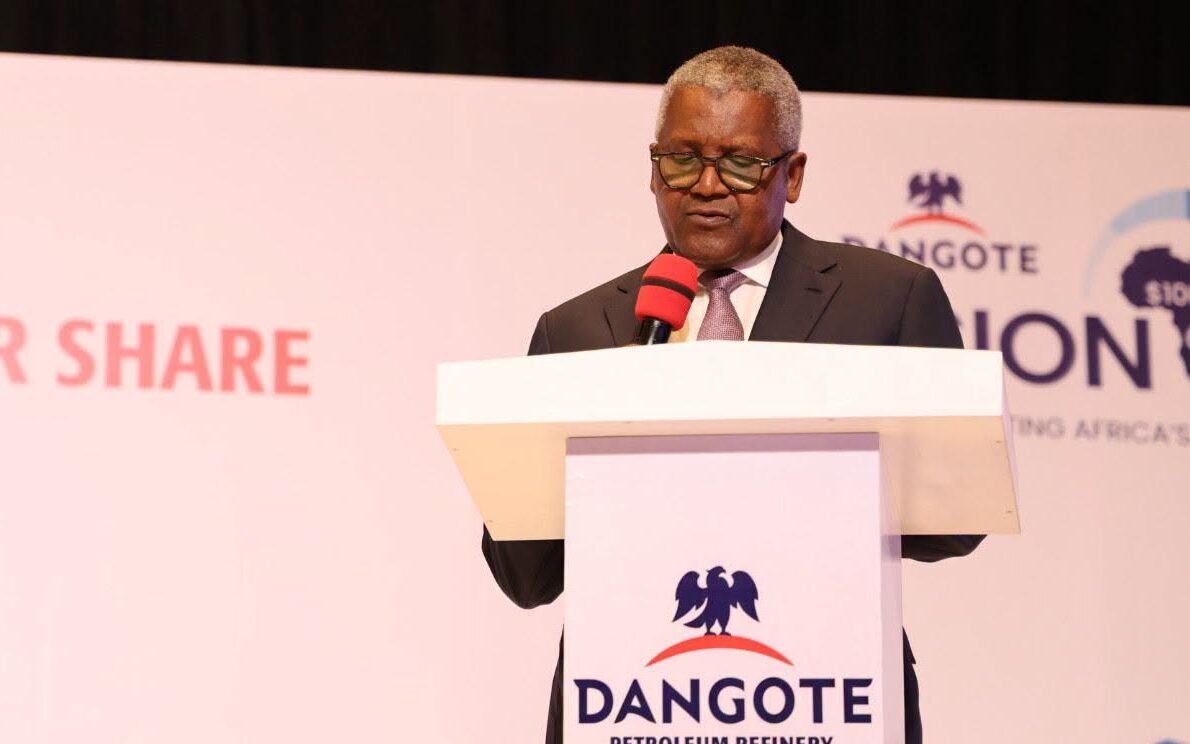
Africa’s richest man and president/CEO of Dangote Industries Limited, Aliko Dangote, and Kenya’s President, William Ruto, are set to break ground on a $16 billion oil refinery in Lamu County, on Kenya’s northern coast.
This is against the backdrop of protests and legal challenges over land acquisition and compensation.
The proposed Dangote East Africa Petroleum Refinery has raised concerns among residents, activists and economic experts over its potential environmental and social impacts, particularly the displacement of communities and the adequacy of compensation for affected landowners.
Ahead of the groundbreaking ceremony, some residents took to the streets to demand better compensation for land earmarked for the project.
Farmers and residents of Chandavai have also filed a lawsuit alleging forced eviction and property destruction without adequate compensation or a proper resettlement plan.
The petitioners argued that the land designated for the refinery is part of their ancestral heritage and provides essential livelihoods for their families.
In response to the legal challenge, the Malindi Environment and Land Court ordered a temporary halt to construction activities pending a hearing.
Environmental activists have also questioned whether the project complied with mandatory public participation requirements and comprehensive environmental impact assessments under Kenyan law.
According to the BBC, Mr Dangote has dismissed the protests as manoeuvres by local marketers and international players, while insisting the refinery would proceed as planned and be ready by 2030.
In an interview with the BBC’s Focus on Africa programme, Mr Dangote disputed claims of inadequate compensation, saying his company had acquired only the portion of land it required from the area made available by the government.
“To come and say some people are demonstrating, demonstrating about what? Have you ever seen people demonstrating against themselves in terms of development?” he asked, indicating that the protests would not derail the project.
Mr Dangote said the refinery would create about 60,000 jobs at the peak of construction, with the benefits extending beyond those directly employed by the project.
“Are we going to bring robots? Of course, the people will benefit,” the BBC quoted him as saying.
The proposed refinery is expected to process 700,000 barrels of crude oil per day, making it one of Africa’s largest refining facilities and the biggest industrial project of its kind in East Africa.
The project is expected to cost between $15 billion and $16 billion and take about three years to construct. It is modelled after Dangote’s 650,000-barrel-per-day refinery in Lagos, Nigeria.
Once completed, the facility is expected to supply refined petroleum products to Kenya, South Sudan, Uganda, Burundi, and the Democratic Republic of the Congo.
The proposed investment has also triggered questions about why Kenya was selected for the refinery, given that it is not an oil-producing country. Some critics have suggested that Tanzania or Uganda would be more suitable locations, particularly as both countries are advancing plans to export crude oil through the East African Crude Oil Pipeline.
However, Kenya’s Energy and Petroleum Minister, Opiyo Wandayi, told the BBC that the refinery would not depend exclusively on crude oil produced within the region.
“Refineries get crude oil from the market. And the market is open,” he said.
Mr Dangote also defended the choice of location, citing Singapore as an example of a country that has developed a substantial refining industry despite having no domestic crude oil production.
“Singapore doesn’t produce a single drop of oil, yet they have a lot of refineries,” he said.
The refinery will also feature a 1,000-megawatt power plant designed to provide electricity for its operations and support other industries expected to emerge in the area.
Mr Dangote has identified unreliable electricity supply as a major obstacle to industrialisation in Africa, particularly in resource-rich countries that export raw materials instead of processing them locally.
READ ALSO: Dangote Refinery a masterpiece of science, engineering, art – Kenyan President
The Nigerian industrialist has about $50 billion worth of projects in the pipeline, including plans to develop 10,000 megawatts of power generation capacity across Africa by 2030, with the possibility of doubling the target depending on demand.
The proposed Lamu power plant is expected to support the refinery’s operations while providing electricity for other industrial activities in the region.
The Lamu project comes as Mr Dangote expands his investments across Africa, following the commissioning of his 650,000-barrel-per-day refinery in Lagos, which can supply petroleum products to domestic and international markets.
The proposed Kenyan refinery is also expected to reduce the region’s dependence on imported petroleum products. East African countries currently rely heavily on fuel imports, much of which comes from the Middle East, exposing them to global supply disruptions and fluctuations in crude oil prices.
The refinery’s development, however, still depends on resolving land acquisition disputes, compensation concerns, and environmental issues raised by affected communities and campaigners.
Discover more from Premium Times Nigeria
Subscribe to get the latest posts sent to your email.
-

 News4 days ago
Rivers Guber: ALDRAP writes INEC, seeks Chinda’s disqualification after Supreme Court judgment
-
News4 days ago
Cross River Ikan Sports Fight Back To Beat Gateway Horns 25-19 In Showtime Bowl Series XV Flag Football
-
 News3 days ago
TikTok Access Disrupted in Parts of Northern Nigeria as Users Turn to VPNs
-
Business3 days ago
Court orders NMDPRA to continue issuing fuel import licences to Matrix, AA Rano, AYM Shafa