Connect with us

News

Gunmen attack funeral train, kill one, injure scores in Plateau

info

Published

on

Gunmen.jpg

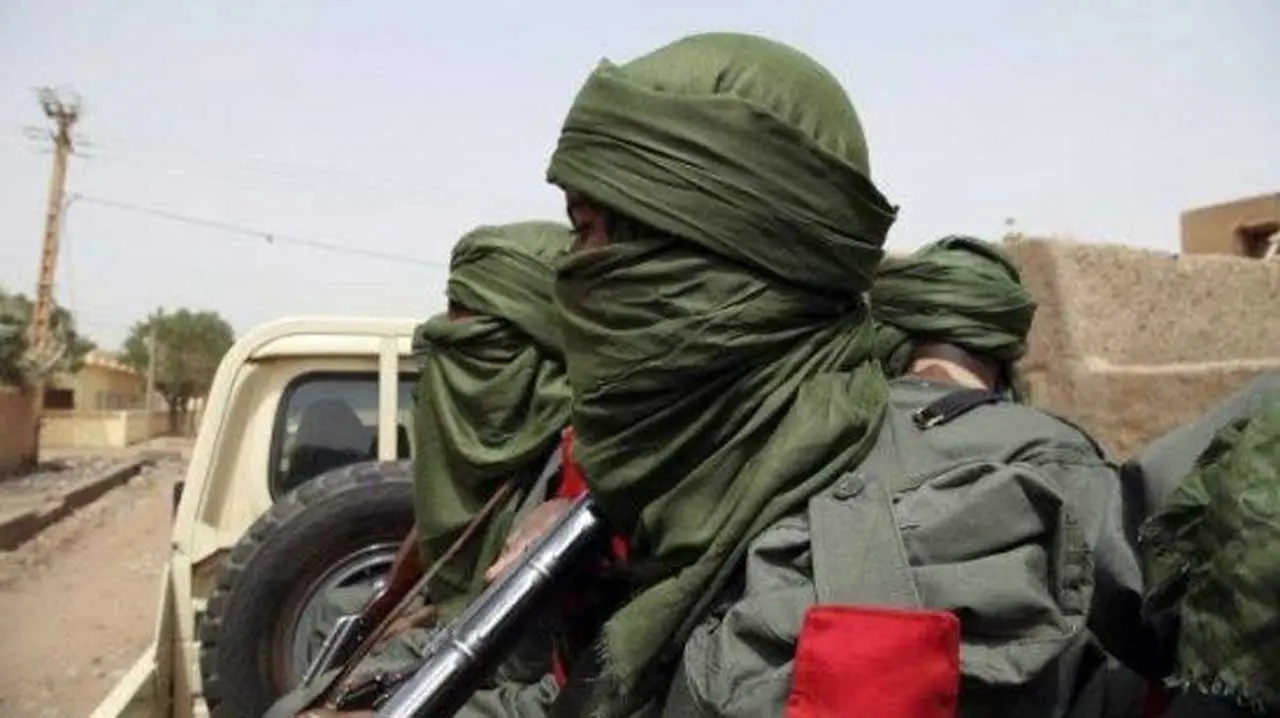
Gunmen suspected to be Fulani militias, on Thursday, attacked a group of mourners who were conveying the bodies of two persons killed in an earlier attack, to the mortuary in Riyom Local Government Area of Plateau State, killing one person and injuring several others.

The President of the Berom Youth Moulders-Association, BYM, Barr. Dalyop Solomon Mwantiri, who confirmed the incident in a statement on Friday morning, said on Wednesday night, some Fulani bandits had launched an attack on the Sol village of Ta-Hoss District in Riyom LGA, killing two people.

However, the bandits ambushed the grieving mourners the following day while conveying the bodies of the victims to a mortuary, opened fire on them and killed one other person while injuring others in the process.

Mwantiri, who condemned the renewed wave of terrorist attacks in Riyom and other parts of the state, called on security agencies to intensify ongoing operations through a comprehensive crackdown on armed criminal gangs terrorizing innocent communities.

“This call follows the gruesome killing of two Berom youths by suspected armed Fulani terrorist gangs who invaded Sol village in the Ta-Hoss community of Riyom LGA at about 9:20 p.m. on June 10, 2026,” Mwantiri said.

He revealed the names of the victims as Davou Dalyop Patu and Dalyop Zaram, who were mowed down in the earlier attack.

Continuing, the BYM President said:

“These productive members of the community were brutally murdered, plunging the entire Ta-Hoss community and surrounding villages into deep mourning.

“Reports indicate that after carrying out the attack, the assailants retreated to a nearby Fulani settlement suspected to serve as a hideout for armed bandits in Kwakwi, Ganawuri District of Riyom LGA.” 

He added that on Thursday morning, while the remains of the two victims were being taken to the Riyom General Hospital to be deposited in the mortuary, the bandits again attacked the mourners in an ambush and opened fire on them, killing one man identified as Toma Chuwang, while some others sustained several degrees of injuries.

“The Association has also received credible reports suggesting that criminal elements responsible for attacks in Barkin Ladi Local Government Area may have redirected their operations toward vulnerable communities in Riyom LGA due to the ongoing security crackdown being conducted by operatives of the Department of State Services (DSS) and other security agencies in Barkin Ladi and its environs,” Mwantiri went on.

“In a related development, BYM condemns the continued destruction of farmlands through indiscriminate grazing in the Gassa/Kassa communities of Ropp District, Barkin Ladi LGA. Such actions threaten the livelihoods of local farmers and further compound the insecurity and economic hardship faced by residents.

“Consequently, BYM calls on the Federal Government, Plateau State Government, and all security agencies to establish and strengthen additional security formations in Riyom LGA to complement ongoing operations and prevent the area from becoming a safe haven for terrorist and criminal elements.

“The Association also appeals to the international community and Nigeria’s development and security partners to support efforts aimed at combating terrorism, banditry, and violent extremism in Plateau State, the Middle Belt region, and Nigeria as a whole.

“Furthermore, BYM urges residents of vulnerable communities in Riyom LGA, Gyel District of Jos South LGA, and other affected areas to remain vigilant and prioritize community security. Citizens should continue to provide timely and credible intelligence to security agencies, including Operation Enduring Peace and other relevant security formations, to enable proactive responses to emerging threats,” he added. 

Continue Reading
Click to comment

Leave a Reply

Your email address will not be published. Required fields are marked *

News

China Approves New Brain-Tech Devices in Growing Race With Elon Musk’s Neuralink

editor

Published

on

By

China , Brain Computer Devices,Elon Musk, Neuralink

China has stepped up its race to develop brain-computer interface technology, approving a series of brain-related devices as it seeks to challenge Elon Musk’s Neuralink and establish itself as a global leader in the emerging field.

Chinese health regulators have approved several brain-technology products this year, allowing domestic companies to move beyond laboratory research and clinical trials into commercial applications.

Brain-computer interfaces, or BCIs, are technologies that translate electrical signals from the brain into commands that can control computers, robotic equipment and other devices. They are being developed for applications ranging from helping people with paralysis regain movement to diagnosing neurological and cognitive disorders.

One of China’s biggest breakthroughs came in March, when the National Medical Products Administration approved NEO, an implantable BCI developed by Shanghai-based Neuracle Technology.

The coin-sized device is designed for people with severe paralysis caused by cervical spinal cord injuries. It is implanted above the brain and captures neural signals generated when a patient attempts to move their hand.

Those signals are then decoded and used to control a pneumatic robotic glove, allowing patients to perform movements such as grasping objects, picking up items and drinking water.

The approval was significant because it was reported as the world’s first market authorisation for an invasive BCI medical device for commercial use.

China later reached another milestone in July when surgeons performed what was described as the world’s first commercial implantation of an approved invasive BCI. The procedure involved a patient who had lost hand mobility following a spinal cord injury.

Chinese authorities have also approved less-invasive brain technologies.

In August, the country’s regulator approved a device developed by Tianjin-based Tiankai Suishi Intelligent Technology. The system consists of a cap fitted with electrodes that can monitor electrical activity in the brain and assist doctors in assessing cognitive functions.

The company is also developing BCI systems aimed at supporting the early diagnosis of conditions linked to cognitive impairment, while seeking approval for technology related to depression diagnosis.

The developments form part of a broader Chinese government strategy to make BCI a major future industry. Beijing has identified the sector as a strategic area and wants China to have a leading position globally by 2030.

Chinese authorities have also introduced measures aimed at speeding up the approval and commercialisation of BCI products, while investment in the sector continues to increase.

The rapid progress has placed Chinese technology companies in direct competition with Neuralink, the California-based company founded by Musk.

Neuralink has been testing its brain implants in human patients, including people with paralysis. Its trials have demonstrated the ability of participants to control computers using neural signals, with the company also working toward controlling assistive robotic devices through brain activity.

While China has moved ahead in securing commercial approval for an invasive BCI, the two technologies are not identical. Neuralink’s implant uses electrodes that penetrate brain tissue, while China’s NEO device is positioned on the surface of the brain’s protective membrane, a design intended to reduce direct damage to brain tissue.

China’s progress therefore marks an important development in the growing global competition over brain-computer technology, an industry that could eventually transform how people with disabilities interact with computers, robotic devices and other technologies.

Continue Reading

News

Peter Obi dropped money in Ekiti – Lere Olayinka dismisses ‘I don’t give shishi’ claims

info

Published

on

By

Lere Olayinka.jpg

Lere Olayinka, an aide to the Minister of the Federal Capital Territory, FCT, Nyesom Wike, has dismissed claims that the Nigeria Democratic Congress, NDC, presidential candidate, Peter Obi does not give out money for political campaigns.

Olayinka recalled that Obi “dropped money” for party delegates in Ekiti State during the 2023 elections.

Featuring on AIT’s Democracy Today, the minister’s spokesman insisted that politics is business.

According to Olayinka: “As a politician or a business man, if your competitor wins what happens to you? If you are seeking a contract from somewhere and your competitor wins, what happens to you? You will lose out.

Recommended

“Most of us Nigerians, politics is business and service. You can only serve when you get to power.

“You want to serve me, for instance, why do politicians spend money including the US? Don’t politicians spend money on campaigns? They spend money to seek election.

“I contested for the House of Representatives in 2023, in your party primaries, you give people money; so let’s not come on television and start deceiving ourselves and people.

“They said that the candidate of the NDC, Peter Obi does not give ‘shishi,’ it’s a lie. I was a delegate in Ekiti when he was in PDP before going to the Labour Party, he came to Ekiti and dropped money for delegates.”

Continue Reading

Trending