News
Plateau: MACBAN accuses ‘Irigwe militias’ of killing herder, rustling cattle in Bassa


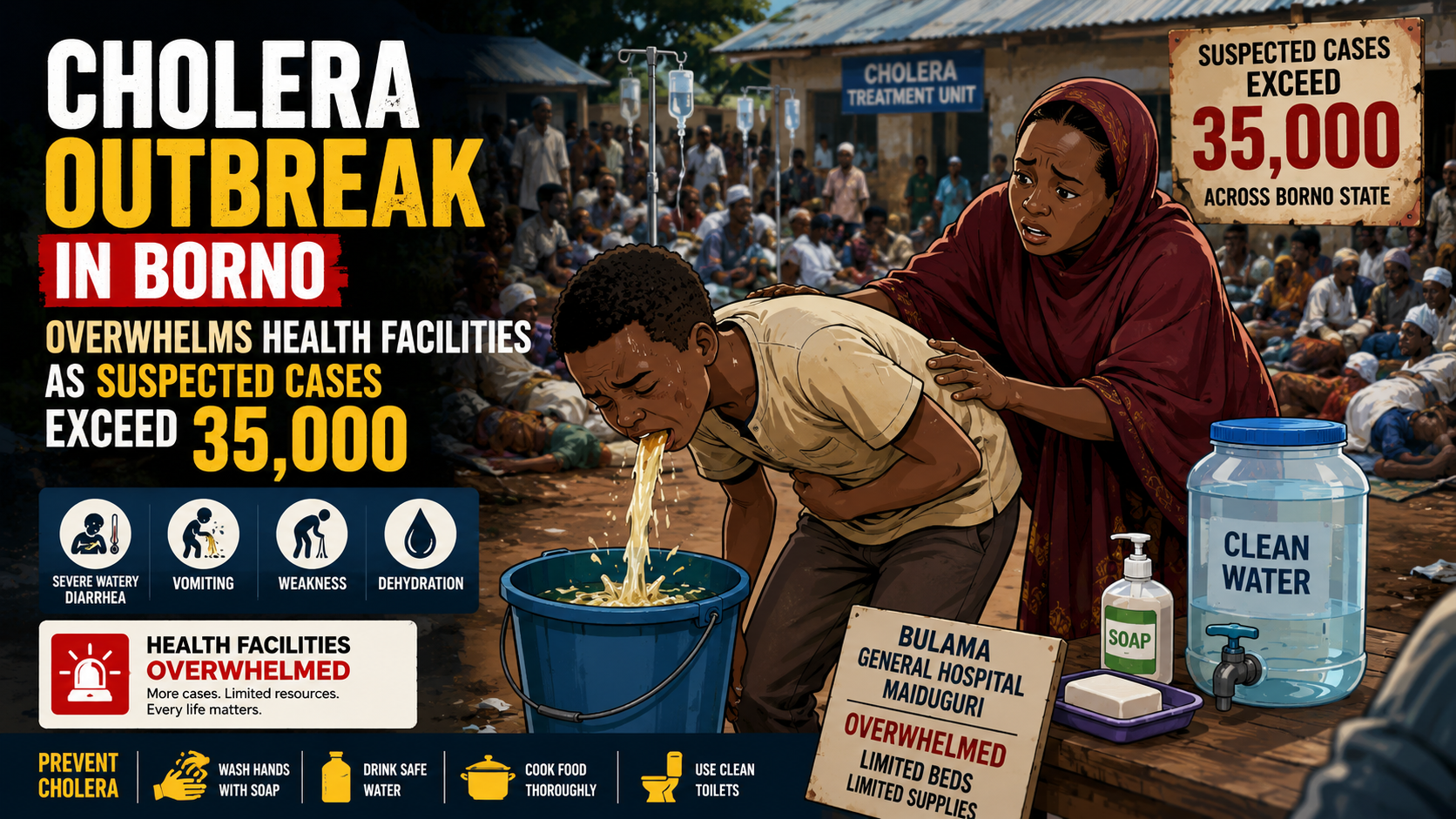

Healthcare facilities in Borno State are under increasing pressure following a rise in suspected cholera cases, with more than 35,500 people infected and 198 deaths recorded since May.
In a statement sent to PREMIUM TIMES on Wednesday, Médecins Sans Frontières (MSF), also known as Doctors Without Borders, cited data from the Borno State Ministry of Health showing that the outbreak has spread rapidly since the first suspected cases were reported on 1 May.
The organisation attributed the surge to overcrowded informal settlements, limited access to safe drinking water, poor sanitation and inadequate waste management.
MSF said the growing number of infections has overwhelmed healthcare facilities, with health workers struggling to keep pace with patients requiring treatment.
Response
Cholera is an acute bacterial infection transmitted through contaminated food and water. It causes severe watery diarrhoea and dehydration, and can become life-threatening within hours if treatment is delayed.

Given the danger of the disease, MSF said it has expanded its emergency response in collaboration with health authorities and other humanitarian organisations by supporting two Cholera Treatment Centres, five Cholera Treatment Units and 17 oral rehydration points across Borno State.
The organisation said it had treated more than 24,000 patients with suspected cholera as of 12 July, adding that more than one in four arrived with severe symptoms.
Speaking on the outbreak, Bienfait Tombola, MSF project medical coordinator in Maiduguri, said the organisation had significantly expanded its response over the past two months.
However, he noted that the disease was continuing to spread faster than efforts to contain it, mainly because many communities still lacked access to clean water, sanitation and healthcare.
Limited awareness
Beyond the strain on health facilities, MSF said limited public understanding of how cholera spreads remains a challenge to containing the outbreak.
READ ALSO: Five dead, 11 cases confirmed in Plateau cholera outbreak
According to the organisation, it has intensified community awareness campaigns, trained healthcare workers in cholera management, and supported water, sanitation, and hygiene interventions, including chlorinating water at key collection points.
It added that health authorities, with support from MSF, conducted an oral cholera vaccination campaign in early July, reaching more than 2.6 million people.
Despite these efforts, the organisation said many communities, particularly those in informal settlements, continue to lack access to safe water, sanitation and healthcare, allowing transmission to persist.
MSF also noted that the outbreak has spread beyond Borno to neighbouring Plateau State, where the state Ministry of Health had reported 102 suspected cholera cases as of 12 July.
The organisation stressed the need to strengthen access to clean water, sanitation, disease surveillance and timely treatment, while expanding vaccination campaigns in affected communities to curb transmission and prevent further deaths.

The Athletics Federation of Nigeria (AFN) has expressed confidence in Team Nigeria’s medal prospects after unveiling a 29-member athletics squad for the 2026 Commonwealth Games in Glasgow, Scotland.
The athletics contingent comprises 16 female and 13 male athletes, blending experienced stars with promising young talents as Nigeria targets a successful outing at one of the Commonwealth’s biggest multi-sport events.
Among the headline names are world record holder Tobi Amusan, sprint sensation Kanyinsola Ajayi, shot put star Chukwuebuka Enekwechi, Rosemary Chukwuma, Favour Ashe, Patience George, Ezekiel Nathaniel, Temitope Adeshina, Esther Joseph and Blessing Ogundiran.
The squad also features exciting youngsters Jessica Oji and Jami Schlueter, who recently switched their sporting allegiance to represent Nigeria, a move the federation believes will further strengthen the country’s athletics programme.
AFN Second Vice President, Akuchukwu Aghazu, described the squad as one of the strongest Nigeria has assembled in recent years.
“We are heading to Glasgow with one of the strongest athletics teams Nigeria has assembled in recent years.
The athletes have shown tremendous commitment in training, and everyone is focused on representing the country with pride,” Aghazu said.
She singled out 19-year-old Jessica Oji and Jami Schlueter for special praise, commending their dedication since joining the national team.
“Jessica and Jami have settled in remarkably well. They are disciplined, dedicated and eager to contribute to Nigeria’s success.
Their commitment has been outstanding, and we are delighted to have them in the Nigerian family.”
Aghazu also applauded the leadership of the National Sports Commission (NSC), led by Chairman Mallam Shehu Dikko and Director General Bukola Olopade, for creating an environment that has encouraged Nigerian-born athletes abroad to commit to representing the country.
According to her, the support provided by the Federal Government through the NSC has enabled the athletes to prepare under favourable conditions ahead of the Games.
She added that the atmosphere at Team Nigeria’s training camp in Aberdeen has been positive, with athletes and coaches united in their quest for success.
“There is a wonderful spirit in camp. The athletes are united, the coaches are working tirelessly, and everyone understands the responsibility of representing over 200 million Nigerians.”
The athletics competition at the Glasgow 2026 Commonwealth Games begins on July 27 and will run for six days.
Meanwhile, AFN President Chief Tonobok Okowa has joined Team Nigeria’s camp in Scotland after official engagements in Egypt and Tunisia.
Okowa, who also serves as Senior Vice President of the Confederation of African Athletics (CAA) and President of CAA Region II, was honoured by the Egypt Athletics Federation and the Tunisia Athletics Federation for his outstanding contributions to athletics development across Africa.
Team Nigeria Athletics Squad (with Events)
Temitope Adeshina
High Jump
Tobi Amusan
100m Hurdles
Ruth Usoro
Long Jump / Triple Jump
Obi Chukwuka
400m
Rosemary Chukwuma
100m / 200m / 4x100m Relay
Patience George
400m / 4x400m Relay
Rosemary Nwankwo
100m / 200m / 4x100m Relay
Esther Joseph
100m / 4x100m Relay
Blessing Ogundiran
400m / 4x400m Relay
Jessica Oji
Shot Put
Olayinka Olajide
100m / 200m / 4x100m Relay
Oyesade Olatoye
Hammer Throw
Prestina Ochonogor
Long Jump
Miracle Ezechukwu
Discus Throw
Favour Onyah
Long Jump / Triple Jump
Obiageri Amaechi
Discus Throw
Kanyinsola Ajayi
100m / 4x100m Relay
Alaba Akintola
400m
Favour Ashe
100m / 4x100m Relay
Chukwuebuka Enekwechi
Shot Put
Chidera Ezeakor
100m
Ezekiel Nathaniel
400m Hurdles / 4x400m Relay
Samuel Ogazi
400m / 4x400m Relay
Israel Okon
100m / 200m / 4x100m Relay
Udodi Onwuzuruike
200m / 4x100m Relay
Edidiong Udo
400m
Adekalu Fakorede
Triple Jump
Jami Schlueter
Pole Vault
Chinekechem Nnamdi
Javelin Throw
Events Represented by Team Nigeria
100m
200m
400m
100m Hurdles
400m Hurdles
High Jump
Pole Vault
Long Jump
Triple Jump
Shot Put
Discus Throw
Hammer Throw
Javelin Throw
4x100m Relay
4x400m Relay
-

 News1 day ago
Gagdi Hails Tinubu’s Infrastructure Drive as Babban Lamba–Sharam Road Project Begins in Plateau
-
News14 hours ago
2027: Atiku, Obi, others should back Tinubu, opposition dead – Abubakar, Fasola
-
News11 hours ago
EFCC Clears NIS Comptroller General Kemi Nandap in Visa Fraud Investigation
-
Events1 day ago
PLABOMA Marks 2026 World Social Media Day, Unveils Unified Bloggers Website in Jos