Health
Fidson mobilises staff, volunteers to clean Lagos communities for World Cleanup Day


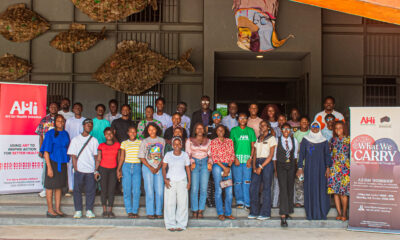
Fidson Healthcare Plc has mobilised its staff and volunteers to clean communities in Lagos as part of activities to mark World Cleanup Day 2026.
The exercise, held on Saturday morning, took place around Obanikoro, Fadeyi, Palmgrove and Shomolu axis of Lagos state, with employees of the company and volunteers participating in the cleanup and environmental hygiene advocacy.
The initiative, tagged Project Clean Sweep 2026, was organised by Fidson in partnership with the African Cleanup Initiative (ACI) as part of its corporate social responsibility (CSR) and sustainability initiative.
The Lagos Waste Management Authority (LAWMA) also participated in the exercise, with its advocacy team supporting the organisers.
World Cleanup Day is an annual global movement held on 20 September to tackle waste pollution and promote sustainable resource management.
Fidson links clean environment to health
In her remarks, Adejoke Alli, the Associate Director of Business Operations at Fidson Healthcare, said the company organised the exercise to contribute to a cleaner and healthier environment in its host community.



“The whole idea is to do our part to ensure that we have a greener Lagos and a greener environment, particularly in our host community around Obanikoro, Fadeyi, Shipeolu and Shomolu, where our head office is located,” Ms Alli said.
“We are very passionate about environmental sustainability. Environmental, Social and Governance (ESG) is also part of our governance framework, so we are particularly interested in ensuring that we maintain an environment with a less carbon footprint, an environment that is clean and habitable, and one that can promote good health.”
She noted beyond just talking or complaining, the organisation decided to take action so that people can see that “we can all make a difference.”
“This is something that we are very proud of, and we hope we’ll continue to do this for the future,” she added.
Tosin Shoboyede, Human Resources Business Partner at Fidson Healthcare, said environmental cleanliness is part of the company’s commitment to its motto, “We value life.”
Mr Shoboyede said maintaining a clean environment was one way of promoting healthy living.
He described the exercise as part of Fidson’s effort to give back to society and contribute to a cleaner environment.
Organisers call for community action
Alexander Kibe, Founder and President of the ACI, said the organisation had been involved in environmental cleanup activities for 16 years, working across Nigeria’s six geopolitical zones.
Mr Kibe said the group was combining the cleanup with advocacy because cleaning the environment without changing people’s behaviour would not provide a lasting solution.

As part of the exercise, the volunteers also went into the market around the area to clean and engage traders on the need to keep their surroundings clean.
“We cannot leave everything to the government,” Mr Kibe said. “As the African Cleanup Initiative, we are playing our part, and Fidson Healthcare is also playing its part.”
He said residents, traders and passers-by also have a responsibility to keep their surroundings clean.
Mr Kibe said the organisers were engaging members of the communities to encourage them to maintain the environment after the cleanup exercise.
Volunteers urge residents to take responsibility
Munnir Adams, Founder of Climb with Me and a volunteer with the ACI, said improving waste management systems would not be enough without citizens taking responsibility for their surroundings.
 Mr Adams said residents should contribute actively to keeping their streets, gutters and areas around their homes clean instead of only complaining about poor waste management.
Rachel Coker, another volunteer with the ACI, said she had participated in the organisation’s activities for more than a year.
Ms Coker said regular environmental sanitation could help reduce exposure to germs and diseases and also contribute to people’s psychological wellbeing.
She said the volunteers were also seeking to set an example for residents and encourage them to make environmental cleanliness a regular habit.
Discover more from Premium Times Nigeria
Subscribe to get the latest posts sent to your email.




The Coordinating Minister of Health and Social Welfare, Muhammad Pate, has said the livestock sector uses more antibiotics than the human health sector.
Mr Pate noted that the responsible use of the drugs in livestock could help reduce the pressure driving antimicrobial resistance (AMR) that can affect humans.
He made the statement on Monday in Abuja at a joint One Health ministerial briefing ahead of the fifth Global High-Level Ministerial Conference on AMR.
Explaining the need for a multi-sectoral approach to AMR, the minister said antimicrobial use in livestock is an important part of the resistance problem.
“The livestock sector uses more antibiotics than the human health sector. So if they are used better, then there’s less pressure for antimicrobial resistance to develop that can affect people,” he said.
Mr Pate said antimicrobial resistance could move between humans, animals and the environment, emphasising the need for collaboration across sectors.
“Much of the zoonotic disease and AMR can come from animal health to humans,” he said, adding that the use of antimicrobials in animal health and human health could have consequences for the wider population.
Prevention before treatment
The minister said efforts to control AMR should not focus only on the treatment of infections but also on preventing diseases that require antimicrobial medicines.
He identified vaccination, hygiene, biosecurity, infection prevention and control, and improved diagnostics as important measures.
“If you can prevent the disease, then you don’t need to use the antimicrobial,” Mr Pate said.
He also urged Nigerians to avoid using antibiotics unnecessarily, noting that not every cough or catarrh requires antibiotic treatment.
“It’s not every cough that needs to use antibiotics. It’s not every catarrh that needs to use antibiotics, please consult a doctor,” he said.
Livestock practices
The Minister of State for Agriculture and Food Security, Aliyu Abdullahi, said AMR also poses a threat to agriculture and food security.
Mr Abdullahi said inappropriate or excessive use of antimicrobials and agrochemicals could undermine disease control, food safety, trade and livelihoods.
According to him, the agriculture sector is prioritising responsible use of antimicrobials, farmer education, extension services, good agricultural practices and biosecurity.
One Health approach
The Minister of Environment, Balarabe Lawal, said AMR cuts across human, animal and environmental health.
READ ALSO: CSOs demand disclosure of JBS $2.5bn Nigeria deal, warn of livestock expansion risks
“Resistance does not respect boundaries. It cuts across sectors. It moves from people to animals, from farms to food, and through water, soil, and waste systems,” Mr Lawal said.
The ministers’ meeting is part of preparations for the fifth Global High-Level Ministerial Conference on AMR, which will be held in Abuja from 6 to 8 December.
The conference is the first global high-level ministerial conference on AMR to be held in Africa, with the theme, “One Healthcare: Advancing global AMR commitments to local action.”
Discover more from Premium Times Nigeria
Subscribe to get the latest posts sent to your email.

The federal government has announced plans to invest an additional $3 billion in Nigeria’s health sector by 2030 as part of efforts to reduce dependence on foreign assistance and strengthen domestic health financing.
The Coordinating Minister of Health and Social Welfare, Muhammad Pate, said this on Monday in Abuja at a media conference announcing the fifth Global High-Level Ministerial Conference on AMR, scheduled for 6 -8 December, 2026.
Mr Pate said the conference, the first to be hosted on African soil, would focus on translating global commitments into practical actions with the theme, “One Health: Advancing Global AMR Commitment through Local Action”.
He was responding to questions on the health Memorandum of Understanding (MoU) between Nigeria and the United States.
The News Agency of Nigeria (NAN) reports that Nigeria and the United States signed a five-year bilateral health MoU on 19 December 2025, under the US America First Global Health Strategy.
Mr Pate said the planned investment was part of a transition arrangement under which both countries would work towards Nigeria fully financing its health sector by 2030.
“From now until 2030, the expectation is that the federal government will put in $3 billion into health, which is more than what the US government will contribute as it ramps down its contribution,” he said.
He said the arrangement reflected Nigeria’s position that long-term dependence on external assistance was not in the country’s national interest.
“Our position is that dependency in the long run is not in our national interest on external support,” he said.
“We articulated that we want Nigeria to exit from dependency from other entities over time.”
Health financing
Mr Pate acknowledged that achieving self-sustaining health financing would require increased domestic investment, noting that Nigeria was not yet in a position to fully fund its health sector.
He said 15 Nigerian government institutions, including the ministries of Foreign Affairs, Finance, and Health and Social Welfare, participated in articulating Nigeria’s position during negotiations with the United States.
According to him, the US had supported health programmes in Nigeria for about 25 years, including interventions for HIV, tuberculosis and malaria, benefiting millions of Nigerians.
However, following a shift in US government policy in 2025, Nigeria decided to assume greater responsibility for financing its health programmes.
“How do we own it responsibly? So, with the US government, we agreed that we will have a transition. By 2030, they exit and we exit. That means we fully fund our health sector,” he said.
Mr Pate said President Bola Tinubu had increased domestic health allocations, including providing six per cent of the government budget for health, as part of efforts to strengthen Nigeria’s contribution.
He emphasised that sustainable financing would require all three tiers of government to increase spending on citizens’ health.
Mr Pate said the transition was intended to strengthen Nigeria’s ownership of health programmes and reduce reliance on funding decisions made by other countries.
“We cannot rely on somebody else’s taxpayers funding for the health of Nigerians,” he said.
On concerns surrounding the MoU, Mr Pate described it as a non-binding framework for cooperation, anchored on Nigeria’s national policies and laws.
“The MoU that was signed with the US government is a non-binding MoU. It is anchored on Nigerian policy, national policies and laws, does not subvert our sovereignty or subvert US government sovereignty over their resources.
“It’s also one that either party can walk away at any time,” he said.
Mr Pate said the Attorney-General of the Federation had also confirmed that the agreement contained nothing that subverted Nigeria’s national interest.
He added that the MoU was publicly available and interested parties could request a copy from the ministry through the Freedom of Information process.
READ ALSO: Nigeria is building a sustainable health financing future, By Muhammad Ali Pate
The minister said the agreement aligned with the government’s Health Sector Renewal Investment Initiative, which prioritises improved governance, stronger primary healthcare, expanded health insurance coverage, domestic production and increased health security.
He said the cooperation would support public health and laboratory capacity, including the detection of antimicrobial resistance, while promoting local capacity to produce essential health commodities.
Mr Pate said strengthening domestic production and ensuring local markets could supply essential medicines, including antimicrobials, were important steps towards reducing external dependence.
He said the transition would require sustained efforts and domestic investment to ensure Nigeria could finance its health priorities as external contributions declined.
Mr Pate urged Nigerians to examine the agreement and its provisions, saying the government’s objective was to strengthen national ownership of health financing and service delivery.
(NAN)
Discover more from Premium Times Nigeria
Subscribe to get the latest posts sent to your email.
-
News4 days ago
Inside INEC’s AI and cybersecurity plans to secure Nigeria’s 2027 Elections – Technology Times
-

 News3 days ago
Petra Power looks to modernize energy for data centers and defense vehicles
-
News3 days ago
EuroMatch NPFL: Ikorodu City Return to Winning Ways as Salami, Ikechukwu Sink Kwara United in Lagos
-
News3 days ago
Microsoft’s Satya Nadella says AI models need an ‘emergency brake’