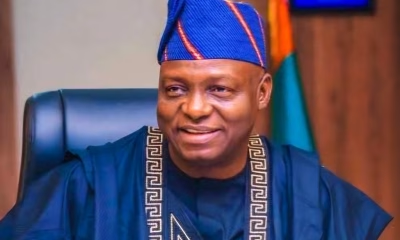
Ogun State Governor, Prince Dapo Abiodun, has moved to reconcile aggrieved members of the All Progressives Congress (APC) who lost in the party’s recent primaries, assuring them that there would be room for all within the party.
Abiodun, who spoke on Monday in Ijebu-Ode during a meeting with APC leaders and stakeholders in Ijebu-Ode Local Government Area, directed the immediate establishment of a reconciliation committee to reach out to aggrieved members, address their concerns and give them a sense of belonging.
The Governor said the reconciliation effort was critical to strengthening the party ahead of the 2027 general elections, stressing that those who contested and lost the primaries remained important members of the APC.
“I want us to set up a reconciliation committee in Ijebu-Ode because I know that we have some of our members who are still angry. I want us to be aggressive about that reconciliation. Let us appeal to them. I am ready to implement the report of the reconciliation you will submit to me,” he said.
Recommended
Abiodun directed that the committee be headed by Chief Olu Okuboyejo, with former Deputy Governor Yetunde Onanuga and state commissioners serving as members.
He also directed that similar reconciliation committees be established at the ward and local government levels to ensure that no aggrieved member was left out of the process.
The Governor assured party members that the objective was not only to reconcile those who lost in the primaries but also to accommodate everyone who remained committed to the party.
“We must reach out to them, give them a sense of belonging, assuage their concerns and ensure proper reconciliation. There is room for everybody,” he said.
Abiodun said elections were about numbers, urging party leaders to bring back members who might have become aggrieved while simultaneously expanding the APC’s membership base by welcoming new members from opposition parties.
“Those who were not with us before were the ones disturbing us and making sure our votes in Ijebu-Ode are not 100 per cent. But now that they are with us, our victory is certainly 100 per cent sure. Let us welcome them,” he said.
The Governor urged party members to concentrate on issue-based campaigns, saying the APC had a record of performance at both the state and federal levels.
He said his administration had grown Ogun State’s economy to about N17 trillion, while internally generated revenue had risen to N250 billion and was projected to reach N300 billion before the end of the year.
Abiodun described the meeting as the formal commencement of his political activities ahead of the 2027 general elections and appreciated the people of Ijebu-Ode for their support for the APC in the 2019 and 2023 elections.
He assured the people that his administration would continue to improve infrastructure and deliver more dividends of democracy to the area.
The Director-General of the Campaign Committee, Senator Lekan Mustapha, said Ijebu-Ode, being the headquarters of Ogun East Senatorial District, had a significant voter population that must be effectively mobilised for the party ahead of the elections.
He noted that the local government had 161 polling units, stressing the need for effective mobilisation across all the units.
The Governor later held similar meetings with APC leaders and executives in Ijebu-North East and Odogbolu Local Government Areas as part of efforts to strengthen the party’s structure ahead of the 2027 elections.
Africa Finance Corporation (AFC), the continent’s leading infrastructure solutions provider, has announced the appointment ofMr. Olayemi Cardoso, Governor of the Central Bank of Nigeria (CBN), as Chairman of its Board of Directors.
He succeeds the immediate–past Chair,Ireti Samuel-Ogbu, who served the Corporation meritoriously during her tenure and continues to serve as a board member.
Cardoso brings extensive experience spanning international banking, investment management, economic policy and public sector leadership.
Since assuming office as Governor of the CBN in September 2023, he has led a far-reaching programme of monetary, financial-sector, and institutional reforms to restore macroeconomic stability, strengthen policy credibility, and rebuild investor confidence in Nigeria’s economy.
Under his leadership, the CBN has implemented significant reforms to Nigeria’s foreign exchange market, addressed longstanding foreign exchange obligations, strengthened monetary policy transmission, and enhanced institutional governance and transparency.
The Bank has also concluded a recapitalisation programme for the banking sector, aimed at strengthening the resilience and capacity of Nigeria’s financial system to support sustainable economic growth.
Prior to his appointment as Governor, Mr Cardoso built a distinguished career in international banking and public service, including a 12-year tenure as Chairman of Citibank Nigeria and service as Commissioner for Economic Planning and Budget in Lagos State.
In the latter role, he contributed to economic planning and fiscal management in one of Africa’s largest economies.
He holds a degree from Aston University in the United Kingdom and a master’s in public administration from Harvard Kennedy School, where he also served on the Alumni Board.
Mr Cardoso’s appointment comes as AFC continues to expand its role in financing and developing strategic infrastructure assets that address Africa’s infrastructure gap, accelerate industrialisation and strengthen regional integration.
His experience in financial sector reform, institutional governance and capital markets will providevaluable perspective on the Corporation’s strategic direction as it mobilises investment to unlock Africa’s economic potential.
Samaila Zubairu, President & CEO of AFC, said: “We are delighted to welcome Mr Cardoso as our Board Chairman. He shares our conviction that Africa’s lasting stability depends on its productive capacity. His leadership will strengthen AFC as we advance The Africa We Build 2050, mobilising African capital to build the infrastructure and industries that create jobs, prosperity and dignity for our people.We also sincerely thank Mrs Samuel-Ogbu for her dedication and contribution to AFC‘s board during her tenure.”
Mr. Cardoso commented on his appointment, saying: “A more productive Africa is a more stable Africa. AFC has the credibility and track record to mobilise capital and build the infrastructure and industries that drive transformation. I look forward to working with the Board, management and member states to advance The Africa We Build 2050. Our measure of success must be the productive capacity we create, the industries we enable and the jobs we support.”
AFC continues to advance transformational infrastructure and industrial investments across Africa, with recent milestones including achieving financial close on the US$753 million Lobito Corridor Railway Project in Angola, to support the rehabilitation, upgrade, and long-term operation of the 1,300-kilometre brownfield rail corridor; supporting a US$600 million facility for Dangote Group’s US$7 billion fertiliser expansion programme to scale production in Nigeria; and committing to a combined US$300 million investment alongside Vision Invest in WIOCC Group to accelerate the expansion of critical digital infrastructure across the continent. These investments reflect AFC’s unique approach to developing strategic infrastructure platforms that connect markets, strengthen industrial value chains and mobilise capital at scale to drive Africa’s economic transformation.
About AFC
AFC was established in 2007 to be the catalyst for pragmatic infrastructure and industrial investments across Africa. AFC’s approach combines specialist industry expertise with a focus on financial and technical advisory, project structuring, project development, and risk capital to address Africa’s infrastructure development needs and drive sustainable economic growth.
Nineteen years on, AFC has developed a track record as the partner of choice in Africa for investing and delivering on instrumental, high-quality infrastructure assets that provide essential services in the core infrastructure sectors of power, natural resources, heavy industry, transport, and telecommunications. AFC has 49 member countries and has invested over US$20 billion in 36 African countries since its inception.
Lagos State is investing $22 million to develop a unified 6,000-kilometre digital network, a major expansion of the fibre infrastructure the government says is needed to support connectivity, digital public services and the state’s growing technology-driven economy.
The proposed network builds on approximately 3,000 kilometres of fibre ducts and networks already laid across the state, potentially giving Lagos a significantly broader digital infrastructure footprint as it seeks to connect more locations and strengthen the backbone supporting its digital economy.
Dr Kadri Obafemi Hamzat, Deputy Governor of Lagos State, disclosed the investment on Tuesday at the fifth edition of TeXcellence, held at the Landmark Event Centre in Lagos.
Dr Kadri Obafemi Hamzat, Deputy Governor of Lagos State, Image credit: LASG.
“Africa’s challenge is no longer a shortage of innovation but the inability to scale successful ideas into sustainable systems that deliver widespread economic and social benefits,” Hamzat said. For Lagos, the proposed 6,000-kilometre network is part of the infrastructure required to close that gap between digital innovation and mass adoption.
With fibre, Lagos broadens digital infrastructure footprint
The scale of the proposed network places fibre infrastructure at the centre of Lagos State’s digital transformation strategy. Beyond providing connectivity, the network is expected to support internet access, digital government services and technology-enabled economic activities across the state.
The announcement comes as Lagos continues to expand the use of digital platforms for public administration and service delivery, increasing the importance of resilient and widely available connectivity infrastructure.
Speaking at the event, themed “Accelerating Africa’s Digital Future Lacks Direction and a Sustained Force,” Hamzat said Africa’s technology challenge was no longer a shortage of innovation but the difficulty of scaling successful ideas into sustainable solutions capable of reaching millions of people.
“Africa’s challenge is no longer a shortage of innovation but the inability to scale successful ideas into sustainable systems that deliver widespread economic and social benefits,” Hamzat said.
For Lagos, the proposed 6,000-kilometre network is part of the infrastructure required to close that gap between digital innovation and mass adoption.
The deputy governor called on governments and private sector organisations to sustain investment in digital infrastructure, establish predictable policies and implement institutional reforms that would enable technology innovations to deliver wider economic and social benefits.
He also called for the removal of bureaucratic bottlenecks that constrain technology businesses and innovators, arguing that a more enabling environment would allow businesses to expand and develop solutions addressing societal challenges.
Digital infrastructure underpinning public services
Hamzat linked the state’s infrastructure investments to broader digital reforms already taking place across Lagos.
He disclosed that more than 6.4 million residents had been enrolled in the state’s resident identity system, while digital reforms had streamlined processes including physical planning permits and mortgage consent applications.
The figures illustrate the growing dependence of government services on digital infrastructure, with the proposed fibre network potentially providing a broader connectivity backbone for the delivery and expansion of such services.
The government’s digital infrastructure programme, he added, also extends to support for research and technology businesses through the Lagos State Science Research and Innovation Council (LASRIC).
Hamzat said LASRIC had supported 80 researchers and more than 75 startups, while approximately ₦1 billion was available in grants for innovators.
The state is also considering an innovation law that would commit a fixed proportion of its annual budget to research, development and risk capital.
According to Hamzat, such a framework would create a more predictable funding structure for researchers and technology businesses developing locally relevant solutions.
He further called for stronger collaboration between government and industry, proposing measurable commitments from both sides to accelerate digital transformation.
Fibre network as digital economy backbone
The proposed 6,000-kilometre network is significant because of the role fibre infrastructure plays in supporting high-capacity digital connectivity.
With approximately 3,000 kilometres of fibre ducts and networks already laid, the new investment would build on an existing infrastructure base rather than starting from scratch.
The resulting network is expected to provide infrastructure that can support the increasing demand for internet connectivity, cloud-based services, digital government platforms, technology businesses and other data-intensive activities.
However, the announcement did not provide details on the geographical coverage of the proposed 6,000-kilometre network, its implementation timeline, funding structure beyond the disclosed $22 million investment or specific completion targets.
Africa must build digital sovereignty
At the same event, Adewale Adeyipo, Group Managing Director and Chief Executive Officer of CWG Plc, urged African governments and technology companies to prioritise digital sovereignty, local artificial intelligence infrastructure and sustainable technology deployment.
Adeyipo said Africa must take deliberate steps to own and shape its digital future rather than depend solely on technologies and infrastructure developed elsewhere.
He called for increased investment in local computing infrastructure, affordable digital devices and digital literacy, while stressing the need to move artificial intelligence solutions beyond experimental projects into reliable and commercially viable systems.
According to him, Africa’s digital transformation requires clear direction, sustained investment and measurable outcomes rather than speed alone.
The discussions at TeXcellence reinforced the importance of coordinated investment in infrastructure, innovation and technology deployment if digital transformation is to reach a larger proportion of the population.