Connect with us

News

2027: Osun already in bag for Tinubu – Bashir Ahmad

info

Published

on

Bashir Ahmad.jpeg

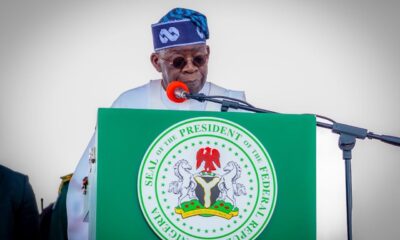
Former presidential aide, Bashir Ahmad, has expressed the optimism that President Bola Tinubu already has the backing of Osun State in the 2027 general elections.
Ahmad made this statement in a post on his verified X handle on Thursday.

This came after Osun State Governor, Ademola Adeleke on Thursday visited Tinubu alongside other members of the state chapter of Accord Party and presented him his Certificate of Return.

Reacting, Ahmad said, “President Bola Tinubu has Osun on both sides, with the ruling party (Accord) and the main opposition (APC) both firmly within his political orbit.

“For President Tinubu, Osun is already in the bag. The political dynamics in the state have already pointed in one direction, the Renewed Hope and victory in 2027.”

DAILY POST reports that Adeleke won the August 15, 2026 election after polling 511,067 votes against his opponent, Bola Oyebamiji of the All Progressives Congress, APC, who polled 444,815 votes.

Najeem Salaam of the African Democratic Congress, ADC, scored 17,180 votes coming third on the ballot.

Continue Reading
Click to comment

Leave a Reply

Your email address will not be published. Required fields are marked *

News

Nigeria to give 5m students 100MB free daily data from October 1 – Technology Times

info

Published

on

By

Image fx 2025 09 22T120537.842.png

The Nigerian Communications Commission (NCC) says about five million students will receive 100MB of free daily data to access approved educational platforms from October 1, 2027, under a new zero-rating initiative aimed at reducing the cost of digital learning.

The programme will initially cover students in public senior secondary schools and public tertiary institutions, allowing beneficiaries to access approved learning platforms and digital educational resources without their regular data balances being deducted.

Participating mobile network operators will provide the daily zero-rated allocation for websites and platforms approved by the NCC and the Federal Ministry of Education.

The approved platforms are expected to include learning management systems, digital libraries, educational repositories, teacher development platforms, and technical and vocational training platforms.

Ayuba Shuaib, NCC Director of Policy, Competition and Economic Analysis, says the initiative was developed in response to sustainability challenges associated with previous government interventions that provided schools with internet connectivity.

Earlier interventions supplied schools with ICT equipment and internet connectivity, but many institutions struggled to renew bandwidth subscriptions after the initial government support expired, according to Shuaib. 

He says the NCC also lacked sufficient resources to continually renew connectivity for all beneficiary schools, prompting the commission to adopt a different model.

Under the new approach, telecoms operators will zero-rate access to selected educational platforms through an operator-sponsored model.

Dr Maruf Tunji Alausa, Minister of Education. Image credit:NCC.

The scale of the intervention could also represent significant value in data costs. Based on Alausa’s calculation, five million users accessing 100MB of free data daily would amount to about ₦15 billion worth of data per month, assuming a value of approximately ₦100 for each 100MB daily allocation. For each beneficiary, the 100MB daily allowance translates to about 3GB of zero-rated access per month.

100MB daily allocation

Rimini Haraya Makama, NCC Executive Commissioner, Stakeholder Management, says the initiative reflects the growing role of internet connectivity in education.

“Learning has moved online. Today, students rely on online courses, digital libraries, virtual classrooms as much as they rely on textbooks and teachers. For them, connectivity is no longer a convenience; it’s part of how education happens,” Makama says.

The initiative is expected to reduce the cost barrier for students who require internet access for assignments, research, online courses and other educational activities but cannot consistently afford data subscriptions.

Dr Maruf Tunji Alausa, Minister of Education, adds that the programme is both an education and inclusion intervention.

“Digital platforms are of little value to a child who cannot afford the data needed to access them,” Alausa says.

The minister says the zero-rating initiative will particularly benefit students who have access to smartphones, tablets or computers but struggle to pay for internet connectivity.

The scale of the intervention could also represent significant value in data costs. Based on Alausa’s calculation, five million users accessing 100MB of free data daily would amount to about ₦15 billion worth of data per month, assuming a value of approximately ₦100 for each 100MB daily allocation. For each beneficiary, the 100MB daily allowance translates to about 3GB of zero-rated access per month.

Aminu Maida, NCC Executive Vice-Chairman and Chief Executive Officer, says the 100MB limit was deliberately set with sustainability in mind and to avoid placing an excessive burden on participating network operators.

Access restricted to approved platforms

The free allocation will not provide unrestricted internet access. Only educational platforms and content approved under the framework developed by the NCC and Federal Ministry of Education will qualify for zero-rated access.

Alausa says the government will not approve platforms simply because they describe themselves as educational. “Zero-rating should not mean indiscriminate access to every platform that describes itself as educational,” he says, adding that educational content must be “credible, safe, appropriate and aligned with curriculum.”

Participating platforms will also be required to comply with telecommunications laws and regulations covering cybersecurity, consumer protection, child protection and data protection.

The NCC says the framework will include safeguards covering net neutrality, fair competition and inclusivity. The commission will monitor implementation through quality assurance and periodic impact assessments to determine whether the programme is delivering its intended benefits to learners.

Part of wider education digitalisation

The initiative forms part of the Federal Government’s broader efforts to expand digital technology across Nigeria’s education system.

Alausa says digitalisation is central to the Nigeria Education Sector Renewal Initiative, while the Federal Ministry of Education is implementing the Nigeria Education Data Initiative to establish a unified national education data architecture.

The ministry is also digitising the annual school census, while more than 240,000 schools have been geomapped or geolocated, according to the minister.

The government is also developing a Learner’s Identification Number, which is expected to provide every Nigerian learner with a unique education identity and enable learners to be tracked through the education system from primary to tertiary level.

The free data programme is expected to begin with senior secondary and tertiary students before expanding to other categories of learners.

Idris Olorunnibe, NCC Chairman, has urged telecoms operators to support the initiative, describing it as an investment in Nigeria’s future.

The commission says the programme is designed to move beyond previous short-term connectivity interventions by creating a more sustainable mechanism for students to access digital educational resources.

With implementation scheduled to begin on October 1, 2027, about five million Nigerian students are expected to receive an initial daily allocation of 100MB for approved educational platforms, potentially reducing one of the major cost barriers to digital learning.

Continue Reading

News

NDC chieftain warns against altering Kaduna governorship primary process

info

Published

on

By

NDC.jpg

A chieftain of the Nigeria Democratic Congress (NDC) in Kaduna State, Ibrahim Muhammad, has appealed to the party leadership not to attempt to alter the already established primary election process in the state.

In a statement issued on Friday in Kaduna, he explained that the matter deserved careful attention, saying that the process of selecting a party’s candidate is central to internal democracy, fairness and the confidence of party members.

Some members of the party are calling for a primary election to select the governorship candidate, alleging that no consensus arrangement was reached to produce a candidate to contest the 2027 election in the state.

According to Muhammad, “Where a primary-election procedure has already been established and communicated, any attempt to change it should be undertaken strictly in accordance with the NDC Constitution, applicable electoral law, the party’s approved guidelines and INEC regulations. INEC’s current regulations specifically provide procedures for changing the type of primary already submitted to the Commission, including the requirement to notify INEC and state reasons for the proposed change.”

Recommended

He stated that any unilateral attempt to replace or substantially alter the Kaduna primary process without the required constitutional authority, consultation and regulatory compliance could raise serious questions of legality and internal democracy.

Muhammad averred that the appeal was for fairness, transparency and respect for established democratic procedures, pointing out that every aspirant and every member deserved confidence that the process would not be changed in a manner that unfairly affected participation or the outcome.

He also appealed to Henry Seriake Dickson, Mr Peter Obi, Dr Rabiu Musa Kwankwaso, the Kaduna State leadership and all NDC stakeholders to carefully examine the matter and ensure that no action was taken outside the party’s constitutional framework and the applicable requirements of INEC.

“Kaduna State is too important to the political development of the NDC for an avoidable internal dispute to undermine the confidence of its members and supporters. A transparent and lawful primary process will strengthen the party, regardless of which aspirant ultimately emerges,” he said.

Continue Reading

Trending