
News
Majekodunmi Charges Southwest Coaches to Sustain Unity, Strengthen Collaboration With State FAs


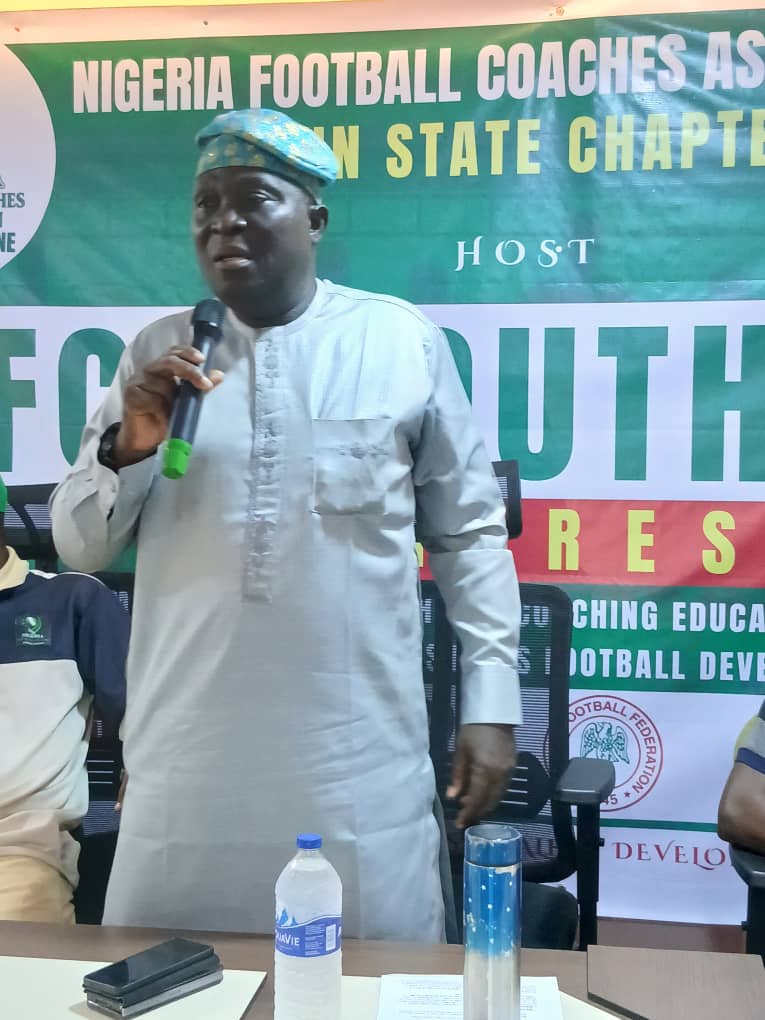
Ogun State Football Association Chairman, Alhaji Ganiu Adesina Majekodunmi, has urged members of the Nigeria Football Coaches Association (NFCA) across the Southwest to sustain unity, continue to respect their leadership structure and strengthen collaboration with their respective State Football Associations to advance football development in the region.
Sports247 reports that Majekodunmi made the call while addressing delegates at the Nigeria Football Coaches Association Southwest Congress held at the SWAN Press Room, MKO Abiola Sports Arena, Abeokuta.
The FA chairman acknowledged the significant contributions of football coaches to grassroots development, describing them as the root and foundation of the football development structure.
He commended their commitment to identifying, nurturing and developing young talents, while noting that coaches and football administrators have complementary responsibilities in the growth of the game.
According to him, while coaches are responsible for developing players and improving their technical abilities, football administrators play a critical role in managing the administrative and political structures that shape the sport.
Majekodunmi particularly charged the NFCA to preserve the unity within its ranks, stressing that mutual respect, cooperation and collective commitment remain essential to achieving meaningful progress.
He also emphasised the importance of respecting past executives and acknowledging their contributions to the association, describing such recognition as a necessary part of building a strong and united organisation.
Addressing the challenges surrounding football administration, the Ogun FA chairman expressed optimism that the ongoing normalisation process would bring positive changes to the football landscape.
He encouraged coaches across the Southwest to establish stronger working relationships with their respective State Football Associations, insisting that collaboration between coaches and administrators would create better opportunities for football development.
Majekodunmi further challenged other states in the region to emulate Ogun and Osun States following their recent CAF D coaching courses, describing such initiatives as important steps towards improving coaching standards and strengthening grassroots football.
He urged the coaches to continue investing in professional development and embrace opportunities that would improve their technical knowledge and coaching capacity.
His message reinforced the need for unity, institutional cooperation, respect for leadership and continuous capacity building as essential ingredients for the sustainable development of football across Southwest.





FCMB Group anchored its 85.7 per cent leap in net profit for the nine months to September, compared to a year ago, on growth in gross earnings and cost efficiency in some of its key expenditure categories, the latest corporate results of the financial institution showed on Friday.
Revenue jumped by 21 per cent to ₦1 trillion. At the same time, net interest income rose to ₦534.2 billion from ₦350.8 billion, boosted by lower costs on interest-bearing liabilities such as deposits, borrowings and debt securities.
Net fee and commission income rose to ₦81.9 billion from ₦56.2 billion, jointly boosted by increased fee and commission income and reduced fee and commission expense.
The group’s digital business, comprising payments, lending and wealth, reported a 25.4 per cent surge in digital revenue and accounted for 14.2 per cent of gross earnings.
“We expect continued earnings momentum in the fourth quarter, supported by lower operating expenses following the full recognition of the 2026 AMCON levy within the nine months, alongside a seasonal uplift in digital lending and payments activity,” CEO Ladi Balogun said in a separate document on Friday.
“With nine-month ROE at 30 per cent, we expect full-year ROE to be materially above an earlier guidance of 25 per cent, providing a strong foundation for further profitable growth and sustained shareholder value creation,” he added.


Net trading income plunged by 83.4 per cent to ₦6.2 billion, taking a hit from a loss on bond trading income and a sharp decline in treasury bills trading income as well as in Eurobonds trading income.
Earnings performance was further boosted by other income, which swelled more than tenfold to ₦9.7 billion, thanks to a gain on the sale of property and equipment.
FCMB Group provisioned ₦76.8 billion to cover impaired assets whose recovery is doubtful, up from ₦57.1 billion a year earlier.
Profit before tax more than doubled to ₦272.6 billion, while profit after tax climbed to ₦232.9 billion from ₦125.5 billion.
READ ALSO: FCMB Group sustains performance, reports 99% growth in profit before tax to N157.3bn
On the balance sheet side, total assets rose 9.7 per cent to ₦8.4 trillion, driven by higher cash and cash equivalents and, in part, by increased investment securities.
FCMB Group is the top shareholder of Olatunde International Limited, an Akure-based cocoa exporter, holding 8 per cent of its share capital.
Discover more from Premium Times Nigeria
Subscribe to get the latest posts sent to your email.

The Nigeria Revenue Service (NRS) has given cryptocurrency exchanges and other virtual asset service providers (VASPs) operating in Nigeria or serving Nigerian residents until November 30, 2026, to register on a new technology-driven tax compliance portal, extending the requirement to foreign-based digital asset platforms with Nigerian customers.
The initiative introduces a centralised technology platform for administering tax obligations arising from virtual asset activities and monitoring compliance across Nigeria’s expanding digital asset ecosystem, with affected businesses required to complete technical integration with the portal by December 31, 2026.
The development brings a broader category of cryptocurrency businesses, including exchanges, custodians, trading platforms, payment providers and digital asset transfer operators, within a more structured tax administration framework, irrespective of whether they maintain a physical presence in Nigeria.

The move, according to the NRS, aligns with Recommendation 15 of the Financial Action Task Force (FATF), which establishes international standards for addressing money laundering and terrorist financing risks associated with virtual assets and their service providers.
In a public notice, the NRS said the requirements apply to persons engaged in virtual asset activities under the Nigeria Tax Act, 2025, and the Nigeria Tax Administration Act, 2025.
The service explained that the VASP Tax Portal was developed to automate the administration of tax obligations arising from virtual asset activities and facilitate registration for anti-money laundering, counter-terrorist financing and counter-proliferation financing (AML/CFT/CPF) purposes.
The move, according to the NRS, aligns with Recommendation 15 of the Financial Action Task Force (FATF), which establishes international standards for addressing money laundering and terrorist financing risks associated with virtual assets and their service providers.
NRS: Foreign crypto platforms serving Nigerians included
A significant aspect of the new requirements is their application beyond cryptocurrency businesses physically established in Nigeria.
The NRS said all persons providing virtual asset services in Nigeria or to Nigerian residents must register, regardless of whether they have a physical presence in the country.
This means foreign-based cryptocurrency exchanges and other digital asset businesses serving Nigerian customers are also covered by the registration and integration requirements.
The categories of businesses affected include operators involved in exchanging virtual assets for conventional currencies, cryptocurrency-to-cryptocurrency exchanges, digital asset transfers, custody and administration services, and operators of virtual asset trading platforms.
The requirements also extend to payment and settlement services involving virtual assets, remittance operators, and businesses providing staking, lending, borrowing, issuance and distribution of digital assets.
The broad scope of the notice places businesses across different segments of the virtual asset value chain within the NRS’s tax administration and AML/CFT/CPF registration framework.
Two compliance deadlines for crypto businesses
The NRS has established two separate deadlines for affected businesses to comply with the new requirements.
Businesses must submit their registration forms through the NRS portal by November 30, 2026, while technical integration with the platform must be completed by December 31, 2026.
To complete the process, affected businesses are required to submit the registration form through the NRS portal and subsequently integrate their operations with the platform.
The service warned that businesses that fail to comply with the stipulated timelines could face penalties and other enforcement measures under relevant laws.
It also clarified that the phased implementation of the portal does not suspend tax compliance obligations already applicable to virtual asset businesses.
Portal does not introduce new cryptocurrency tax
The NRS has sought to distinguish the introduction of the technology platform from the creation of additional taxes on cryptocurrency transactions or virtual asset activities.
“The VASP Tax Portal does not impose any new tax or create any new tax obligation,” the agency stated.
It added that the platform provides the technology through which it administers applicable tax obligations arising from virtual asset activities while facilitating registration for AML/CFT/CPF purposes.
The service also clarified that registration on the portal does not automatically grant a licence or authorisation to provide virtual asset services in Nigeria.
This distinction separates the NRS’s tax and compliance registration process from the regulatory approval that may be required to operate as a virtual asset service provider in the country.
The introduction of the portal adds another layer of compliance requirements for Nigeria’s digital asset ecosystem, bringing cryptocurrency exchanges, custodians, payment providers and other virtual asset businesses into a more structured tax administration and financial compliance framework.
For foreign-based platforms, the requirement to register and integrate with the portal means that serving Nigerian residents carries tax administration and compliance obligations under the applicable Nigerian laws, even where the service provider operates from outside the country.
Affected businesses can access the registration form through the NRS portal at https://vasp.nrs.gov.ng/register.
According to the agency, requests for clarification and technical support can be directed to [email protected].
-

 Business1 day ago
Elon Musk Launches X Money, Bringing Banking and Payments to Social Media Platform
-
Health2 days ago
JUTH Student Nurse Anaesthetist Dies After Collapsing During Football Match in Jos
-
News1 day ago
OPEP troops arrest 21-year-old suspected child trafficker, rescue five minors in Plateau
-
News2 days ago
Canadian Police Arrested ‘Lagos BigBoy’ Tosin Damilola Oyebade, 11 Others Over $4.5m Stolen Vehicle Network


