Business
OPay lists on NYSE, raises $304m in IPO at $4 billion valuation


OPay, a Nigeria-focused digital financial services company, has listed on the New York Stock Exchange (NYSE), raising $304 million in its initial public offering (IPO) and securing a market capitalisation of more than $4 billion.
The company began trading on Friday, pricing its offering at $19 per American Depositary Share (ADS). It sold 16 million ADSs, with each representing 10 ordinary shares.
According to the company, the United States Securities and Exchange Commission declared its registration statement effective on 29 October, and the offering was expected to close on 2 November.
Lars Boilesen, OPay’s co-chief executive officer, said the listing marked a significant milestone for the company and Nigeria’s financial technology sector.
“Today, OPay serves over 50 million monthly active users across Nigeria, Egypt, Pakistan, and Indonesia. Since launching in Nigeria eight years ago, we have pioneered seamless digital payments to become the country’s leading digital financial platform,” he said.
Mr Boilesen said the company had recorded a 9.9 per cent market share across Africa and the Middle East based on monthly average users in the first half of 2026.


He said OPay saw further growth opportunities in Nigeria, where an estimated 40 million adults remained outside the formal financial system.
“Our journey is just beginning. In Nigeria, an estimated 40 million adults remain outside the formal financial system,” he said.
He added that the company intended to apply its experience in Nigeria to other emerging markets, where young populations and increasing mobile internet access were expanding demand for digital financial services.
Stephen Wen, another co-chief executive officer of OPay, said the company was positioned to expand across emerging markets, citing growing smartphone penetration and demand for accessible financial services.
“In Nigeria, more than 60 per cent of the population are underserved by traditional banks and rely on cash. As we grow, we will stay focused on solving our customers’ pain points to make financial services accessible and convenient,” he said.
James Perry, OPay’s chief financial officer, said the company had reached a $1 billion revenue run rate in the second quarter of 2026.
He said OPay recorded 137 per cent year-on-year growth and a 19 per cent net margin in the first six months of the year.
ALSO READ: How OPay is taking financial inclusion closer to more Nigerians
“OPay enters the public markets from a position of financial strength, reaching a $1 billion revenue run rate in Q2 2026. For the first six months of 2026, we grew 137% year-on-year and reached 19% net margin,” Mr Perry said.
He said the company planned to use the IPO proceeds to invest in technology and support growth in Nigeria and other African markets.
OPay has expanded beyond payments into savings, credit and merchant services, with plans to develop a broader financial and lifestyle platform.
Launched in Nigeria in 2018, OPay operates an integrated digital financial platform serving users in Nigeria, Egypt, Pakistan and Indonesia.
Discover more from Premium Times Nigeria
Subscribe to get the latest posts sent to your email.







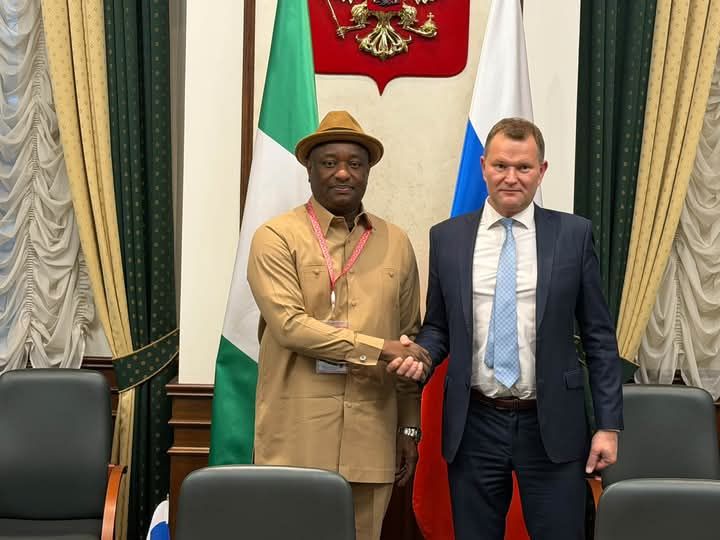
Nigeria and Russia have agreed to replace a 59-year-old aviation agreement, aiming to update air transport relations and create opportunities for stronger connectivity between the two countries.
The agreement to renegotiate the Bilateral Air Services Agreement (BASA), which dates back to 1967, was reached during a meeting between Nigeria’s Minister of Aviation and Aerospace Development, Festus Keyamo, and Russian officials on the sidelines of the Third Russia-Africa Summit in Moscow.
Mr Keyamo disclosed the development in a post on his X account on Friday, saying both countries had agreed to complete negotiations within six months and sign a new agreement in Saint Petersburg, Russia, in April 2027.
He said the Nigerian delegation met with Dmitry Stanislavovich Zverev, the State Secretary and Deputy Minister of Transport of the Russian Federation.
“We resolved to renegotiate our last Bilateral Air Service Agreement that was made in 1967. We set a timeline of six months to conclude the negotiations and sign a new one in Saint Petersburg in April 2027,” Mr Keyamo said.
He added that both countries had formed negotiating teams to begin work toward an agreement within the agreed period.
The proposed renegotiation is expected to update the framework governing air transport between Nigeria and Russia, reflecting changes in the international aviation industry over the past six decades.
What the agreement means
A Bilateral Air Services Agreement provides the legal framework for scheduled air services between two countries. It generally sets out the conditions under which airlines from both countries can operate international flights, including routes, traffic rights, designated airlines and other operational arrangements.
Nigeria’s Ministry of Aviation and Aerospace Development says its Air Transport Management Department negotiates and reviews new and existing air services agreements and monitors their implementation.
The ministry also works with the Nigerian Civil Aviation Authority and other aviation agencies to facilitate international air links and regulate airline operations.
The proposed replacement of the Nigeria-Russia agreement could therefore create opportunities for improved air connectivity and cooperation between their aviation sectors.
However, neither Mr Keyamo nor the ministry disclosed proposed flight routes, designated airlines or the frequency of possible operations under the new agreement.
Wider cooperation
Beyond the aviation agreement, Mr Keyamo said the meeting also examined other areas of cooperation between Nigeria and Russia.
He said both sides had resolved to explore additional opportunities in the coming months.
The Nigerian delegation included the Director-General of the Nigerian Civil Aviation Authority, Capt: Chris Najomo, and the Registrar of the Nigerian College of Aviation Technology, Dr Danjuma Adamu Ismaila.
Directors from the Federal Ministry of Aviation and Aerospace Development and the NCAA also participated in the discussions.
ALSO READ: Nigeria sends low-level delegation to Russia-Africa summit
Nigeria and Russia have maintained diplomatic relations since shortly after Nigeria gained independence in 1960. Their relationship has included cooperation in areas such as defence, trade, science and technology.
According to the Nigerian Embassy in Russia, the Soviet Union provided political and military assistance to Nigeria during the 1967–1970 Civil War. Cooperation between the two countries has also extended to space technology, including the launch of Nigeria’s satellites aboard Russian rockets in 2011.
The planned aviation agreement is expected to form part of broader efforts to deepen bilateral relations and identify further areas of cooperation.
Both countries are expected to begin negotiations through their respective teams, aiming to conclude the process and sign the new agreement in Saint Petersburg in April 2027.
Discover more from Premium Times Nigeria
Subscribe to get the latest posts sent to your email.
-
News4 days ago
MTN Challenges Nigerians: Compare our data prices with Kenya, South Africa, Zimbabwe – Technology Times
-

 News3 days ago
Upwind raises $400M after walking away from Datadog acquisition offer
-
News3 days ago
GOVERNOR MUTFWANG OPENS 11TH JOS NATIONAL TRADE FAIR, TARGETS INDUSTRIAL GROWTH FOR PLATEAU
-
News4 days ago
Dakar 2026: “Today’s Young Athletes Are Tomorrow’s Olympic Champions” — SSA Adeboye Charges Team Nigeria