Connect with us

Business

NMDPRA approves 830,000-tonne petrol imports amid Dangote legal battle

info

Published

on

428683862 796449282514152 6787495153779598606 n e1733992153588.jpg

The Nigeria Midstream and Downstream Petroleum Regulatory Authority (NMDPRA) has approved petrol import permits covering about 830,000 metric tonnes for multiple companies ahead of the fourth quarter of 2026, PREMIUM TIMES has learnt.

George Ene-Ita, spokesperson for the authority, confirmed the development to PREMIUM TIMES on Tuesday.

“Yes, petrol import permits were approved for Q4 2026 to ensure there’re no supply gaps heading into the critical end-of-year period,” Mr Ene-Ita said.

Companies reportedly granted the permits include Matrix Energy, A.A. Rano, AYM Shafa, NIPCO, Pinnacle Oil and Bono Energy.

The approvals were reportedly issued on 18 September, although details of the individual allocations to the marketers were not immediately available as of the time of filing this report.

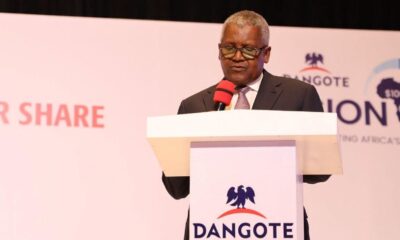
The latest approvals come amid an ongoing legal dispute between Dangote Petroleum Refinery and the regulator over the continued issuance of petrol import licences.

PT WHATSAPP CHANNEL
Dangote Refinery AD

They also come as heightened tensions in the Middle East continue to disrupt global energy markets, keeping crude oil prices elevated and raising concerns about the cost of petroleum supplies.

Dangote’s legal challenge

In May, PREMIUM TIMES reported that Dangote Petroleum Refinery filed a fresh lawsuit against the Attorney-General of the Federation, challenging fuel import licences issued to oil marketers and the Nigerian National Petroleum Company Limited (NNPC Ltd).

In the suit, the refinery argued that the licences granted to some marketers threatened its operations and were contrary to provisions of the Petroleum Industry Act (PIA).

The refinery contended that fuel import licences should only be issued when domestic supply is insufficient to meet national demand.

Nigeria has historically depended heavily on imported petrol, largely because of the poor performance of its state-owned refineries.

The $20 billion Dangote Refinery, owned by businessman Aliko Dangote, was expected to reduce the country’s dependence on imported refined petroleum products by supplying the domestic market.

With an installed capacity of 650,000 barrels per day, the facility is Africa’s largest single-train refinery and was projected to significantly reduce the foreign exchange burden associated with fuel imports.

However, petrol imports have continued as the refinery ramps up production and distribution, while some industry operators maintain that domestic output has yet to fully meet national demand.

Regulatory dispute

Since commencing operations in 2024, Dangote Refinery has repeatedly pushed for local marketers to source petroleum products from domestic refineries rather than rely on imports.

The former NMDPRA leadership under Farouk Ahmed resisted measures that it considered capable of creating a monopoly, arguing that allowing a single refinery to dominate the market could undermine competition and create risks for Nigeria’s energy security.

The disagreement contributed to a public dispute between Mr Dangote and Mr Ahmed.

Mr Dangote subsequently accused the former regulator of corruption and alleged that the NMDPRA was colluding with international traders and fuel importers to frustrate local refining by continuing to issue import licences.

He also raised questions about Mr Ahmed’s lifestyle and alleged that four of his children attended expensive secondary schools in Switzerland, claims that formed part of the broader controversy over the regulator’s conduct.

Mr Ahmed later resigned as NMDPRA chief executive.

Previous lawsuit

In 2024, Dangote Refinery instituted a separate suit, marked FHC/ABJ/CS/1324/2024, seeking N100 billion in damages against the NMDPRA over the issuance of import licences to some marketers and the subsequent importation of petroleum products.

The marketers named in the suit included NNPC Ltd, Matrix Petroleum Services Limited, AYM Shafa Limited, A.A. Rano Limited, T. Time Petroleum Limited and 2015 Petroleum Limited.

In the suit dated 6 September 2024, the refinery’s lawyer, Ogwu Onoja, asked the Federal High Court to declare that the NMDPRA violated Sections 317(8) and (9) of the Petroleum Industry Act by issuing licences for the importation of petroleum products.

Dangote Refinery argued that such licences should only be issued where a shortfall in domestic petroleum supply exists.

The refinery also asked the court to declare that the NMDPRA failed in its statutory responsibility under the PIA to encourage domestic refining.

However, in a counter-affidavit dated 5 November 2024 and filed by Ahmed Raji (SAN), the marketers asked the court to dismiss the refinery’s claims.

They argued that competition was essential to the health of Nigeria’s economy and the viability of the petroleum sector, insisting that they were qualified to receive import licences under Section 317(9) of the PIA.

READ ALSO: NMDPRA speaks on petrol price rise, regulatory action

The defendants further accused Dangote Refinery of attempting to monopolise the petroleum industry by seeking sole control over fuel supply, distribution and pricing.

In July 2025, Dangote Refinery discontinued the lawsuit challenging the import approvals. The refinery did not publicly state its reasons for withdrawing the case.

Meanwhile, the Dangote Refinery’s current case challenging the continued issuance of petrol import licences is scheduled for further hearing on 7 October.

Asked on Tuesday for an update on the legal dispute with Dangote Refinery, Mr Ene-Ita declined to comment, citing the ongoing court proceedings.

“The Dangote case is still in court. I cannot say anything in a court case,” he said.


Discover more from Premium Times Nigeria

Subscribe to get the latest posts sent to your email.

Continue Reading
Click to comment

Leave a Reply

Your email address will not be published. Required fields are marked *

Business

Shettima Urges African Leaders to Process Minerals Locally

info

Published

on

By

Shettima vice president.jpg

Vice President Kashim Shettima has called on African countries to reduce their dependence on the export of raw mineral resources and focus more on local processing and industrialisation.

Shettima made the call in New York while representing President Bola Tinubu at the Third High-Level Roundtable of the Africa Minerals Strategy Group, held on the sidelines of the 81st United Nations General Assembly.

He said Africa needed to move beyond its traditional role as a supplier of raw materials and develop industries capable of processing its mineral resources within the continent.

According to the Vice President, greater local processing would help African countries create jobs, strengthen industries and retain more value from their natural resources.

Shettima also called for stronger cooperation among African countries, including the development of regional processing hubs, integrated markets and cross-border mineral corridors.

He cautioned against competition among African nations for foreign investment through lower royalties, weaker local-content requirements and excessive concessions, arguing that stronger continental coordination would improve Africa’s bargaining position in global mineral supply chains.

The Vice President said Africa could not continue to consider itself wealthy because of its mineral resources while communities located around mineral deposits remained poor and lacked adequate economic opportunities.

He also highlighted reforms in Nigeria’s mining sector, including efforts to improve geological data, formalise artisanal mining, promote local value addition and tackle illegal mining.

Shettima pointed to developments in lithium processing in Nasarawa State as an example of the opportunities available when mineral resources are processed locally.

He further backed the Africa Minerals Strategy Group’s Mutual Assured Development Framework, which promotes predictable policies, credible institutions, responsible investment, technology transfer and local value creation.

The Minister of Solid Minerals Development and Chairman of the Africa Minerals Strategy Group, Dele Alake, also proposed the establishment of an African Artisanal Mining Formalisation and Safety Facility.

The discussions formed part of broader efforts to develop strategies that would enable African countries to derive greater economic benefits from the continent’s mineral wealth.

Continue Reading

Business

General Business to Drive 72% of Mutual Benefits Assurance’s Projected ₦96.82bn GWP

info

Published

on

By

BY NKECHI NAECHE-ESEZOBOR—Nigeria’s lead underwriter, Mutual Benefits Assurance Plc has protected a Gross Written Premium of ₦96.82 billion for the twelve months ending 31 December 2026.

According to notice released on the exchange, for dealing members and investors, the company’s insurance revenue, is projected to stand at ₦89.42 billion.

The company’s general business is expected to generate 72% of the projected GWP, while the Life arm of the group  will account for j28%.

Investment income would largely be driven by returns on its financial assets, with non-cash items such as depreciation of non-current assets, amortisation of intangible assets, and net fair value gains or losses on financial assets factored into its profit or loss and other comprehensive income statement.

On the profitability side, Mutual Benefits projects gross premium written of ₦96.82 billion and insurance revenue of ₦89.42 billion, against an insurance service expense of ₦81.56 billion. Net income from reinsurance contracts held is estimated at ₦802.64 million, bringing the insurance service result to ₦8.66 billion.

Net investment income is expected  to stand at ₦13.16 billion, while net insurance finance expenses are projected at ₦1.99 billion, resulting in net insurance and investment results of ₦19.84 billion. With other income of ₦237.03 million and total non-attributable expenses of ₦2.76 billion, the company expects a profit before income tax of ₦17.31 billion.

After an income tax expense of ₦1.90 billion, Mutual Benefits projects a full-year profit of ₦15.41 billion for the period under review.

The post General Business to Drive 72% of Mutual Benefits Assurance’s Projected ₦96.82bn GWP appeared first on Business Today NG.

Continue Reading

Trending