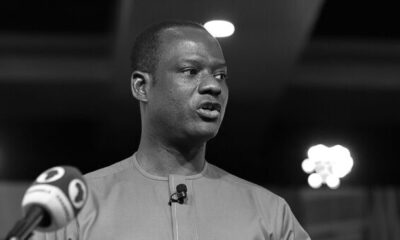
Suspected armed bandits in Jos South and Mangu local government areas of Plateau State have kidnapped a medical doctor and his friend, who were in transit from Mangu to Jos.
The medical doctor identified as Dr. Nuhu Bakwa and his family, who reside in Abuja, was in Farin-Kassa in Mangu local government over the death of his father, who passed away last week.
A source close to the family disclosed that Dr. Bakwa and his family, along with a pastor friend, were traveling back to Abuja on Wednesday when the gunmen met them at Bisichi in Jos South local government and forced the medical doctor and his pastor friend out of the car they were traveling in and whisked them away.
The source who said the unfortunate incident occurred at about 8:00 p.m. added that the gunmen left the doctor’s wife along with two other children in the car.
He added that the wife, who was in a state of confusion, later alerted the relatives of her husband, who dashed to the scene of the incident along with some security men.
“The medical doctor and his family came home over the death of his father, who passed on last week. He left at about 6:00 p.m. along with his family and a friend who was simply identified as a pastor but who was kidnapped at Bisichi village in Jos South local government.
“The abduction has further left the family devastated with the death of his father.” But the kidnappers this morning (Friday) contacted the family with a demand for N10 million in ransom”.
The spokesman of Plateau State Police Command, DSP Alfred Alabo could not be reached for confirmation on the unfortunate incident.
The Economic and Financial Crimes Commission (EFCC) on Wednesday f2026 arraigned Mr. Ahmed Adamu Dikko, former Managing Director of Port Harcourt Refining Company Ltd (PHRC), before Justice Inyang Ekwo of the Federal High Court, Abuja, on a 12-count charge bordering on money laundering.
The charge, marked FHC/ABJ/CR/360/2026 and dated and filed on June 22 by the Commission’s counsel, Ekele Iheanacho, SAN, listed Dikko and Masterpiece Projects & Investment Limited as first and second defendants respectively.
Dikko, who led the Port Harcourt Refining Company for about four years, pleaded not guilty to a 12-count charge filed against him by the Commission on Wednesday, July 8, 2026.
The EFCC accused Dikko of laundering N1,322,839,112.7 (One Billion, Three Hundred and Twenty-Two Million, Eight Hundred and Thirty-nine Thousand, One Hundred and Twelve Naira, Seven Kobo) in proceeds allegedly linked to contractors engaged by the Nigerian National Petroleum Company Limited (NNPCL) for the rehabilitation of the Port Harcourt refinery, through cash property purchases, undisclosed bank retentions, third-party fund concealment and unauthorised currency conversion, in violation of the Money Laundering (Prevention and Prohibition) Act, 2022.
Count one reads in part: “That you AHMED ADAMU DIKKO… did directly make cash payment of the dollar equivalent of the sum of N218,375,000.00 to one Hadeija Bashir for the purchase of Plot 558, Abubakar Umar Street, Katampe Extension, Abuja without passing through a financial Institution and you thereby committed an offence contrary to Sections 2(1)(a), 19(d) of the Money Laundering (Prevention and Prohibition) Act, 2022 and punishable under Section 19(2)(b) of the same Act.”
Count eight reads: “That you AHMED ADAMU DIKKO, former Managing Director of the Port Harcourt Refining Company Ltd (PHRC) on or about the 26th of June, 2023 in Abuja within the jurisdiction of this Honourable Court disguised the origin of the sum of N328,710,337.50 (Three Hundred and Twenty Eight Million, Seven Hundred and Ten Thousand, Three Hundred and Thirty Seven Naira, Fifty Kobo) paid into the GTBank Account Plc No. 0123201507 operated by Masterpiece Projects & Investment Limited by OMSA Integrated Services Limited from the transactions involving NNPC Limited allocation of Vacuum Gas Oil for export when you knew that the said sum of N328,710,337.50 constituted proceeds of unlawful activity and you thereby committed an offence contrary Section 18(2) (a) and punishable under Section 18(3) of the Money Laundering (Prevention and Prohibition) Act, 2022.”
Count eleven reads: “That you AHMED ADAMU DIKKO between October, 2022 and May, 2025 did convert the aggregate sum of $77,080 through Ibrahim Isa Yaro which amount did not form part of your known lawful earnings as a former public officer with the Nigerian National Petroleum Company Ltd and you thereby committed an offence contrary to Section 18(2)(b) of the Money Laundering (Prevention and Prohibition) Act, 2022 and punishable under Section 18(3) of the same Act.”
The defendant pleaded not guilty to the charges when they were read to him.
Thereafter, counsel to the defendant, Okechukwu Ajunwa, SAN urged the court to grant the defendant bail pending the determination of the suit. Iheanacho, however, opposed the bail application.
In his ruling on the bail application, Justice Ekwo granted the defendant bail in the sum of N150,000,000 (One Hundred and Fifty Million Naira) with a surety who must be resident within the jurisdiction of the court and with a landed property valued at not less than the bail sum. He ordered that the defendant be remanded in the custody of the EFCC pending when he’s able to meet the bail conditions.
The matter was therefore adjourned to October 12, 13 and 14, 2026 for trial.
Truecaller has opened a public fight with India’s telecom regulator over rules governing caller ID apps, saying the country’s anti-spam framework is making it harder to protect consumers from unwanted calls in its biggest market.
On Wednesday, CEO Rishit Jhunjhunwala (pictured above) took to X to publicly challenge the Telecom Regulatory Authority of India (TRAI), accusing the watchdog of preventing Truecaller from displaying community-reported spam information for calls from the country’s dedicated 1400 and 1600 number series, a restriction he said had enabled abuse of those numbers and eroded trust in legitimate business calls.
The dispute stems from a framework introduced in 2024 under which India’s telecom authorities designated the 1400 and 1600 number series for commercial communications, with businesses using the former for telemarketing calls and the latter for service- and transaction-related calls. TRAI later mandated the migration to the dedicated numbering series, saying the move would help consumers identify legitimate business communications and curb spam and scam calls.
The framework was rolled out amid growing concerns over spam and scam calls in India, one of the world’s largest telecom markets, where regulators and telecom operators have rolled out multiple measures to curb fraudulent communications. Last year, the Indian communications ministry said authorities disconnected more than 2.1 million fraudulent mobile numbers and took action against more than 100,000 entities over the preceding year, underscoring the scale of the challenge.
Jhunjhunwala argued the policy has produced unintended consequences. Citing internal company data, he said consumers have increasingly lost trust in the designated number series, with Truecaller users ignoring 81% of calls from the 1400 series and 79% from the 1600 series over the past eight months. During the same period, users manually blocked 74 million calls from the two number series, while daily blocking actions against 1600-series numbers have more than tripled since October 2025, he said.
Unable to mark those numbers as spam, Truecaller instead introduced a “Frequently Blocked” badge to alert users when a number from the designated series has been blocked by many people.
The unusually public criticism came after Indian business daily The Economic Times reported that TRAI had sought powers under India’s Information Technology Act to take action against caller ID apps such as Truecaller, Hiya, and Whoscall for labeling numbers from the designated 1400 and 1600 series as spam.
TRAI and India’s Ministry of Electronics and Information Technology, which would consider any such proposal, did not immediately respond to requests for comment.
Jhunjhunwala said Truecaller would share its data with the Indian IT ministry as part of the regulatory process, arguing that any decision on caller ID apps should be evidence-based.
“Penalize the bad actors, not the ones like Truecaller that make a significant positive impact,” he wrote.
When you purchase through links in our articles, we may earn a small commission. This doesn’t affect our editorial independence.