News
Historic Wheelchair Basketball Debut Ends In Heartbreak As Scotland Crush Nigeria, But Commonwealth Games Dream Lives On

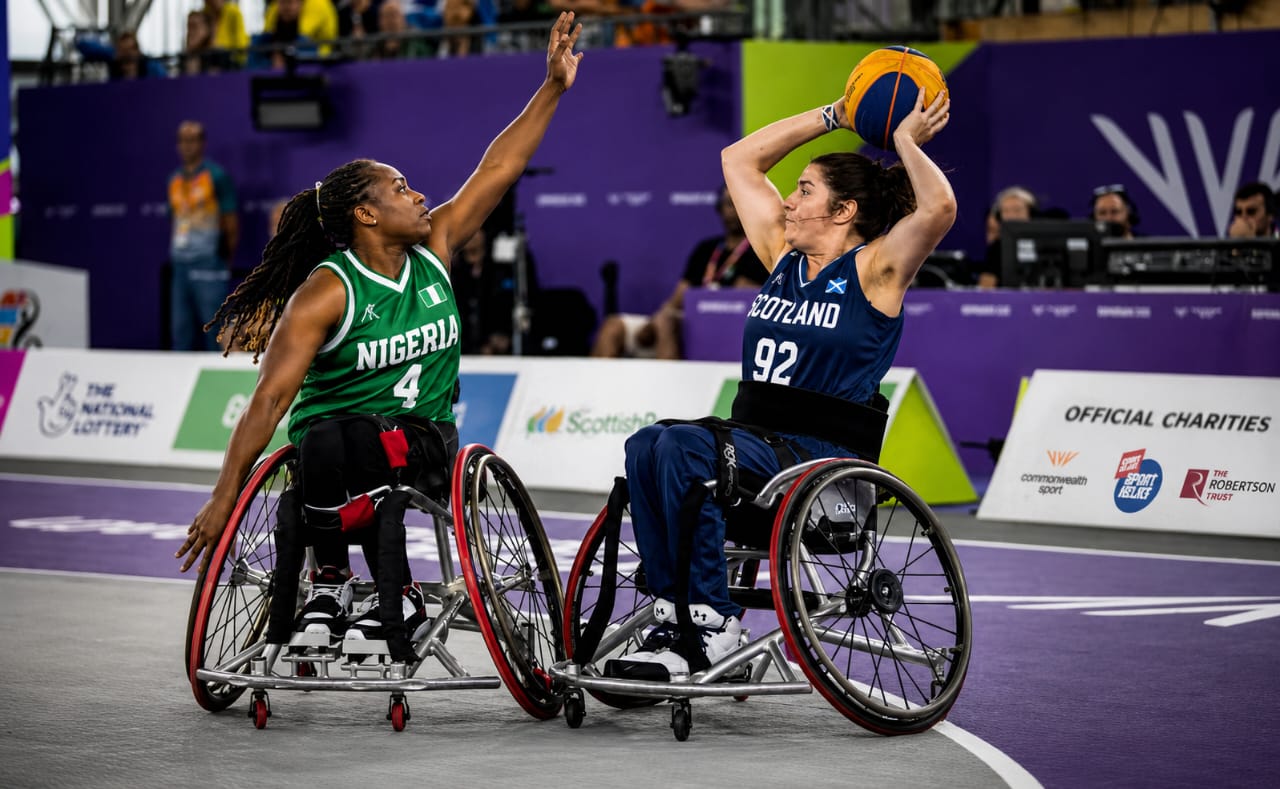
Team Nigeria’s historic debut in wheelchair basketball at the Glasgow 2026 Commonwealth Games began with a tough lesson on Saturday as the women’s team suffered a 16-1 defeat to host nation Scotland in a Pool B encounter at SEC Hall 4.
Playing before a lively home crowd, the Scots produced a dominant display, combining clinical finishing, quick ball movement and disciplined defending to overwhelm the Nigerian side from the opening whistle.
Scotland seized control of the contest early, dictating possession and setting the tempo with relentless attacking play. Nigeria struggled to break through the hosts’ well-organised defence, while Scotland capitalised on almost every scoring opportunity to gradually extend their advantage.
Despite the one-sided scoreline, the Nigerian players refused to give up, battling until the final buzzer in what was their first taste of Commonwealth Games wheelchair basketball.
The defeat was a disappointing result for Team Nigeria, particularly after the country’s encouraging performances in other events, where the delegation has already secured three gold and three silver medals, all from para powerlifting, while the women’s 3×3 basketball team also opened its campaign with victory over the Cayman Islands.
However, beyond the result lies a story of history and progress.
The Glasgow Games mark the first time Nigeria has qualified a wheelchair basketball team for the Commonwealth Games, making the country’s participation a landmark achievement for the sport. Reaching the Games is the culmination of years of development and growing investment in para sports, placing Nigeria among the Commonwealth’s elite wheelchair basketball nations for the very first time.
Although Scotland proved too strong on the day, the defeat does not end Nigeria’s campaign.
The wheelchair basketball competition is being played in a round-robin group format, meaning every team is guaranteed additional Pool B matches before the knockout and classification stages. Nigeria therefore remains in contention and still has opportunities to improve its standing and fight for a place in the latter rounds.
For the coaching crew, the immediate challenge will be to analyse the shortcomings exposed by the hosts, rebuild confidence and prepare the players for the crucial fixtures ahead.
The experience gained against one of the tournament favourites could prove invaluable as the Nigerians continue their historic journey on the Commonwealth stage.
Sports247, reporting from Glasgow, observed that there was no sense of resignation in the Nigerian camp after the final whistle. Coaches and officials quickly rallied around the players, reminding them that this tournament is about far more than one result. As Nigeria’s first-ever wheelchair basketball team to qualify for the Commonwealth Games, they have already etched their names into the country’s sporting history.
With more Pool B matches still to come, Team Nigeria now has the chance to transform the disappointment of its opening defeat into renewed determination. Every remaining game offers another opportunity to chase a first Commonwealth Games victory, build valuable international experience and inspire the next generation of wheelchair basketball players across Nigeria.
Sports247 Medal Watch – Team Nigeria
🥇 Gold: 3
🥈 Silver: 3
🥉 Bronze: 0
Total: 6
Medal Winners
🥇 Esther Nworgu – Women’s Lightweight Para Powerlifting (Commonwealth Games Record)
🥇 Folashade Oluwafemiayo – Women’s Heavyweight Para Powerlifting (World Record)
🥇 Riluwan Idris – Men’s Heavyweight Para Powerlifting
🥈 Roland Ezuruike – Men’s Lightweight Para Powerlifting
🥈 Esther Oyema – Women’s Lightweight Para Powerlifting
🥈 Rita Ferdinand – Women’s Heavyweight Para Powerlifting (World Record)





If there was one thing that was obvious from Meta Connect this year, it’s that the social media giant is all-in on its burgeoning line of smart glasses.
Indeed, the glasses were pretty much everywhere at the annual event, where Meta shows off its newest hardware and AI products. Both Meta staff and the flocks of influencers who frequent the event seemed to arrive with the glasses glued to their faces. Most of the demos the company offered this week also involved the glasses.
I swiftly joined the bespectacled masses and found myself trying on pair after pair of Meta’s high-tech specs.
One of the more notable products I had an opportunity to demo were Meta’s new, still-unreleased, audio-only smart glasses. News of these glasses emerged not long after the company weathered accusations that it was selling “pervert glasses,” with critics alleging that its camera-equipped specs could be used for nefarious surveillance purposes.
The new glasses come equipped with six microphones, but no camera, and they have no native way to record your surroundings, which should go a long way toward easing privacy concerns. They are significantly lighter than any of the other smart glasses I’ve worn, and they were quite comfortable.
The Meta staffer I talked to emphasized the glasses’ entertainment and communication options: You can listen to music easily (they’re more comfortable than earbuds) and take phone calls without reaching for your phone.
The glasses will also integrate with Muse, Meta’s personal agentic system, which can carry out tasks on the user’s behalf. The new integration, which isn’t yet available to the public, lets wearers speak to Muse and give it commands verbally. Meta also plans to personalize the agent, letting users pick from an assortment of cute digital avatars that can represent the agent when it communicates with them.
I was given an opportunity to try this out, which was fun but also somewhat comical. You have to be very direct with the agent, and you can’t talk to anyone else at the same time or it will get confused. Problematically, I kept chatting intermittently with the Meta staffer who’d given me the glasses, and the agent kept thinking I was speaking to it, so it would talk over her.
Still, in the right context, it’s easy to see how this new integration could be incredibly useful. If you don’t mind being seen in public talking to your own sunglasses, you’ll be able to ask Muse to take care of various digital tasks for you, like sending emails or reciting to-do lists, and it will handle them while you’re out grocery shopping or having a beer. You can also ask the glasses anything, and like a mobile version of ChatGPT, they’ll spit out an answer. (I asked the glasses a question about World War II, and they gave me a succinct and historically accurate response.)
Finally, I also got to test-drive a second audio-only pair: Meta’s new glasses for the hearing impaired. Given that hearing loss affects many families (some 50 million Americans are said to have some level of hearing loss), this device, unlike a lot of other modern tech gadgets, serves a clear and practical purpose.

I spoke briefly with a member of Meta’s research team who said the glasses had been in development for about five years, and he pointed out a price difference that could make them appealing: Whereas a lot of hearing aids can run as high as $1,600, the glasses will sell for $150.
The experience of wearing these glasses was interesting. Meta had me put earplugs in before trying them on to simulate the hearing loss that the glasses are meant to help users overcome. Once the glasses were on, they seemed to amplify the voice of the person I was talking to. Users can switch the amplification from focused, which zeroes in on the person in front of them, to omnidirectional, which picks up sound from all around them, depending on how they want to experience their surroundings.
Mark Zuckerberg has made it clear that he believes smart glasses are the future, and it’s evident that his company is doing its best to fulfill that vision. But smart glasses remain a niche that has yet to truly find its footing. What was most obvious at Connect is that Meta has — in an attempt to succeed where others have failed — cast a very wide net, trying to make its glasses stylish, functional, and, most of all, useful.
Is this the future? Unsurprisingly, everyone at Connect seemed to think so. I suppose we’ll have to see if the rest of the world follows suit.
When you purchase through links in our articles, we may earn a small commission. This doesn’t affect our editorial independence.
-

 Featured3 days ago
PLATEAU STATE: IS THERE PEACE, OR ONLY THE ABSENCE OF VIOLENCE?
-
News3 days ago
Plateau Killings: Rotjimwa Yilyok Urges Security Agencies to Intensify Action
-
Business3 days ago
General Business to Drive 72% of Mutual Benefits Assurance’s Projected ₦96.82bn GWP
-
Business3 days ago
Shettima Urges African Leaders to Process Minerals Locally