
News
Army Speaks on Alleged Terrorists’ Plan to Attack Institutions


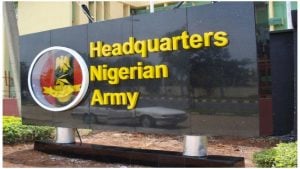
The Nigerian Army has rejected a circulating document alleging that terrorists are preparing to attack schools, churches, mosques, NYSC orientation camps and other public facilities across the country.
Army spokesperson, Col. Appolonia Anele, said the document did not originate from the military and should not be regarded as an authentic Army intelligence alert.
Anele described the document as “fake” and said its circulation appeared designed to create fear and tension among members of the public.
She, however, said the Army was not taking security threats lightly, adding that military commands had been directed to remain vigilant and prevent any successful attack on vulnerable facilities.
The development followed the circulation of an alleged memo addressed to formations and units of the 2 Division Nigerian Army, containing claims of possible coordinated attacks across several parts of Nigeria.
An officer attached to the division also expressed doubts about the authenticity of the document, saying a similar message had reached the General Officer Commanding the division.
“Even though I doubt the authenticity. My GOC said he got the same message before we left for Benin two days ago. That he has directed commands on it.
“I feel it is one of those text messages circulated to create palpable fear,” the officer said.
The disputed document claimed that intelligence had revealed increased mobilisation of fighters and resources by terrorist groups for possible attacks on vulnerable locations.
It mentioned the North-East, North-West, North-Central and parts of the South-West as areas allegedly at risk, while identifying churches, schools, NYSC orientation camps and other public facilities as possible targets.
The document further alleged that Catholic and Protestant churches, primary and secondary schools and other locations with large gatherings had been identified for possible attacks.
It also claimed that armed fighters had moved from Katsina through Kaduna towards Plateau State, describing the alleged movement as part of intelligence that had heightened concern among security formations.
“Further intelligence revealed that suspected members of Islamic States West African Province (ISWAP) have commenced surveillance and reconnaissance activities against identified targets with support from their local collaborators,” the document stated.
Another claim in the document was that educational institutions could be targeted around the resumption of the 2026/2027 academic session, with the alleged attackers seeking to exploit the presence of large numbers of students and staff.
It claimed such attacks could cause mass casualties and increase fear ahead of the 2027 general elections.
The Army’s response came against the backdrop of a separate security warning reportedly issued by the Department of State Services to religious leaders in Osun State.
DSS officials reportedly met Muslim and Christian leaders in Osogbo and advised them to strengthen security around places where large numbers of people gather.
President of the Osun State Muslim Community, Alhaji Mustapha Olawuyi, confirmed the meeting and said the security agency had asked religious leaders to take precautions.
“The meeting is true; it was held on Wednesday in Osogbo. We need to be careful and vigilant. These people (terrorists) have been trying to infiltrate Osun for quite some time,” Olawuyi said.
According to him, the DSS warned mosque leaders to pay attention to suspicious vehicles, unfamiliar persons and activities around worship centres.
“The DSS came from Abuja to Osun to warn us about a plot by some politicians and terrorists to frustrate the 2027 election, and for every one of us to be careful,” he said.
Olawuyi said the advice was subsequently communicated to imams across the state.
Christian leaders were also reportedly briefed by the DSS. Osun State Chairman of the Christian Association of Nigeria, Pastor John Adeleke, said churches were advised to improve their security awareness and pay attention to unfamiliar visitors and vehicles.
A report circulated among Christian leaders alleged that terrorists had mapped Osun State as part of a wider plan to attack states before the 2027 presidential election.
The report claimed that the suspected attackers could move through Kaduna and Jos before heading towards Osun, with churches, mosques, markets, schools, clubs and viewing centres identified as possible targets.
Adeleke said the information was shared with CAN blocs and other Christian groups so that religious leaders could take precautionary measures.
“After sharing with us that the churches will need to be careful and that we should encourage our churches also to be on alert, we sent the message to all our blocs and different platforms, where our people may be informed,” he said.
He added that church leaders were advised to be cautious about vehicles parked close to worship centres and to properly identify visitors before allowing them into church premises.
“They also said we should be careful of night programmes, so that the people will not take advantage of the darkness to perpetrate their evil plans. The message is that our people should be security-conscious. If they see anything, they should say it,” Adeleke said.








Arsenal dropped points in their Premier League title defence on Saturday, November 21, 2026, as they were held to a 2-2 draw by Newcastle United at St James’ Park.
Noni Madueke produced the decisive moment, scoring a stylish 78th-minute equaliser that earned the Gunners a share of the spoils in a match that swung dramatically after half-time.
Arsenal controlled the first half and deservedly led through Eberechi Eze’s 33rd-minute strike. Kai Havertz forced a turnover and teed up Eze, who swept home from the edge of the box.
The visitors dominated the opening period, generating far higher expected goals and restricting Newcastle to very little.
Newcastle responded strongly after the break. A triple change at half-time helped the hosts equalise just four minutes into the second half when William Osula set up Harvey Barnes to fire low into the corner. Momentum continued to shift, and Malick Thiaw put the Magpies ahead in the 62nd minute with a sharp finish from a corner sequence.
Arsenal’s reply arrived in the 78th minute and showcased Madueke’s quality. Martin Ødegaard slipped a clever pass into the winger, who cut inside onto his left foot and picked out the far corner with a precise finish to make it 2-2.
The late stages remained tense, with Arsenal losing goalkeeper David Raya to injury (replaced by Kepa Arrizabalaga) and both sides picking up bookings, but neither could find a winner.
Madueke was Arsenal’s standout performer, earning a Sofascore rating of 8.4. Beyond the goal, he registered six shots (two on target, one hitting the woodwork), completed 28 of 33 passes, added a key pass, won eight duels, covered over 10.6 km, hit a top speed of 35.1 km/h and contributed defensively with tackles and recoveries.
His expected goals contribution and overall involvement underlined a complete display that lifted the team when they needed it most. Fans and data aligned in naming him the player of the match.
The result keeps Arsenal near the top of the table as they defend their Premier League title, while highlighting Madueke’s growing importance.
The 24-year-old, who joined Arsenal from Chelsea in the summer of 2025, has shown clear improvement in recent weeks, stepping up with greater consistency, work rate and end product—particularly valuable amid competition for places and earlier absences of key attackers.
Speaking on his recent upturn in form following the goal against Newcastle, Madueke said:
“The Ballon d’Or is my target for next year. I know it sounds ambitious, but I genuinely believe I can compete at the highest level and become one of the best players in the world.
“I’ve been putting in serious work behind the scenes, improving every aspect of my game because I know what I’m capable of.
“I’m not just here to play football; I want to make history, win the biggest trophies and earn individual recognition. I believe in myself, and I’m working every day to make that dream a reality.”
Madueke’s performance and ambition reflect a player determined to establish himself as a central figure for both club and country as the season progresses. Arsenal will look to build on the character shown in recovering a point on the road when they return to action.

Preventing infections through proper hygiene, vaccination, safe food and water practices can reduce the need for antimicrobial medicines and help curb antimicrobial resistance (AMR), health experts have explained.
Philip Osun, a clinical microbiologist at the Lagos University Teaching Hospital (LUTH), said preventing infections is one of the most important ways to reduce the use of antibiotics and slow the development of resistance.
“If you don’t have infections, then it’s not likely there will be antimicrobial resistance,” Mr Osun said.
He advised Nigerians to practice regular handwashing, keep their vaccinations up to date, prepare food safely, use clean water, care for wounds properly and observe respiratory hygiene to reduce the spread of infections.
He also cautioned against taking antibiotics for illnesses such as common colds, which are usually caused by viruses and do not require antibiotics.
“Most of the common colds don’t require antibiotics,” he said, urging people not to rush to pharmacies to obtain antibiotics without appropriate medical advice.


Antimicrobial resistance occurs when bacteria, viruses, fungi and parasites develop the ability to withstand medicines designed to treat infections, making illnesses increasingly difficult to treat.
Mr Osun explained that resistance develops in microorganisms, not in the human body, and that people can become infected with resistant organisms even when they have not personally misused antibiotics.
He said resistance is a cumulative problem driven by the use and misuse of antimicrobials across communities, healthcare facilities, animals and the environment.
Prevent infections before treatment
Folasade Lawal, a pharmacist and managing director of Victory Drugs, also stressed the importance of preventing infections, noting that reducing infections would lessen the need for antimicrobial treatment.
“If there is no infection, there is nothing to treat,” she said.
Ms Lawal urged people to use medicines appropriately, obtain prescriptions from qualified healthcare professionals and follow instructions on dosage and duration.
She warned that inappropriate use and overuse of antimicrobials accelerate resistance, making medicines less effective against infections.
Preventing infections, she said, also requires vaccination, access to clean water, proper hygiene and responsible practices in healthcare and animal production.
Why prevention matters
The World Health Organisation (WHO) says antimicrobial resistance threatens the effectiveness of medicines that have transformed modern healthcare, making infections harder to treat and putting lives at risk.
According to the WHO, bacterial AMR was linked to over 4.7 million deaths globally in 2021, and about one in six laboratory-confirmed bacterial infections worldwide resisted antibiotic treatment in 2023.
ALSO READ: AMR Week: Artists, health experts use arts to raise awareness about drug resistance
It added that poor infection prevention, inadequate water and sanitation, inappropriate antimicrobial use in humans and animals, and unsafe waste disposal contribute to the spread of resistant organisms.
It recommends infection prevention through vaccination, hand hygiene, clean water, sanitation and effective infection control in healthcare facilities and farms.
Discover more from Premium Times Nigeria
Subscribe to get the latest posts sent to your email.
-

 Business2 days ago
Elon Musk Launches X Money, Bringing Banking and Payments to Social Media Platform
-
Health2 days ago
JUTH Student Nurse Anaesthetist Dies After Collapsing During Football Match in Jos
-
News2 days ago
OPEP troops arrest 21-year-old suspected child trafficker, rescue five minors in Plateau
-
News2 days ago
Canadian Police Arrested ‘Lagos BigBoy’ Tosin Damilola Oyebade, 11 Others Over $4.5m Stolen Vehicle Network


