News
Wordfence launches threat team as Nigerian WordPress sites battle cyber risks – Technology Times

Wordfence, the WordPress security company, has launched a dedicated Threat Response Team to respond to active attacks against WordPress sites, a move that could be significant for Nigerian organisations and publishers relying on the platform for public-facing websites and digital services.
The new team, led by senior vulnerability researcher Alex Thomas, is designed to respond to rapidly emerging threats during what Wordfence describes as the critical first 72 hours after an active threat is identified. The team will handle reports involving active exploitation of WordPress plugins or themes, supply-chain compromises and attack campaigns targeting multiple sites.
The development comes at a time when WordPress security has become an increasingly important concern for Nigerian organisations. In August, Nigeria’s Computer Emergency Response Team (ngCERT) warned that a large-scale cybercrime operation known as StopAndProtect had compromised thousands of WordPress websites globally, using some of the sites as infrastructure for malware delivery, command-and-control and storage of stolen data. Nigerian organisations running WordPress sites were specifically urged to take protective action.

The ngCERT warning underscores why faster identification and response to WordPress threats matters in Nigeria, where government agencies, businesses, media organisations, educational institutions and other organisations use websites to deliver public-facing services and information.
The ngCERT warning underscores why faster identification and response to WordPress threats matters in Nigeria, where government agencies, businesses, media organisations, educational institutions and other organisations use websites to deliver public-facing services and information.
Wordfence says reports of active threats can now be sent directly to its Threat Response Team rather than entering a general support queue. The company says the team will assess reports and, where an emerging threat is confirmed, work to put protection in place for Wordfence users while publishing guidance for affected site owners.
The company has distinguished the new response function from its longer-term vulnerability research. Its Threat Intelligence Team will continue handling vulnerability research, vulnerability records and routine disclosure work, while the Threat Response Team will focus on urgent, active threats requiring immediate attention.
WordPress vulnerability research
Thomas, who leads the new Threat Response Team, is a senior vulnerability researcher at Wordfence with OSCP and GPEN certifications. Wordfence’s vulnerability research profile credits him with 76 vulnerability discoveries and ranks him 84th in its all-time researcher ranking.
Thomas has contributed to research into vulnerabilities affecting WordPress plugins and themes, including multiple unauthenticated cross-site scripting vulnerabilities. Wordfence’s research records also show him among researchers who have disclosed vulnerabilities across the WordPress ecosystem.
His work is relevant to the Nigerian market because vulnerabilities in widely deployed WordPress components can affect organisations regardless of where their websites are hosted. A vulnerable plugin, theme or underlying server component can provide attackers with a route into websites that may hold administrative credentials, customer information or other sensitive data.
The threat is not limited to WordPress itself. Recent research from Thomas on two critical PHP vulnerabilities, CVE-2026-109618 and CVE-2026-109619, illustrates the importance of securing the wider technology stack supporting WordPress websites. The vulnerabilities affect PHP, the programming language on which WordPress primarily runs, and Wordfence says they can allow unauthenticated remote code execution on affected systems. Updating WordPress itself does not install the PHP fixes.
Nigerian website operators and new WordPress threats
The latest development highlights a broader security challenge for Nigerian organisations: protecting a WordPress website requires attention not only to the content management system but also to its plugins, themes, PHP runtime, web server, operating system and other supporting infrastructure.
Wordfence says its security approach is based on defence in depth, combining WordPress-specific threat intelligence, firewall protection, malware detection and remediation. The company says its network protects more than five million WordPress websites and that attack data gathered across its network informs its security rules and malware signatures.
Wordfence also operates a vulnerability database covering WordPress core, plugins and themes and is authorised to assign CVE identifiers to qualifying WordPress vulnerabilities. Its vulnerability disclosure process allows researchers to report security flaws for review and possible CVE assignment.
For Nigerian website operators, the significance of the new Threat Response Team therefore extends beyond Wordfence users. It reflects the growing importance of rapid threat intelligence, responsible vulnerability disclosure and coordinated response as attackers increasingly target the software supply chain and publicly accessible websites.
The launch also provides another channel through which active threats affecting the WordPress ecosystem can be escalated quickly. Wordfence says site owners who identify an actively exploited plugin or theme, a supply-chain compromise or a campaign targeting multiple WordPress sites can report it directly to the Threat Response Team.
With ngCERT already warning Nigerian organisations about the abuse of compromised WordPress websites, the ability to identify and escalate active attacks quickly could become an increasingly important part of the country’s broader website security response.








The Chairman of the Independent National Electoral Commission, INEC, Prof. Joash Amupitan, has dismissed allegations questioning his political neutrality following claims that his phone number was associated with a controversial account on X, formerly Twitter.
Amupitan insisted that he had never owned or operated an account on a social media platform, adding that an independent forensic examination had been conducted to investigate the claims.
He disclosed that the matter had also been referred to the Department of State Services, DSS, and the Inspector-General of Police for further investigation.
The INEC chairman made this known on Thursday while speaking at a high-level event hosted by Chatham House in London in collaboration with the Kimpact Development Initiative, KDI.
Addressing concerns about his previous involvement in politically sensitive court cases and whether such engagements could affect his impartiality as electoral umpire, Amupitan explained that his participation in those matters was strictly based on his professional responsibilities as a lawyer before assuming office.
He reaffirmed his commitment to upholding the country's Constitution and electoral laws, insisting that his decisions as INEC chairman would not be influenced by political interests.
“My loyalty is solely to the Constitution of the Federal Republic of Nigeria and the Electoral Act,” he affirmed.
“Every constitutional institution—including the Presidency, the National Assembly, and state governors—owes its primary loyalty to the Constitution and the rule of law.”
The electoral commission chairman also addressed allegations of irregularities in the national voter register, including reports claiming that the number of registered voters in a ward in Ebonyi State had increased by 85 per cent.
He said INEC had looked into the complaint and taken steps to resolve the matter in accordance with the provisions of the law.
Amupitan further explained that the Electoral Act gives Nigerians the right to raise objections, submit claims and request certified true copies of the voter register as part of measures to promote transparency and accountability in the electoral process.
Amupitan, while speaking on the importance of youth participation in democracy, urged young Nigerians to become actively involved in shaping the country's political future.
He stressed that the responsibility of building a better Nigeria rests partly on the younger generation, warning that the circulation of false information and digital disinformation could weaken public confidence in democratic institutions.
“This country belongs to young Nigerians, and they must continue working toward the Nigeria they want,” he said.
“Misinformation is among the greatest dangers facing our democracy. Citizens should verify information before acting on it or sharing it, and allow our democracy the opportunity to succeed.”
Nigeria is expected to hold its 2027 general elections in two phases, beginning with the Presidential and National Assembly elections scheduled for January 16, 2027.
The Governorship and State Houses of Assembly elections are subsequently scheduled for February 6, 2027.
2027: Amupitan clarifies alleged bias, ownership of X account, voter register manipulation
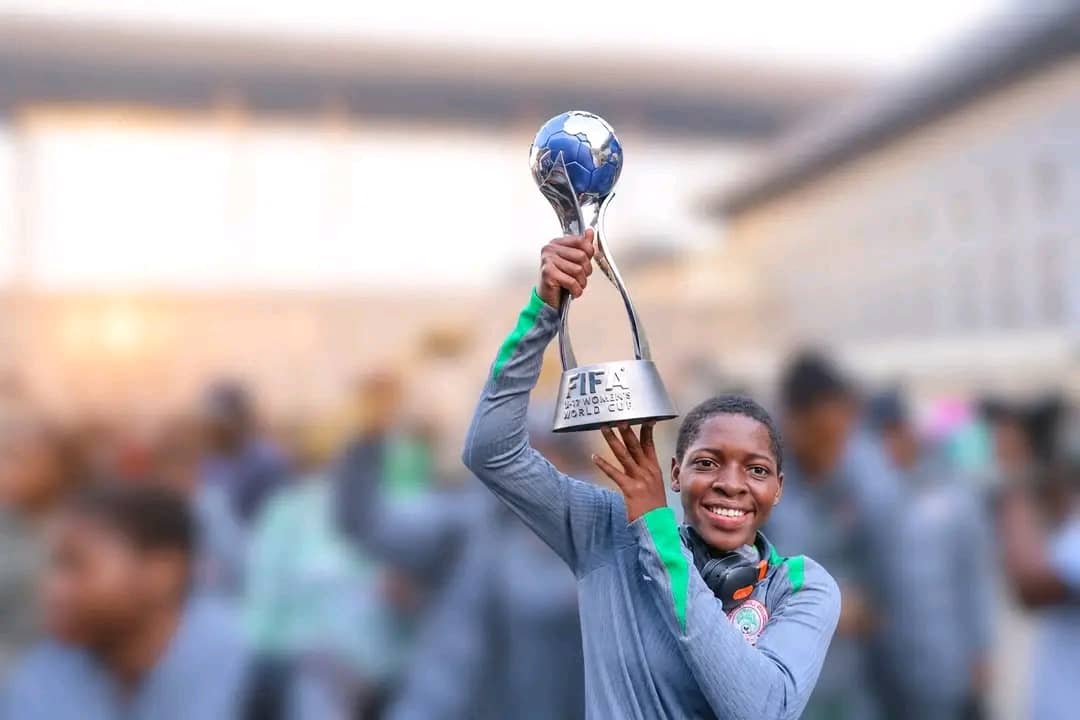
Nigeria U-17 captain Harmony Chidi has shared the personal challenges she faced while pursuing her football career, revealing that her mother initially opposed her decision to play the sport and wanted her to get married instead.
Speaking about her early journey in football, Chidi explained that her grandmother was the only person who encouraged her to keep pursuing her dream despite the lack of support at home, Sports247 gathered.
“When I started football, my mama didn’t allow me play. She didn’t want me playing football; she wanted me to get married. Only my grandma encouraged me, and now my grandma is no more. It’s just me and my mum now,” Chidi said.
Her revelation highlights the personal obstacles she had to overcome in order to pursue a career in football, with her grandmother playing a significant role in encouraging her ambition.
Despite the challenges, the young Nigerian captain remains determined to make her mark in the game and has set herself an ambitious target.
Chidi declared that she hopes to surpass the achievements of Super Falcons legend and former African Footballer of the Year, Asisat Oshoala.
“My dream is to be greater than Asisat Oshoala,” she said.
Her ambition reflects the confidence and determination she carries as she continues her development in the game. Oshoala’s achievements have made her a reference point for aspiring Nigerian female footballers, and Chidi now hopes to carve out a legacy of her own.
For the U-17 captain, the journey is about more than playing football; it is also about pursuing a dream that was not initially supported by those closest to her.
-

 News4 days ago
Troops Arrest Suspected Gunrunner, Neutralise Two Terrorists in Plateau
-
News3 days ago
APM holds Presidential Campaign in Plateau, Pledges Security and Economic Reset
-
News4 days ago
APC Legacy Assembly Expresses Confidence in Tinubu Ahead of 2027 Election
-
News4 days ago
Is Jensen Huang’s job on the line? Yale’s Jeffrey Sonnenfeld estimates it’s “about a 50-50”