News
Tinubu Moves to Review APC 2027 Campaign Council List Over ‘Anomalies’


The Bola Tinubu administration is reviewing the membership of the All Progressives Congress (APC) 2027 Presidential Campaign Council following concerns over omissions, controversial inclusions and other anomalies in the list.
The review comes days after the ruling party released the 108-member council, which immediately generated reactions from members of the APC, opposition politicians and other stakeholders ahead of the 2027 presidential election.
Sources within the Presidency and the APC said the list was being fine-tuned to prevent issues surrounding some of the appointments from becoming a major embarrassment to the campaign.
Presidency Reworks Campaign Council List
Tinubu is expected to chair the council, with Vice President Kashim Shettima and APC National Chairman, Nentawe Yilwatda, serving as Vice Chairmen I and II. Former Zamfara State Governor, Abdul’aziz Yari, was named Director-General, while Imo State Governor, Hope Uzodimma, was appointed Secretary.
However, the leadership structure is not expected to change in the ongoing review. Rather, sources said some members could be removed while others who were left out could be added before the council is inaugurated.
A Presidency source said the concerns surrounding the list were already being addressed at the Presidential Villa.
“Everything is being done in the Villa, but we are aware that the list is being reviewed due to the concerns raised about the inclusion of names of some people who are not supposed to be there and the exclusion of those that would add value to the campaign.
“But that should be expected in politics as lots of interests are involved,” Daily Trust quoted a source.
The issues reportedly fall into three broad areas. They include the inclusion of individuals facing allegations of financial impropriety, the omission of experienced political figures who were expected to play important roles and the accidental exclusion of some members.
The development has also affected the timing of the inauguration of the campaign council, as no date has been officially announced.
Among the names that have attracted criticism are former Minister of Humanitarian Affairs, Betta Edu, and former Chairperson of the Nigeria Social Insurance Trust Fund board, Ngozi Olejeme.
Edu was listed as Director of Women Mobilisation, while Olejeme was named South-South Zonal Director for Election Planning, Coordination and Mobilisation. Both women have faced allegations relating to financial impropriety from their periods in public office.
Another appointment that has generated questions is that of Zacheus Adedeji, Chairman of the Nigeria Revenue Service, who was named Deputy Director of Fundraising for the campaign council.
Critics have questioned whether the head of a key government revenue agency should occupy a partisan campaign position while still serving in that public office.
The review is also expected to address the absence of some politicians with previous campaign experience. Those mentioned include Aviation and Aerospace Development Minister Festus Keyamo, who served as spokesman and Director of Public Affairs for the 2023 campaign council, and former Plateau State Governor Simon Lalong, who was the Director-General of the APC Presidential Campaign Council for the 2023 election.
Former governors who are members of the APC, including Yahaya Bello, Gbenga Daniel and Ibikunle Amosun, were also mentioned among those who could have been considered for roles because of their political experience.
The Deputy Speaker of the House of Representatives, Benjamin Kalu, and some senators serving in state campaign offices were reportedly among those omitted through what sources described as oversight.
A source who participated in the 2023 campaign said the current review was not unusual, noting that the APC also recalled and adjusted its first campaign council list before the 2023 election.
Questions were also raised over the absence of Katsina State Governor Dikko Radda from the published list despite his support for Tinubu’s administration. Radda has, however, continued to express his commitment to the President’s bid for a second term in 2027.
Opposition Attacks Council as Melaye Threatens Court Action
The controversy surrounding the campaign council has also spread beyond the APC, with opposition figures questioning the composition of the structure.
Former Kano State Governor and Vice Presidential Candidate of the Nigeria Democratic Congress, Rabiu Musa Kwankwaso, criticised the council and said its composition suggested that the 2027 election would be a choice between continuing with the present administration and seeking a different political direction.
Kwankwaso said the council contained many politicians who had either supported or participated in the Tinubu administration.
“The council brings together many of the same political actors who have supported, defended or participated in the present administration.
“Their coming together raises a fundamental question: what exactly are they asking Nigerians to vote for in 2027, a new beginning, or the continuation of the same system that has brought severe hardship to our people?” he said.
The former governor said Nigerians were dealing with economic and social difficulties, including high food prices, unemployment, insecurity and pressure on essential public services.
He also appealed to Yari to reconsider accepting the position of campaign Director-General, arguing that the former governor understood the difficulties facing people in the North-West.
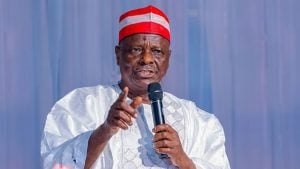
“I will be surprised if, in his good conscience, he will lead a campaign whose principal objective is to secure the continuation of a government under which many of the people he once governed, and other innocent Nigerians, remain trapped in these challenges,” Kwankwaso said.
He further questioned the participation of senior officials overseeing public revenue and national finances in the APC campaign structure.
Kwankwaso specifically cited Adedeji and the Director-General of the Budget Office of the Federation, Tanimu Yakubu Kurfi, arguing that officials occupying such sensitive positions should maintain institutional neutrality and public confidence.
Former Kogi West Senator Dino Melaye also threatened legal action over Adedeji’s appointment, saying there could be a conflict of interest in having the head of a major revenue agency serve in a partisan campaign structure.
“You are serving as the country’s Chairman of Nigerian Revenue Service, NRS, formally known as FIRS. Is there no conflict in this? As a lawyer, by the grace of God, on Monday, I’m going to court. We have to test that,” Melaye said.
Melaye also questioned Tinubu’s decision to chair his own presidential campaign council.
Defence Minister, APC Group Defend Campaign Council
Meanwhile, Defence Minister Christopher Musa defended his participation in the campaign council, saying his political assignment would not interfere with his responsibility for national security.
Musa, through his Special Assistant on Media, Leah Katung-Babatunde, described the appointment as a call to higher service and promised to maintain his focus on the country’s security responsibilities.
“National security remains our highest imperative. The ongoing operations, strategic reforms, and inter-agency collaborations across the defence sector will continue unabated with increased vigour.
“Our resolve to uphold the mandate of the Ministry of Defence, protect our people, and drive Mr. President’s vision for a safe and prosperous Nigeria remains firm and unshakeable,” he said.
The minister also urged APC members and Nigerians supporting the administration to remain united behind Tinubu, expressing confidence that the party would win the 2027 election.
The controversy has equally attracted criticism from within the ruling party.
APC Daga Titi Zuwa Titi, a North-West grassroots mobilisation group, accused Kwankwaso of being unsettled by Yari’s appointment as campaign council Director-General.
In a statement by its National Coordinator, Jaafar Hassan, the group said Kwankwaso’s decision to directly appeal to Yari to reject the position showed the importance the opposition attached to his emergence.
The group argued that political opponents would not normally ask a rival to abandon an appointment they considered insignificant.
Another APC chieftain, Babafemi Ojudu, has also criticised the composition of Tinubu’s campaign council, questioning the suitability of some of the people selected.

Ojudu described the 108-member council as a mixture of different political personalities, including individuals with strong reputations and others whose records could raise concerns among voters.
He said the list contained “saints and former sinners, the tried and the tired, reformers and those still awaiting reform.”
He added that some names “inspire confidence” while others “inspire a quick check on one’s wallet.”
Ojudu warned that the APC needed to consider the image the council would project during the campaign, arguing that the party should not give the impression that it was using the election campaign to shield controversial figures from scrutiny.
“A campaign seeking the confidence of Nigerians should not appear to be offering political sanctuary to every controversial figure who can command a convoy, finance a rally or mobilise a forest,” he said.
Ojudu, a former senator representing Ekiti Central, served as Special Adviser on Political Matters to former President Muhammadu Buhari. He was also a prominent supporter of former Vice President Yemi Osinbajo during the 2022 APC presidential primary, when he opposed Tinubu’s presidential ambition.







A survey by the National Information Technology Development Agency (NITDA) has found that 79% of local digital infrastructure and service providers are ready to accommodate additional financial-sector workloads ahead of Nigeria’s January 1, 2027 compliance deadline for the National Sovereign Cloud Initiative.
The pre-event survey, presented at an Executive Regulatory Dialogue organised by NITDA in partnership with the Central Bank of Nigeria (CBN), also found that 74% of the 42 providers surveyed could onboard new financial-sector customers within three months.
The findings by the technology agency provide an indication of local infrastructure readiness as both agencies intensify efforts to strengthen data localisation, improve digital resilience and increase domestic capacity to host critical financial-sector workloads.

“Imagine what will happen to our economy if tomorrow a major disruption or geopolitical crisis prevents our banks from accessing critical digital infrastructure hosted outside our country. Can our citizens still transfer money? Can businesses still receive payments? Can our banks keep processing transactions? Can our economy continue functioning?” he asked.
Muhammad Aminu Lawal, Special Assistant to the NITDA Director-General on Policy, presented the survey findings, identifying regulatory clarity, migration timelines and local infrastructure capacity as major issues requiring attention ahead of the January 2027 deadline.
He noted that much of the planned infrastructure expansion was expected in 2027, while financing costs, electricity supply and foreign exchange constraints remained significant challenges for providers.
The survey recommended clear written regulatory guidance, phased or risk-based implementation milestones, a defined exceptions process and verifiable information on infrastructure providers capable of meeting the requirements.
NITDA, CBN target financial sector for sovereign cloud compliance
The survey findings come as NITDA and the CBN strengthen collaboration to make the financial sector the first to comply with the National Sovereign Cloud Initiative.
Kashifu Inuwa, NITDA Director-General, disclosed the partnership at the regulatory dialogue, explaining that it was designed to strengthen Nigeria’s control over critical financial data, improve infrastructure resilience and reduce dependence on externally hosted digital systems.
“Through this partnership, NITDA and CBN are working together to make sure the financial sector is the first sector to comply with our National Sovereign Cloud Initiative,” he said.
The NITDA DG argued that Nigeria’s growing dependence on digital infrastructure had made digital sovereignty a national priority, particularly as banks and other financial institutions increasingly rely on technology to process payments and deliver essential services.
Highlighting the risks associated with relying on infrastructure hosted outside Nigeria, he questioned the potential impact of external disruptions or geopolitical crises on the country’s financial system.
“Imagine what will happen to our economy if tomorrow a major disruption or geopolitical crisis prevents our banks from accessing critical digital infrastructure hosted outside our country. Can our citizens still transfer money? Can businesses still receive payments? Can our banks keep processing transactions? Can our economy continue functioning?” he asked.
The NITDA Director-General maintained that digital sovereignty was not about isolating Nigeria from international technology providers but building domestic capacity to manage critical infrastructure and make independent technology decisions.
“Digital sovereignty is not about politics. It is not about isolation. It is not about building everything ourselves, but it is about building our digital capacity to compete in the world we are today,” he said.
NITDA outlines implementation and assurance framework
Inuwa explained that NITDA would provide the standards and overarching policy framework, while sector-specific regulators would apply the requirements within their respective industries.
Successful implementation, he added, would require collaboration among financial institutions, telecommunications operators, data centre providers, system integrators, technology companies and international cloud service providers.
The agency is also developing an assurance framework to guide implementation, drawing on existing international certification standards while requiring providers to meet Nigeria’s national sovereign architecture requirements.
Inuwa said NITDA was exploring national certification options to provide greater flexibility for technology providers while maintaining the required assurance standards.
He further stressed the need for reliable domestic infrastructure capable of sustaining essential financial services during disruptions to international connectivity.
The objective, he explained, was to ensure that disruptions to submarine cable infrastructure would not automatically affect Nigeria’s payment systems.
CBN emphasises financial stability, data protection
In his keynote address, Lamido Abubakar Yuguda, CBN Deputy Governor, Financial System Stability, reaffirmed the Bank’s commitment to strengthening financial stability, cybersecurity and the protection of critical financial data through the initiative.
Yuguda noted that the increasing adoption of digital payments, fintech services, mobile money and digital banking had made the financial sector increasingly dependent on digital infrastructure.
Financial institutions must therefore strengthen their cybersecurity, business continuity, disaster recovery and risk management arrangements while complying with applicable data localisation requirements, he said.
The CBN Deputy Governor also emphasised the need for financial institutions to meet the January 1, 2027 implementation timeline for critical payment transaction data.
“Our collective objective should be clear: to build a digital financial ecosystem that is innovative without compromising security, sovereign without becoming isolated and resilient enough to sustain public confidence,” he said.
Nigeria advances national cloud policy
The National Sovereign Cloud Initiative forms part of the Federal Government’s broader efforts to strengthen domestic digital infrastructure, improve data governance and reduce dependence on externally hosted critical systems.
In October 2025, NITDA published the National Cloud Policy 2025 to establish a framework for cloud adoption across government institutions and encourage investment in domestic cloud infrastructure.
The policy provides guidelines for cloud procurement, deployment, security and data management, while encouraging the participation of indigenous technology providers in the country’s expanding digital infrastructure ecosystem.
With the January 1, 2027 compliance deadline approaching, the latest survey findings offer an early indication of the capacity available among local infrastructure providers.
-

 News4 days ago
Democrats launch Nvidia investigation, write scathing letter on Huang’s ‘scheme’ with Trump
-
News2 days ago
Tinubu (APC) in Jos: Promises to restore peace in the State and Nigeria
-
News3 days ago
Every ₦1 spent on advertising generates ₦16.50 in Nigeria’s GDP, ARCON says – Technology Times
-
Business4 days ago
Veritas Kapital Assurance Records 54% Growth in Total Assets to ₦54.56 Billion, Strengthens Financial Position