Business
Uber’s exit from Nigeria highlights workers’ exposure to AI risks

Isiaka Agbaje wobbled through the parking space of the Murtala Muhammed International Airport, Lagos, as the afternoon sun baked human skin with fiendish delight. It was the third week of October, and elementary schools had just resumed. A frustrated cab driver, Mr Agbaje, said he has struggled to provide for his family in recent years despite working nearly 14 hours daily.
“The children, my children, are already complaining over their school fees that I haven’t paid, yet I barely make enough even to feed the family,” said Mr Agbaje, 42, with resignation written on his face. He told PREMIUM TIMES that the ride-hailing business no longer pays his bills, amid rising costs and domestic economic pressures.
“It was bad before, but it’s even worse now that Uber has left the country,” he added.
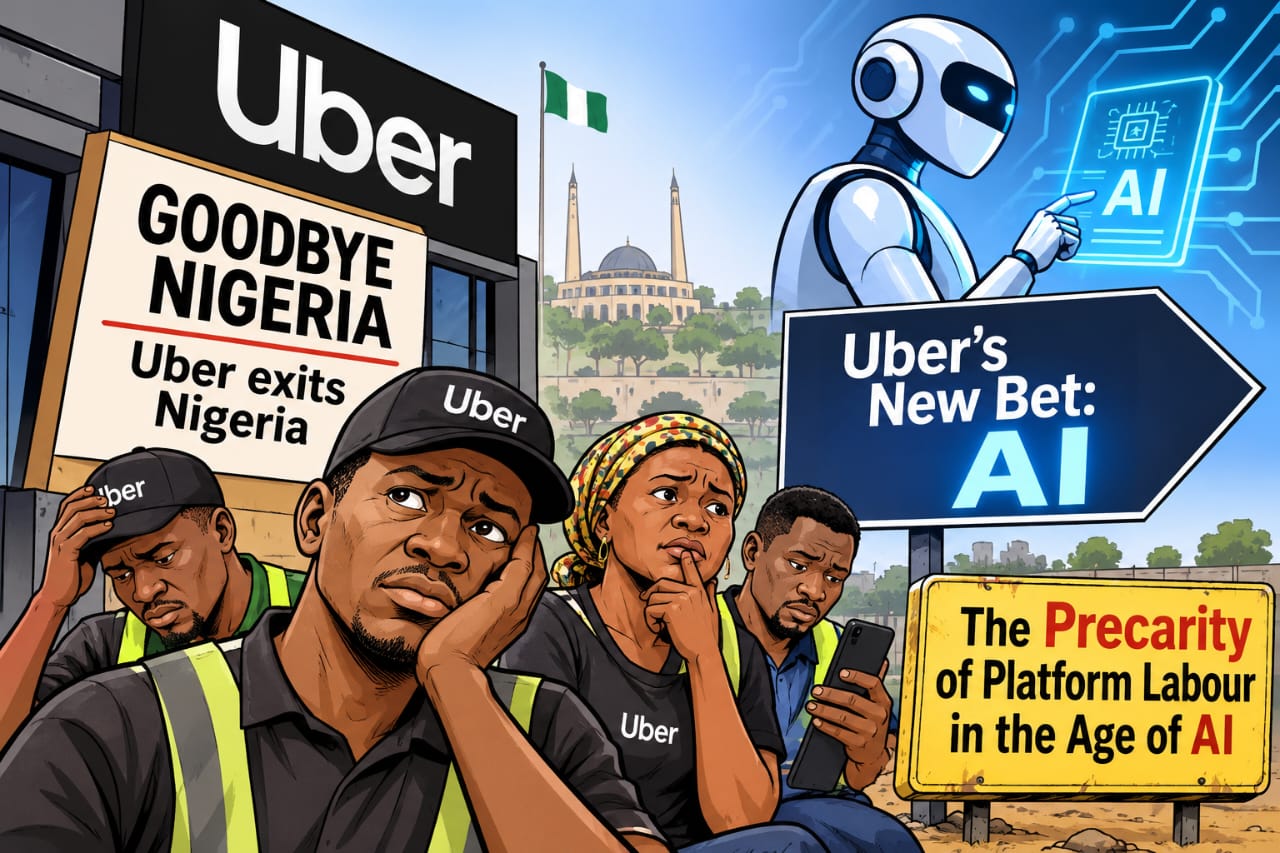
Mr Agbaje’s ordeals aren’t peculiar to him, PREMIUM TIMES gathered from extensive interviews with nearly a dozen cab drivers operating in Lagos, Nigeria’s commercial nerve centre, Abuja, and other parts of the country. Responses from the cab drivers highlight the precarity of platform labour in Nigeria and parts of Africa, as adoption of artificial intelligence deepens.
On September 2, Uber confirmed it was discontinuing its operations in Nigeria after 12 years in one of Africa’s biggest markets. It also announced a similar exercise in Uganda, adding that the decision followed a review of its business priorities and investment focus across Africa.
Although Uber didn’t officially link its exit from the Nigerian market to investment in AI efficiency, the developments illustrate the impact of artificial intelligence in the platform economy and how workers become susceptible to risks as technology and business priorities evolve.


Meanwhile, the next day, 3 September, Uber and British AI company Wayve launched supervised autonomous ride-hailing services in London. The service allows passengers to be matched with electric vehicles equipped with Wayve’s AI Driver technology. The vehicles initially operated with licensed safety drivers onboard. The move followed its global restructuring plans—including cutting about 3,300 jobs—to redirect savings and investments into autonomous vehicles and robotaxi partnerships.
The company’s departure from Nigeria and its growing investment in artificial intelligence (AI) and autonomous ride-hailing have raised questions about the security of jobs and livelihoods tied to digital platforms, particularly for drivers who depend on ride-hailing companies for income and survival.
Operating Challenges
Long before it exited the two countries, ex-Uber drivers interviewed by this newspaper described how rising fuel prices, high commissions, and fare disputes affected their earnings.
These challenges left them struggling to cover operating costs, amid severe pressures to meet personal financial obligations. Their experiences mirrored the vulnerability of platform workers whose access to customers and income depends on decisions made by technology companies.
Samuel Adeoti, a cab driver, said one of the biggest challenges was that the fares failed to keep pace with rising fuel prices and other operating expenses. He said Uber’s commission, which he put at 35 per cent, left drivers with little money after paying for fuel, vehicle maintenance and other expenses.
“The same price we worked with when the fuel price was low, [was] still the same when the price was high; at that point, it didn’t favour the drivers,” Mr Adeoti said.
Speaking about the pressure drivers faced, he gave a hypothetical example of a ₦10,000 trip, from which he said Uber deducted ₦3,500 in commission, leaving ₦6,500 with the driver. After spending about ₦5,000 on fuel, he said a driver would have just ₦1,500 left to cover other costs.
“From the remaining ₦1,500, you have car maintenance and still deal with the task force, police, road safety, etc.,” he said. Mr Adeoti said these expenses made it difficult for drivers to maintain their vehicles and support their families.
Left in the lurch
In 2023, shortly after being sworn in, Nigeria’s President Bola Tinubu introduced some sweeping reforms in Nigeria’s foreign exchange market and the downstream petroleum sector as part of measures to address fiscal imbalances in the economy.
The government abolished what it termed a wasteful subsidy regime and harmonised the foreign exchange market, with an attendant increase in the cost of living and general price levels.
This significantly impacted cab drivers on Uber and other mobility platforms, eating deep into their earnings.
Lanre Mustapha, an ex-Uber driver, said the company failed to adequately address drivers’ complaints about fares and commissions amid sky-high domestic prices.
“They didn’t give us a chance to see what we were talking about concerning the price we charge and the economic situations [in Nigeria],” he said.
Mr Mustapha said drivers had protested against low fares about six months before Uber left Nigeria, but the company failed to address their concerns.
John Promise, 39, another driver on the platform, told PREMIUM TIMES that the drivers remained on the platform notwithstanding because they had no better options and didn’t want to lose access to their customers.
For workers already struggling to cover operating costs, Uber’s exit also meant losing access to a platform through which they had secured customers.
New platforms, fresh uncertainties
As the complaints mounted before Uber exited the Nigerian market, some drivers had already moved to competing ride-hailing services in search of better earnings. Still, the transition did not necessarily resolve their problems.
Mr Mustapha, who said he migrated to InDrive, another ride-hailing platform, described uncertainty over account suspensions on the alternative platform as a major challenge.
“I am with InDrive, and they too have started these ‘unfortunate behaviours’. For instance, you can wake up in the morning to work and discover you have been permanently blocked. Why? They won’t state the reasons,” he said. His experience highlights another concern for platform workers: access to work can depend on an account remaining active, while a suspension can disrupt earnings.
Innocent Ogwuche, another ex-Uber driver, said he initially had a positive experience with the service because of its app and safety features. But things changed when fuel prices increased, and the automated fares charged on the platform failed to keep pace with the cost of operating his vehicle.
“Uber is not the one fuelling your car, Uber is not the one doing your maintenance,” he said, lamenting inadequate compensation for trips delayed by traffic. He said he repeatedly faced technical problems while accessing his driver account, which contributed to his decision to leave the platform.
AI and the future of work
Like in Nigeria, Uber’s exit from key African markets and significant investments in AI raise important questions about the precarity of platform labour.
The development demonstrates how AI tools are increasingly being integrated into tasks previously performed by humans, with ripple effects on the sustainability and survival of workers in the platform economy.
READ ALSO: Uber exits Nigeria after 12 years of operation
Earlier this year, the World Bank released a report titled World Development Report 2026: The Promise of Artificial Intelligence, which assesses how AI impacts 5.6 billion people in low- and middle-income countries and offers a roadmap for developing economies to harness artificial intelligence despite severe resource gaps. The report showed that AI offers a rare path to accelerate growth at a time when global development progress has dipped to its weakest pace in 75 years. It can help bridge chronic gaps in key areas such as health, agricultural guidance for farmers, and basic administrative support for governments. Across economies, especially in the developing world, the report urged policymakers to follow a structured three-step approach: adopt existing AI tools, tailor the tools to local realities, and develop the technology.
Meanwhile, the report also cautioned that traditional work faces targeted white-collar disruption, entry-level hiring freezes, and widening productivity gaps. While mass automation is less immediate in developing economies—where only 4.5 per cent of jobs are highly exposed compared to 14.2 per cent in wealthy nations—the report warns of several major threats to traditional employment, with tendencies that economic benefits from AI tend to flow toward business and capital owners rather than wage workers.
On 22 October, Uber announced a separate expansion of its AI adoption, making ChatGPT Work available to more than 30,000 employees globally after an initial pilot involving 1,000 workers. Through initiatives like Uber AI Solutions and Digital Tasks, Uber also lets drivers and contractors earn money by labelling data, recording voice prompts, and evaluating AI responses during downtime.
Digital labour sociologist Antonio Casilli describes this move as a “Great Digital Labour Convergence”, adding that merging physical gig work with micro-task data labelling normalises underpaid, algorithmically managed work across more industries while threatening traditional employment protections.
He argued that platforms serve as “testing grounds where industrialists experiment with ideas they plan to roll out across all labour markets, ultimately reshaping labour norms and turning what was once unthinkable into the new standard. “In their wake, even traditionally stable professions have begun to absorb gig-like features—flexible scheduling, task-based pay, algorithmic oversight, and the normalisation of precarious autonomy—blurring the boundaries between formal employment and platform labour,” the scholar argued.
In their book, ‘Notes Towards a Digital Worker’s Enquiry’, Julie Chen, a professor of communications and digital labour, and other scholars examined how previously viewed “unorganizable” digital and precarious workforces are building collective resistance and identifying tactical chokepoints within platform capitalism.
Abubakar Aliyu, a cab driver based in Abuja, agrees that platform workers need to strengthen engagement for collective protection as the ecosystem becomes increasingly precarious.
He said a union, the Amalgamated Union of App-Based Transport Workers of Nigeria (AUTTWON), represents ride-hailing and app-based transport drivers (such as Bolt, InDrive, etc.). They use strikes, fare boycotts, and court actions to push back against algorithmic control, he explained.
He added, however, that because the platforms often treat workers as independent contractors rather than employees, they use legal technicalities and grey areas to avoid collective bargaining agreements and demands for better service conditions.
“We are also getting there; we are engaging, rather slowly, but there are challenges,” he said, with uncertainties written on his face.
Discover more from Premium Times Nigeria
Subscribe to get the latest posts sent to your email.









António Guterres, the United Nations secretary-general, has renewed his call to hold fossil fuel companies accountable by making them pay for the harm their actions have done to poorer countries through climate change, marking a defining moment of his last UN climate summit in office.
Mr Guterres gave his final press conference at the 31st Conference of the Parties to the United Nations Framework Convention on Climate Change (COP31) in Antalya, Turkey, as the head of the organisation.
The former prime minister of Portugal has led the UN since January 2017 and exits the role on 31 December, when his second five-year term ends.
Mr Guterres addressed representatives of civil society groups, who gathered Friday to bid him farewell and recognised him with an award for using the UN’s platform to confront the world’s most powerful industries.
“You have given a voice to this injustice like no other leader,” Louise Hutchins, convener of the Make Polluters Pay International Coalition, said.
The session was filled with chants of “make polluters pay”, and speakers asked him to return to a future climate summit wearing an NGO badge.
Mr Guterres told the gathering that the UN’s loss and damage fund now exists but was “funded at a ridiculous level”.
“Those who pollute the least are those who are paying the highest price,” he said.
He urged civil society to apply the counter-pressure needed to help governments understand that things must change.
The UN chief’s final address to a COP leaders’ summit on Wednesday urged governments to levy a tax on oil companies’ windfall profits and use the money to help vulnerable countries recover.
READ ALSO: COP31: What Nigeria, other African countries will push for at UN climate summit
He also proposed a climate justice compact to help countries shift away from fossil fuels, noting that the climate crisis is outrunning the world.
Mr Guterres told the leaders he will no longer be secretary-general from next year, but said, “I will not stop telling the truth.”
At Friday’s press conference, he demanded an immediate and drastic cut in emissions by big emitters.
“You cannot build peace on a burning planet,” he said.
Mr Guterres’ successor has not been announced. The new secretary-general will take office on 1 January 2027 and will lead the UN into the next climate summit (COP32) in Addis Ababa, Ethiopia, later that year.
Discover more from Premium Times Nigeria
Subscribe to get the latest posts sent to your email.

Kel Armstrong Amobi, host of the KaaTruths Podcast, said he vowed to take MTN Nigeria and other telecommunications operators to court over an alleged disappearance of more than 150GB of his mobile data.
Mr Amobi, popularly known as KAA, disclosed this in a post on X on Saturday, accusing MTN of failing to provide a satisfactory explanation of the incident, despite holding two telephone conversations with the company’s customer service representatives.
Mr Amobi said he and other parties will meet MTN and other telecommunications operators at the Federal High Court in Abuja on 18 November over the mysterious data disappearance.
According to him, about three weeks ago, he complained to MTN that more than 150GB vanished from his line, including the depletion of 20GB from his data balance within eight minutes, even though his mobile data was switched off at the time.
“Within minutes of making that post, @MTNNG replied publicly. They said they had investigated and that I actually used the data. They said this without even knowing which number was affected,” Mr Amobi stated.
The podcast host said MTN subsequently contacted him privately through X and requested to have a telephone conversation with him.
“On the call, a customer service agent apologised when I asked why they had lied publicly about an investigation that never happened. Then we got to the real issue. She admitted she had no answers. She said she would send the case to their technical team and call me back, he stated.
Mr Amobi said the representative later called back with the outcome of the investigation, claiming that he had used 30GB on Google services and another 19GB on YouTube on the day in question.
Mr Amobi, however, disputed the claim, particularly the assertion that he consumed the 19GB on YouTube while attending a meeting at Transcorp Hilton Abuja.
The customer care officer could not give a convincing response to what happened to the remaining data, he noted.
“But let’s take it even further, according to my phone records. The iPhone 17 Pro Max eSIM has a 5,088 mAh battery capacity, and at 95 per cent battery health, it would take about 25-30 per cent to stream a 4K Video on YouTube for three hours. Still, on that day, my battery usage records showed that YouTube used only 2% of Battery and spent about 20 minutes of screen time,” he remarked.
He also claimed that his iPhone’s records showed total YouTube data consumption of 23.8GB over the 10 months he had used the device, making MTN’s insistence that he used 19GB on YouTube in one day questionable.
According to him, MTN’s explanation did not account for the remaining data or establish how the alleged consumption occurred while his mobile data was switched off.
The podcast host said he would not blame the customer service representative, describing her as an employee carrying out her duties, but insisted that the company’s management should account for its public claims and the unresolved complaint.
“My last words to her were: tell your people not to bother sending you again. Bring the explanation and the results of your so-called investigation to court. We meet MTN and the other telcos at the Federal High Court, Abuja, on the 18th of this month,” he said.
As of the time of filing this report, Mr Amobi has not responded to PREMIUM TIMES with the details of the legal steps he plans to take or other circumstances surrounding his experience with the mobile network operator. MTN is also yet to respond to this newspaper’s request for comment.
Similar encounters
Mr Amobi’s post triggered similar reactions from other social media users with similar past experiences with Nigerian telecommunicationsservice providers.
Akinrinlola Olamide, a software engineer, said she has had comparable incidents repeatedly, alleging that MTN’s data usage meter is no longer functioning on the telco’s app.
“This is ridiculous; it has been happening to mine too, and they keep doing it because I’m not talking; their data usage meter is no longer working on their app,” Mr Olamide said.
Also sharing his experience, an X user, Big Sam @_samueld_, expressed his displeasure with the disappearance of his 1.28 terabyte data subscriptions, adding that he reached out to the telco for a remedy to the situation but got no response.
“I wish I could go to court too. My 1.28TB data disappeared overnight! I have sent a detailed email to MTN and tagged necessary regulatory bodies; nothing has been done. More than a month has passed,” he said.
The complaints persist despite regulatory measures introduced by the Nigerian Communications Commission (NCC) to shield telecommunications subscribers from unexplained data depletion, billing errors, and poor network services.
In January 2021, the NCC announced that it had instituted a forensic audit to investigate complaints of unexplained data depletion and wrongful deductions from subscribers’ accounts, with the possibility of compensating affected consumers.
ALSO READ: MTN partners Omoni Oboli to unveil seven Christmas films on YouTube
However, complaints persisted, prompting the regulator in May 2024 to direct mobile network operators to audit their billing systems, following renewed reports of unexplained data depletion.
In July 2024, the commission also introduced the Nigerian Communications (Quality of Service) Regulations, which established minimum service-quality standards for telecommunications operators. It provided for the measurement, reporting and monitoring of network performance.
When complaints about rapid data depletion and inaccurate billing persisted, the NCC, in August 2025, directed telecommunications operators to engage independent audit firms to scrutinise their billing systems.
The regulator has also introduced additional consumer-protection measures, including a refund framework for failed airtime and data transactions in January 2026 and a compensation framework for subscribers affected by poor network services in March 2026.
That notwithstanding, complaints of unexplained data depletion remain commonplace, raising questions about the efficacy of existing regulatory measures and the transparency of operators’ billing systems.
The extent to which subscribers can accurately verify their data consumption also remains uncertain.
Discover more from Premium Times Nigeria
Subscribe to get the latest posts sent to your email.
-

 News3 days ago
UNIJOS Appoints Patricia Lar as First Female Vice-Chancellor
-
News23 hours ago
Tinubu (APC) in Jos: Promises to restore peace in the State and Nigeria
-
News3 days ago
Democrats launch Nvidia investigation, write scathing letter on Huang’s ‘scheme’ with Trump
-
News3 days ago
Nigeria opens 3MTT Cohort 5 with ₦4bn funding – Technology Times