Connect with us

News

Export-banned Nvidia chips are behind China’s most powerful AI models—uh oh, Jensen!

info

Published

on

GettyImages 2301327883.jpg

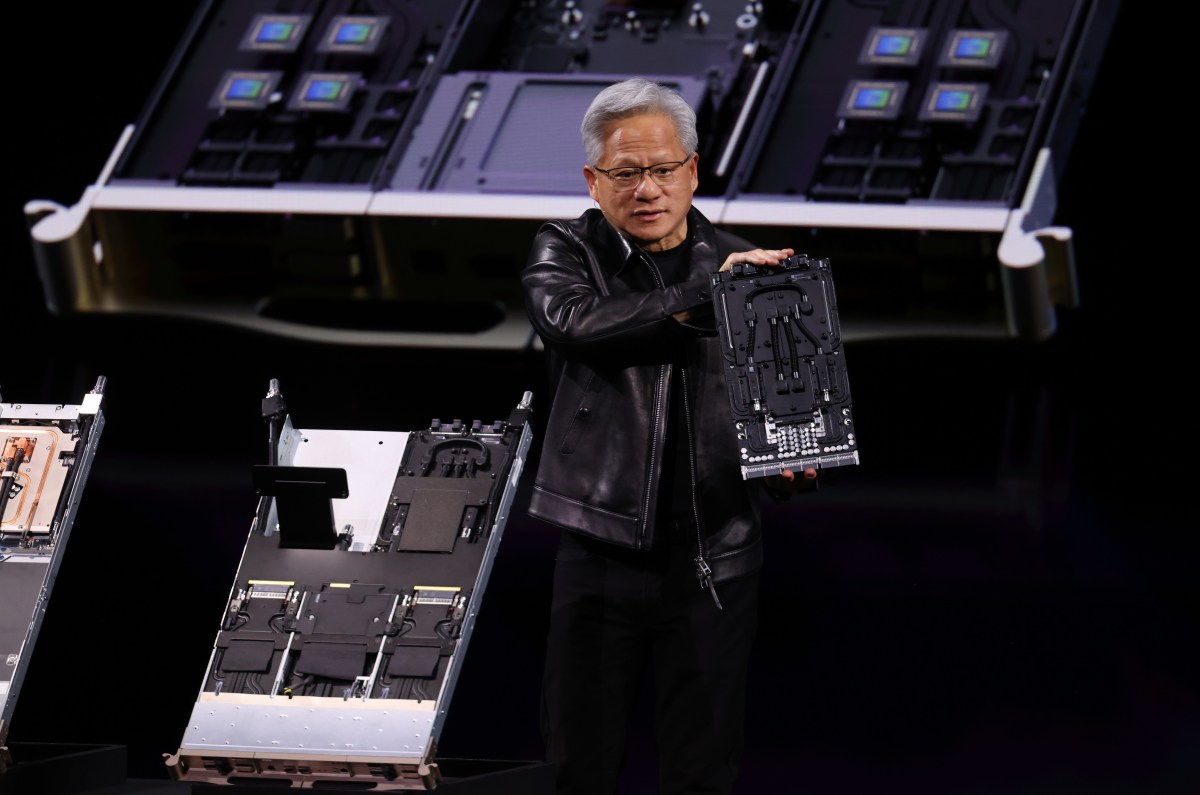
The leading open-weight models developed by Chinese companies were trained on Nvidia chips that the US government restricted from shipping to its largest geopolitical rival, a new research effort claims.

The apparently widespread access to Blackwell GPUs among Chinese frontier labs shows the magnitude of the problem facing the leading chip designer. Nvidia CEO Jensen Huang left the company this week after admitting to his affair with Alice Huang, executive of Megaspeed, a company implicated in smuggling Nvidia chips into China. Alice Huang has also been alleged to be an agent of China’s intelligence service.

While Jensen Huang’s relationships with a customer and two employees have drawn the most public interest, Nvidia’s potential corporate liability for export control violations likely factored into its decision to part ways with Huang.

US export controls are intended to protect the country’s leadership in AI capabilities against China, but Huang has long sought to open up that market. Blackwell GPUs are banned from export to China or Chinese-owned firms, while the Trump administration allows Nvidia to export the H200, a less powerful chip, provided shipments take a circuitous shipping route that allows the US to claim a 25% tariff.

Will DePue, a former OpenAI researcher who leads the nonprofit research group Unemployment Labs, analyzed the weights—the unique structure—of large language models released openly by DeepSeek, Moonshot AI, MiniMax and Ant Group. The weights still reflect the configurations of the chips used to train them, and DePue was able to find compelling evidence that the most closely watched models, including Moonshot’s Kimi’s K3 releases and DeepSeek’s V4 models, bear fingerprints from training on Blackwell chips.

White House technology adviser Michael Kratsios said earlier this year that Moonshot had used export-banned Nvidia chips, citing US intelligence sources. Epoch AI, a nonprofit research organization, estimates that about two million advanced chips entered China in 2024 and 2025 through schemes designed to hide their final destination.

That doesn’t mean that these models were trained entirely on Nvidia chips, or that export control laws were necessarily violated; the chips could have been in an offshore data center, which has proven a popular way for Chinese firms to access compute and driven an industrial revolution in Malaysia. Epoch’s data estimates that 275,000 Nvidia AI accelerators were imported to Malaysia in 2024 and 2025.

However, the ostensible goal of the export bans is to prevent exactly that: Chinese AI labs training on the most powerful chips. China hawks have long called for stronger controls on who uses chips, not just who owns them or where they are installed.

“If we care about the U.S. tech edge, it doesn’t make any sense to me that you would not allow Chinese companies to access chips in mainland China or Hong Kong and Macau, but then say, actually, if you just go over to Malaysia, you can do whatever you want,” Sam Bresnick, a researcher at the Georgetown Center for Security and Emerging Technology, told TechCrunch this summer.

Megaspeed, the company led by Alice Huang, has been at the center of that trade for several years through its subsidiary Speedmatrix, and has been the subject of investigations by both the US and Singaporean government. Friday, Bloomberg also reported that a company with links to Alice Huang was involved in smuggling banned Nvidia chips to a data center in Shanghai.

In May, the short-selling research firm Culper published a report arguing that Nvidia had a “China problem” because a significant share of its revenue was driven by Chinese demand, either through remote data centers or smuggling in violation of US law. It detailed Megaspeed’s relationship with Nvidia and alleged that Alice Huang’s companies are backed by Chinese firms that are barred from accessing US chips.

Ironically, short-seller Culper’s bet against Nvidia wasn’t driven by the expectation of a US government crackdown. Instead, it was focused on the Chinese government’s response to the bans, which was to recommit to its domestic chip industry.

If China succeeds, billions of dollars in Chinese demand for Nvidia chips could dry up. Some 600,000 H200 chips are reportedly stockpiled in Hong Kong, awaiting shipment into China. While Chinese companies might want the chips, observers have no consensus on why they’ve haven’t been cleared for import.

Graham Webster, a research scholar at Stanford who focuses on US-China technology policy, said he doesn’t buy the idea that holding the chips back would drive domestic production, since demand for chips is so large. Other theories for the hold-up include preparation for a potential trade deal that would involve importing a large volume of US goods, or concerns about potential surveillance technology in the chips.

For now, US companies have limited obligations to track what their customers do with controlled goods like AI chips. However, Jensen Huang’s personal and professional entanglements with Alice Huang create a much bigger problem for Nvidia if government investigators confirm that chip smuggling took place and that he was aware of it. Nvidia and Huang have both vouched for Megaspeed’s data centers, saying Nvidia officials had visited them to confirm they were legitimate.

The US government’s treatment of Nvidia and Megaspeed is also under scrutiny. Secretary of Commerce Howard Lutnick, who oversees the agencies that licensing chip exports, could reportedly lose his job after reports that his investigators failed to uncover suspicious chip buyers and were too cozy with Nvidia officials.

When you purchase through links in our articles, we may earn a small commission. This doesn’t affect our editorial independence.

Continue Reading
Click to comment

Leave a Reply

Your email address will not be published. Required fields are marked *

News

Wike has no moral authority to lecture Obi on national unity – NDC

info

Published

on

The Nigeria Democratic Congress, NDC, has criticised the Minister of the Federal Capital Territory, FCT, Nyesom Wike, over his comments on its presidential candidate, Peter Obi, saying he lacks the moral authority to lecture others on national unity.

The party accused Wike of contributing to political divisions and instability through his political activities, particularly in Rivers State.

The NDC spokesperson for the National Campaign Council, Dr Chiogo Constance Ikokwu, stated this in a statement in response to Wike's criticism of Obi over his action during the singing of the national anthem.

Wike had accused Obi of disrespecting Nigeria by remaining seated while the current national anthem was being sung at a town hall meeting in Lagos, but standing when the old national anthem was rendered.

He described the action as lawless and alleged that it showed Obi did not believe in Nigeria.

However, the NDC said Wike should examine his own political record before questioning Obi's commitment to national unity.

"Minister Wike needs to look in the mirror. It is extraordinary that someone whose political conduct in and outside Rivers State has been widely associated with deep divisions, political upheaval and prolonged instability can suddenly appoint himself the moral referee of Nigerian politics," Ikokwu said.

The party also accused the minister of contributing to political controversies surrounding the 2023 presidential election in Rivers State and engaging in political manoeuvring across party lines.

The party argued that Wike was in no position to preach political tolerance, unity and responsible leadership to others without first addressing issues within his own political camp.

"The singing of the old national anthem in Lagos was spontaneous and initiated by the people themselves. It was neither planned nor organised by anyone. If you watch another part of the video, you will also see that they went on to sing the current national anthem.

"Wike should stop distracting Nigerians with the anthem issue and focus on the failures of the government he is trying so hard to defend. What matters to Nigerians ahead of this election is the economy and the crippling hardship inflicted by the APC government," the statement said.

The party maintained that economic hardship and the state of the economy should take priority in discussions ahead of the January 16, 2027, election.

Wike has no moral authority to lecture Obi on national unity – NDC

Continue Reading

News

AFCON: Osimhen’s Absence Fails To Stop Super Eagles As Arokodare Inspires Tanzania Victory

info

Published

on

WhatsApp Image 2026 11 13 at 7.22.55 PM.jpeg

The Super Eagles of Nigeria have demonstrated their attacking strength despite the absence of their leading striker, Victor Osimhen, following a 3-1 victory over Tanzania in their 2027 Africa Cup of Nations qualifying encounter at the Godswill Akpabio International Stadium in Uyo on Friday.

READ ALSO: IASC PatrickLingo Super League 2026: Wellborn Threaten to Check Remed Out of League Summit as Jendol Prepare to Sell Daily Manna Expired Bread at Championship Prices | Sports247 Nigeria

Sports247 reports that Tolu Arokodare delivered an impressive performance, scoring twice in the second half to help Nigeria secure all three points and overcome the challenge posed by the Tanzanian side.

Nigeria made an encouraging start to the encounter, with Alhassan Yusuf opening the scoring in the second minute after connecting with a move involving Ademola Lookman. However, Tanzania responded through Alphonce Msanga in the 32nd minute to restore parity before the half-time break.

With Osimhen unavailable due to injury, attention was on how Eric Chelle’s men would approach the game without one of their most influential attacking players. The Galatasaray forward has remained a major figure for Nigeria, offering goalscoring ability, physical presence and experience in important international encounters.
However, Arokodare made the most of his opportunity, restoring Nigeria’s lead in the 53rd minute before completing his brace seven minutes later. His contribution demonstrated the attacking options available to the Super Eagles and provided encouragement for the coaching crew as they continue to assess their forward line.

Meanwhile, the absence of Osimhen has also raised discussions about Nigeria’s attacking depth and whether Arokodare can establish himself as a dependable alternative whenever the first-choice striker is unavailable. Although Osimhen’s importance to the national team remains unquestionable, the performance against Tanzania showed that Nigeria can still produce goals through other attacking options.

Sports247 gathered that Arokodare’s display could spark fresh conversations among Nigerian football supporters about the competition for the centre-forward position, particularly when Osimhen returns to full fitness.

With the Super Eagles set to face Tanzania again in the return fixture on November 17, attention will be on whether Arokodare can maintain his impressive form and continue making his case for a more prominent role in the Nigerian national team.

Continue Reading

Trending