Connect with us

Business

How Benin runway incident exposed fresh safety gaps, triggered recommendations — NSIB

info

Published

on

WhatsApp Image 2026 07 23 at 7.36.42 PM e1784833659879.jpeg

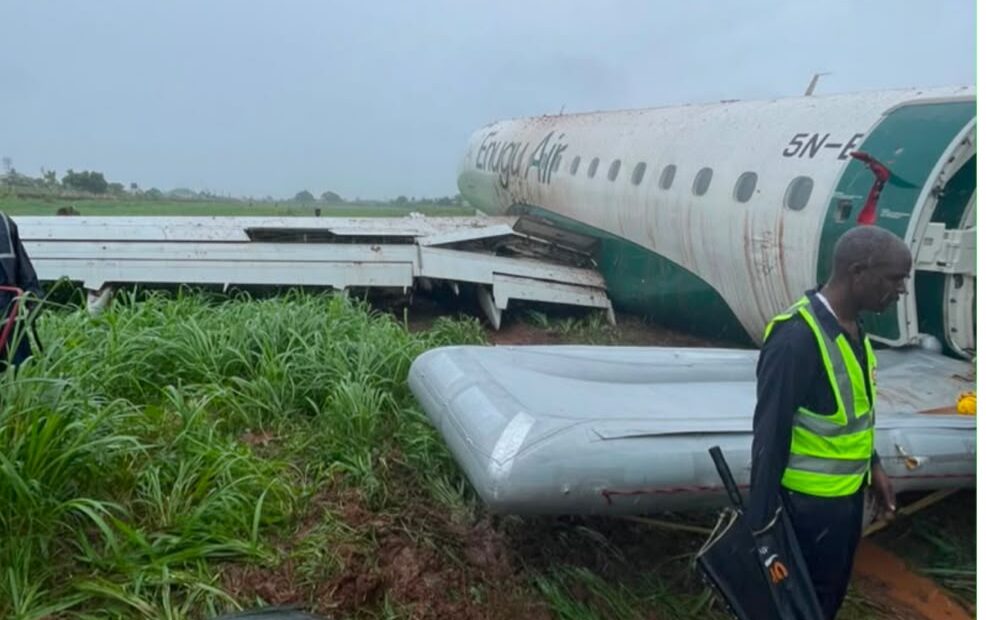
The Nigerian Safety Investigation Bureau (NSIB) has identified safety concerns around the runway-end environment, control tower line of sight and availability of meteorological information following the runway overrun involving an Enugu Air aircraft at the Benin Airport in Edo State.

The bureau has consequently issued four immediate safety recommendations to the Nigerian Civil Aviation Authority (NCAA), the Federal Airports Authority of Nigeria (FAAN) and the Nigerian Meteorological Agency (NiMet) as part of its ongoing investigation into the 23 July incident.

The recommendations, numbered A-2026-039 to A-2026-042, were contained in the preliminary report disclosed by the NSIB in a statement issued on Friday by its Director of Public Affairs and Family Assistance, Funke Arowojobe.

The report concerns an Embraer ERJ 170-100LR aircraft, registration number 5N-ENR, operated by Enugu Air Limited on scheduled passenger flight ENU4264 from the Murtala Muhammed International Airport, Lagos, to the Oba Akenzua II Airport, Benin.

The aircraft had 63 passengers and five crew members on board when it landed on Runway 05 at about 2:55 p.m. It subsequently continued beyond the runway end into an unpaved area, where it struck approach-lighting installations and two fixed concrete structures associated with a decommissioned localiser installation.

All 68 occupants were evacuated safely using the aircraft’s emergency escape slides, with no injuries reported.

The latest findings provide the first detailed account from the accident investigation since the occurrence temporarily led to tbe shutdown of the Benin Airport runway and disrupted scheduled flights.

What happened before the overrun

According to the preliminary report, the aircraft departed Lagos at about 2:19 p.m. for Benin and completed its take-off, climb, cruise and descent phases normally.

The crew was initially cleared to conduct an Instrument Landing System (ILS) approach to Runway 23 but later requested and received approval for an RNAV approach to Runway 05.

During the approach, the crew raised concerns about rain around the airport. The control tower subsequently advised that the approach path to Runway 23 appeared to have better conditions.

The crew, however, continued with the RNAV approach to Runway 05.

At about 2:48 p.m., the tower informed the crew that visibility was approximately 1,500 metres in moderate rain. The aircraft was subsequently cleared to land on Runway 05, with the crew also cautioned that the runway surface was wet.

The NSIB’s preliminary report does not, however, establish that any of these factors individually caused the runway overrun. The bureau said its investigation remains ongoing and that further technical examination and analysis are required.

The report was compiled from information obtained through several sources, including witness statements, flight recorder data, air traffic control communications and preliminary inspection of the aircraft.

NSIB flags airport safety issues

The four recommendations issued by the bureau focus on the conditions and systems surrounding the runway rather than assigning responsibility for the occurrence.

The NSIB identified the runway-end environment, the control tower’s line of sight and the availability of meteorological information as areas requiring attention by the relevant aviation agencies.

The recommendations are intended to address safety issues identified during the investigation and reduce the possibility of similar occurrences.

The bureau also released a preliminary recreation of the aircraft’s flight path based on information available at the current stage of the investigation.

It said the video was part of its effort to improve transparency and communicate relevant safety information to the public while the investigation continues.

The NSIB cautioned against treating the preliminary findings as a final determination, stressing that the information remains subject to further review and could change as investigators obtain and analyse additional evidence.

The final report, according to the bureau, will contain its conclusions and any further safety recommendations arising from the completed investigation.

The incident had consequences beyond the aircraft and its occupants.

Following the occurrence, FAAN temporarily closed the Benin Airport runway to facilitate the recovery of the aircraft and allow authorities to conduct safety assessments.

The closure disrupted scheduled flights, forcing airlines operating to and from Benin to cancel or adjust their services.

PREMIUM TIMES reported that the runway reopened after 12 days, with ValueJet announcing that its flights to and from Benin would resume from 5 August, confirmed by FAAN.

The reopening restored the runway to operational use, but did not signify the conclusion of the NSIB investigation.

In aviation, an airport can resume operations after safety assessments while a separate accident or occurrence investigation continues. The operational reopening is aimed at establishing that the facility is safe for use, while the investigation seeks to determine what happened and identify measures that could prevent a recurrence.

NSIB says investigation is not about blame

The bureau said the preliminary report should not be interpreted as an attempt to establish liability against the airline, flight crew, airport authorities or any other party.

It said the investigation is being conducted in accordance with Annex 13 to the Convention on International Civil Aviation, whose primary objective is the prevention of future accidents and incidents.

The NSIB therefore urged the public and other stakeholders to avoid drawing conclusions about the cause of the occurrence before the investigation is completed.

The bureau said further technical work would be undertaken before its final conclusions are reached.

For Benin Airport, the recommendations come 16 days after the reopening of the runway following nearly two weeks of disruption. They also provide aviation authorities with specific areas to examine as they work to strengthen safety around the airport.

While no passenger or crew member was injured in the Enugu Air occurrence, the NSIB’s preliminary findings show that the incident exposed issues beyond the aircraft itself, particularly around the conditions, visibility and information available during the approach and at the end of the runway.

Continue Reading
Click to comment

Leave a Reply

Your email address will not be published. Required fields are marked *

Business

Dangote Refinery to launch $1.5 billion IPO mid-September

info

Published

on

By

Dangote Refinery 2 1024x831 1 e1778177983979.jpg

MTN ADVERT

Dangote Refinery will open the order book for its initial public offering to retail investors on 14 September, effectively kickstarting the $1.5 billion public share sale, said to be the continent’s biggest ever, Reuters reported Friday, citing two sources who have close knowledge of the move.

Pricing will commence at any moment now at N525 per share ($0.40), with 4.1 billion shares up for subscription, the report added, noting that the sources spoke on the understanding that their identities will not be disclosed.

The crude processing plant, which holds the distinction of being the world’s largest single-train refinery, will have the latitude to sell 15 per cent of the offer size in addition to the total number of shares up for grabs in the event the transaction is oversubscribed, a source was quoted as saying.

The facility, owned by Africa’s richest man, Aliko Dangote, is ready to double nameplate capacity to 1.4 million barrels per day (bpd).

Financing will be provided by proceeds from both the planned equity sale and a private placement held in July, which raised $2.5 billion from institutional investors and high-net-worth individuals. It was 270 per cent oversubscribed.

PT WHATSAPP CHANNEL

Another refinery, the size of the current one at 700,000 bpd, is to be established in the coastal town of Lamu in Kenya, strategically conceived by the Dangote Group as the gateway to the broader East African market.

READ ALSO: Dangote Cement sets date for London capital markets day ahead of LSE listing

Last month, the group offered a 30 per cent stake in the proposed refinery to countries in the region, including Kenya, Rwanda and Ethiopia.

The groundbreaking is scheduled for this month.

Dangote Refinery is exploring a cross-border listing on the Johannesburg Stock Exchange, the continent’s foremost bourse, following a primary listing in Lagos.

The corporation said in August that a London listing, which its sister company, Dangote Cement, is actively pursuing, is not on the cards, adding that a potential listing in the UK capital is at least three years away.


Discover more from Premium Times Nigeria

Subscribe to get the latest posts sent to your email.

Continue Reading

Business

Tinubu speaks on Africa’s new credit rating agency

info

Published

on

By

795983524 1635134861682925 4976397448398499118 n scaled e1788466644254.jpg

MTN ADVERT

President Bola Tinubu has welcomed the planned launch of the African Credit Rating Agency (AfCRA), saying Africa needs financial institutions that better understand the continent’s economies and risks.

The African Union has announced that the agency will officially launch on 7 October in Port Louis, Mauritius.

President Tinubu said the development was another step towards building African financial institutions capable of providing more accurate assessments of the continent’s economies.

The president disclosed this in a post on his official X account on Thursday, recalling that he had advocated for an African credit rating agency in a February 2026 Financial Times article.

He said he also raised the issue at the Africa CEO Forum in Kigali, Rwanda, in May, where he called for Africa to develop financial institutions that understand its economic realities.

PT WHATSAPP CHANNEL

“Africa is not asking for favourable ratings. We are asking for fair ratings, grounded in our fundamentals and in the reforms our economies are actually carrying out,” he said.

Why the agency matters

Credit ratings influence how investors assess the risk of lending to countries and companies. They can also affect borrowing costs and the amount of capital available to governments and businesses.

African governments have repeatedly raised concerns about what they describe as an “Africa premium”, under which African countries may face higher borrowing costs because of how investors perceive the continent’s risks.

The three major global rating agencies, including Fitch, Moody’s and S&P Global Ratings, currently play a major role in assessing African sovereign and corporate borrowers.

President Tinubu, in an article published by Financial Times, argued that African economies were paying too much to borrow because international assessments did not always adequately capture their economic realities.

He cited a 2023 United Nations Development Programme estimate that shortcomings in credit ratings cost African countries about $75 billion annually through higher interest payments and foregone lending.

He also argued that commodity-dependent African economies could be particularly exposed to downgrades during global market downturns, even when their reserves, fiscal positions, and debt profiles remained manageable.

The proposed agency is therefore expected to provide an Africa-focused alternative by taking greater account of local economic conditions and reforms.

The African Union has said that AfCRA will operate alongside existing global rating agencies rather than replace them.

Tinubu seeks investor confidence

In his statement Thursday, the president said the establishment of an African rating agency should not be interpreted as a demand for preferential treatment.

READ ALOS: US court case on Tinubu’s past forfeiture is civil, not criminal matter – Presidency

Rather, he said, the agency must provide assessments based on economic fundamentals and the reforms being implemented by African countries.

He pointed to Nigeria’s experience, arguing that improvements in economic data, fiscal transparency and reforms had contributed to recent upgrades by international rating agencies.

However, he acknowledged that the credibility of AfCRA would ultimately depend on the quality and independence of its assessments.

“AfCRA must now earn the confidence of global capital. That confidence will rest on its independence and the rigour of its work,” he noted.

The launch is scheduled for 7 October in Mauritius, with President Tinubu saying he looks forward to the development.


Discover more from Premium Times Nigeria

Subscribe to get the latest posts sent to your email.

Continue Reading

Trending