News
Gov Sani visits family of murdered Kaduna teacher


Governor Uba Sani of Kaduna State has paid a condolence visit to the family of Islamic teacher, Ummulkhairi who was gruesomely murdered by a mob in Maraban Jos, Igabi Local Government Area in the state.
In a post on Saturday, Abdallah Yunus Abdallah, the senior special assistant on new media to the governor, said that the governor met with the slain teacher’s husband.
“This evening, Governor Uba Sani visited the family of the late Ummulkhairi in Maraban Jos, Kaduna, to extend his heartfelt condolences.
“He met with her husband, Malam Aliyu, and other family members to offer support. The Governor explicitly assured them that those responsible for her murder will be brought to justice,” he wrote.
Mr Abdallah stated that the governor committed to personally assisting Mr Aliyu and caring for the children she left behind until they reached adulthood.
“Governor Sani assured that the 41 suspects already detained will be prosecuted, and that efforts are ongoing to apprehend the remaining suspects,” he added.
Mr Abdallah added that the governor said a comprehensive investigation was underway to ensure that any police officers suspected of involvement are held accountable.
Peoples Gazette reported on Wednesday that police in the state had arraigned 24 suspects in connection with the murder of the school teacher.










By Sumaila Ogbaje
The Chief of Army Staff (COAS), Lt.-Gen. Waidi Shaibu, has reiterated the Nigerian Army’s commitment to enhancing operational readiness and personnel welfare.
Shaibu stated this on Monday at the operationalisation of refurbished operational vehicles and the renovated Soldiers’ Club named, “Nightingale Club” of the Nigerian Army Women Command (NAWC), Giri, Abuja.
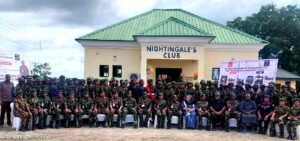
The COAS, represented by the Acting Director, Army Public Relations, Col. Appolonia Anele, said serviceable vehicles were critical to the timely movement of personnel, equipment and logistics.
He said the refurbishment of the vehicles would significantly enhance the Command’s ability to respond promptly and effectively to operational requirements.
According to him, mobility remains a critical component of military effectiveness, particularly in supporting troops during operations.
He urged personnel entrusted with the vehicles to treat them as valuable government assets by ensuring proper maintenance, responsible handling and strict adherence to extant regulations.
Shaibu also stressed the importance of personnel welfare, saying a military organisation was sustained not by equipment alone, but also by the morale and cohesion of its personnel.
He said the Soldiers’ Club would provide an avenue for relaxation, recreation, social interaction and strengthening of esprit de corps among personnel and their families.
The COAS urged the Command to sustain the culture of maintenance, accountability, discipline and prudent management of resources.
He commended the leadership and personnel of NAWC for the initiative, saying the projects demonstrated what could be achieved through effective leadership and collective commitment.
Earlier, the Commander, NAWC, Brig.-Gen. Mohammed Adamu, said the refurbishment was in line with the COAS’s Command Philosophy of ensuring operational readiness.
Adamu said the Command had a responsibility to ensure that its personnel could be mobilised and deployed at short notice whenever required to support military operations.
He recalled that on April 14, 2026, the COAS directed the deployment of a company from the Command to Plateau State following security challenges in the state.
According to him, the Command was able to mobilise and deploy the troops promptly because it had the necessary operational mobility and other enablers.
He said the experience underscored the importance of maintaining operational vehicles in serviceable condition at all times.
Adamu said four refurbished coaster buses previously in deplorable condition were being operationalised to enhance the Command’s mobility and capacity to respond to operational assignments.
He also said the renovation of the Soldiers’ Club was part of the Command’s commitment to the Soldiers First Concept, which places the welfare of soldiers at the centre of command responsibilities.
The commander said the facility had previously been in a deplorable condition, with inadequate lighting and poor sanitary facilities.
He said its rehabilitation had provided soldiers with a more conducive environment for relaxation, social interaction and receiving guests.
“Anything we do under the leadership of the Chief of Army Staff that does not put soldiers’ welfare first is not in keeping with the Soldiers First concept,” she said.
Adamu urged commanders at all levels to prioritise the welfare of soldiers, noting that motivated personnel were better positioned to deliver effectively on assigned responsibilities. (NAN)
Edited by Isaac Aregbesola
News
“Enough of This Disregard” — NRFF President Aré Warns Rugby Clubs Over Bypassing State Associations

Nigeria Rugby Football Federation President Dr. Ademola Aré has warned rugby clubs and stakeholders against operating outside recognised state association structures, insisting that continued disregard for established administration could slow the development of the sport in Nigeria.
Aré issued the warning following complaints from sports directors and commissioners in some states about clubs carrying out activities without working with their respective state rugby associations.
For the NRFF president, clubs seeking national recognition must first establish a functional relationship with the structures responsible for rugby within their states.
“To get into the national federation, you need to align with state associations,” Aré said.
“Unfortunately, some club owners are not doing this, yet they want to travel abroad to represent the country.”
Aré believes such practices create unnecessary conflict between clubs, state associations, sports councils and the national federation.
“They keep forgetting the basic things, which makes them work at cross purposes with the federation, and it is rugby that suffers,” he added.
The warning comes as the NRFF pushes to expand rugby at grassroots level and strengthen its presence within Nigeria’s national sporting structures. The federation has also recently invested in training coaches, referees and medical personnel, with Aré urging those beneficiaries to work closely with their state associations and communities.
Aré said cooperation at state level could also strengthen the federation’s attempts to secure greater recognition for rugby in national competitions.
“If they did, it would be easier for the sport to gain wider acceptance, and we would not need to fight every time for recognition,” he said.
The NRFF president went further, saying clubs seeking to travel internationally should obtain clearance from their state association and the national federation.
“Enough of this disregard for constituted authority,” Aré declared. “All stakeholders must respect the structures put in place for the proper administration and development of rugby in Nigeria.”
With Nigeria targeting continued international growth and ultimately an Olympic pathway, Aré’s message is that progress on the field must be matched by stronger organisation off it.
-

 Business2 days ago
Lingzhi Global, NACOFTAN Announce 2026 Coffee Festival in Cross River
-
Events2 days ago
Peace Walk: WOPPI Urges Plateau Citizens to Invest in Peace Every Day
-
News4 days ago
ADC chieftain dumps party, defects to APC
-
News2 days ago
INEC declares APM’s Adamu Yakubu winner of Sakwa bye-election in Bauchi