Connect with us

News

2027: ‘Only God, Tinubu know what will happen in presidential election’ — Galadima

info

Published

on

Buba Galadima.jpg

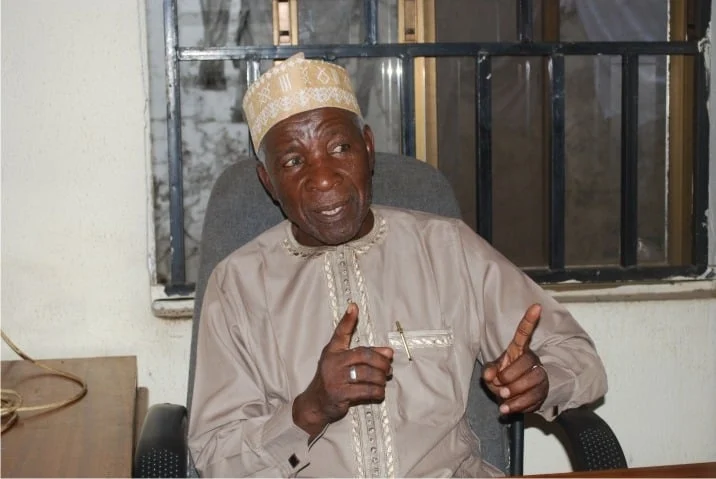
A chieftain of the Nigeria Democratic Congress, NDC, Buba Galadima, has said only God and President Bola Ahmed Tinubu know what will happen in the 2027 presidential election.

Galadima made the remark on Thursday during an appearance on Channels Television’s Politics Today, where he discussed the opposition party’s preparations for the 2027 election and the prospects of its presidential ticket involving Peter Obi and Rabiu Musa Kwankwaso.

When asked whether he expected the 2027 election to be free and fair, Galadima expressed doubts, alleging that political developments ahead of the poll had given the opposition cause for concern.

“If you are dealing with criminals and fraudsters like these ones we have, you can’t be sure of anything,” he said.

Recommended

“Only God and Tinubu know what will happen to this election.”

Galadima also alleged that opposition politicians had come under coordinated attacks, citing incidents involving opposition supporters in Enugu, Peter Obi in Benue State and an ADC governorship candidate in Kaduna.

The NDC chieftain, however, expressed confidence in the Obi-Kwankwaso ticket, saying the pair would win if the election were conducted freely, fairly and transparently.

“Obi and Kwankwaso will win this election if it is free, fair and transparent, unless somebody decides to use the machinery of government and take it away from them,” he said.

Galadima also disclosed that he is currently the chairman of the coordinating strategic committee for the presidential candidate and his running mate. He said the committee was working to harmonise the political blueprints of Obi and Kwankwaso, who contested the 2023 presidential election on different platforms.

According to him, the two politicians complement each other and are being presented as a single ticket for the country.

“It is a single ticket for Nigeria. We are not going to run a divided government, one belonging to Kwankwaso and one belonging to Peter. No, we are running a Nigerian government. That is why we call this ticket a healing ticket for Nigeria,” he said.

He identified national unity, public confidence in government and security as some of the issues the ticket would focus on if elected.

“We want to create public confidence in governance, in government, and in the people running our country,” Galadima said, adding that the proposed administration would pursue security measures that would allow Nigerians to conduct their daily activities without fear.

Galadima also questioned reported political engagements involving President Tinubu and the Independent National Electoral Commission, INEC, saying the opposition did not know what such interactions entailed.

“If they are doing the kind of politics that we see in Nigeria, he may announce himself having met the INEC chairman [and] some prominent Nigerians in France, and we don’t know what they are doing,” he said.

He further criticised the reported gathering of academics who publicly expressed support for Tinubu and argued that those individuals should not subsequently be recruited to serve in the election.

“We are saying, as a political party, that none of those 600 professors … should be recruited to serve in the elections, because they have already taken sides by declaring their support for a candidate in this election,” he said.

He also maintained that the NDC’s strategy would not necessarily depend on producing a single opposition candidate against Tinubu, arguing that the opposition had moved beyond the stage where legally distinct parties could field one joint candidate.

Continue Reading
Click to comment

Leave a Reply

Your email address will not be published. Required fields are marked *

Business

Ethiopia, Djibouti hail Dangote’s $660 million pipeline as energy security boost

info

Published

on

By

Screenshot 2026 05 15 085218.png

Ethiopian Prime Minister Abiy Ahmed and Djibouti President Ismaïl Omar Guelleh have commended Dangote Group’s $660 million Damarjog-Dewele Oil Terminal and Pipeline Project, describing it as a major infrastructure investment capable of transforming regional trade and energy supply.

The leaders spoke at the groundbreaking ceremony for the project at the Damerjog Industrial Development Free Trade Zone in Djibouti.

The project involves the construction of a 120-kilometre multiproduct pipeline connecting marine and coastal storage facilities at Damarjog in Djibouti with inland storage and distribution facilities at Dewele in Ethiopia.

Upon completion, the pipeline is expected to facilitate the movement of refined petroleum products into Ethiopia, reduce transportation bottlenecks and improve the reliability of fuel supplies to the country and the wider region.

Boost to Djibouti

President Guelleh said the project would support Djibouti’s ambition to become a major logistics, industrial and energy hub in Africa.

“Today marks an important chapter in Djibouti’s journey toward becoming a premier centre for logistics, energy, and industrial development. The Damarjog-Dewele Pipeline Project is not merely infrastructure; it is an investment in the future prosperity of our region,” he said.

PT WHATSAPP CHANNEL
Dangote Refinery AD

According to him, the investment would increase trade volumes, expand port operations, attract additional investments and create direct and indirect employment opportunities.

“We are proud to partner with the Dangote Group in delivering a project that demonstrates the strength of African-led investment and practical African solutions to African challenges,” Mr Guelleh said.

On his part, Prime Minister Abiy said the pipeline would strengthen Ethiopia’s energy security by providing a more efficient and reliable channel for transporting refined petroleum products.

“Ethiopia’s continued economic expansion depends on reliable and efficient access to energy resources. This pipeline will provide a modern, dependable, and cost-effective system for transporting refined petroleum products into the country, thereby enhancing our energy security and reducing supply-chain vulnerabilities,” he said.

He said the project would support sectors including aviation, transportation, agriculture, manufacturing and construction by improving access to petroleum products.

The prime minister also said the infrastructure would reduce losses associated with long-distance transportation and improve the efficiency of Ethiopia’s petroleum distribution network.

He described the project as another example of economic cooperation between Ethiopia and Djibouti.

The project will reduce logistics risks

Speaking at the ceremony, Aliko Dangote, President and Chief Executive of Dangote Industries Limited, said the project was part of the group’s broader efforts to develop infrastructure that supports Africa’s economic growth and self-sufficiency.

“This project is designed to enhance energy security, improve supply-chain efficiency, and create sustainable economic value for both Djibouti and Ethiopia,” Mr Dangote said.

He said Djibouti would benefit from increased port activity, revenues and employment, while Ethiopia would gain improved energy security and reduced logistics constraints.

Mr Dangote noted that the Djibouti corridor is a major route for Ethiopia’s imports and exports, including petroleum products.

According to him, the pipeline would reduce dependence on long-distance tanker movements, ease congestion and lower operational risks associated with transporting petroleum products by road.

READ ALSO: Dangote refinery drove Nigeria’s petrol supply in August as NNPC refineries remain shut — Report

The project is also expected to create jobs during construction and operation and provide opportunities for local contractors, suppliers, transport operators and communities.

The Damarjog-Dewele project is part of Dangote Group’s Vision 2030 strategy, under which the conglomerate plans to invest $50 billion across Africa in industrial and energy infrastructure.

Mr Dangote said the group’s objective was to support African countries in reducing dependence on imports and increasing local production.

“Our vision is to support African countries in becoming self-sufficient in products for which they possess the raw materials, market demand, and strategic necessity,” he said.

The project further expands Dangote Group’s investments in Africa’s energy and industrial sectors, following the development of the Dangote Petroleum Refinery in Nigeria and other investments across the continent.


Discover more from Premium Times Nigeria

Subscribe to get the latest posts sent to your email.

Continue Reading

News

Lightspeed targets $250M for new India fund, focusing on early-stage AI

info

Published

on

By

India ai.jpg

Lightspeed is sharpening its India strategy around AI, targeting $250 million for a new early-stage fund as the venture firm bets the technology will drive the next wave of startups in one of the world’s largest markets.

The Silicon Valley venture firm is already a major investor in AI companies including Anthropic, xAI, and Databricks. In India, it has backed Sarvam AI, one of the country’s leading large language model developers and a startup selected by the Indian government to help develop sovereign AI models.

The new fund, Lightspeed India Partners V, will be half the size of its $500 million predecessor, raised in 2022, and has already secured commitments for 80% of its $250 million target, according to a letter sent to investors on Thursday and seen by TechCrunch.

In late April, Lightspeed disclosed the new fund in a U.S. regulatory filing, though the filing did not specify its target size. Indian media had previously reported that the firm was looking to raise between $300 million and $350 million for the vehicle.

Lightspeed plans to begin investing from the new fund within two months and has designed it around an investment period of roughly two and a half years, per the letter. Until then, it will continue making its final investments from the existing fund.

A Lightspeed spokesperson declined to comment.

Starting with the new fund, Lightspeed is also moving its India funds onto the same fundraising cycle as its global funds for the first time, per the investor letter. The change brings a regional business it established nearly two decades ago more closely in line with the rest of the firm.

The move follows a similar shift by rival firm Accel, which in August raised its latest $550 million India fund alongside new U.S. and Europe funds and a global growth vehicle as part of a coordinated $3.5 billion fundraising effort. It was the first time Accel had raised all four funds simultaneously.

The $250 million fund is sized to match how quickly Lightspeed is currently investing and its shorter investment period, according to the letter. Lightspeed suggested to investors that the smaller size lets it focus on individual deals rather than fund size, and raise its next fund sooner.

The new fund also marks a sharper focus on AI for Lightspeed’s early-stage investment strategy in the region. The investment thesis outlined in the letter anticipates AI creating more value in India than the internet did, with the fund seeking out AI companies across India and Southeast Asia.

India has yet to produce a major frontier AI model developer on the global stage and has attracted far less investment in AI than the U.S. and China. Investors, nonetheless, increasingly see an opportunity for India in the application layer, drawing on the country’s large pool of software developers and its decades-long history as a hub for software and technology services.

The new $250 million India vehicle is a fraction of the capital available across Lightspeed’s global platform. The firm, which manages more than $65 billion in assets globally, raised $9 billion across several new funds last December, the largest fundraising haul in its history. The total included a $980 million early-stage venture fund.

Lightspeed’s dedicated India and Southeast Asia funds represent only part of the capital the firm has put to work in the region. Those funds have deployed roughly $900 million, while Lightspeed’s global funds have invested another $1.6 billion to support companies from the regional portfolio, according to the investor letter.

The decision to dedicate its newest regional fund entirely to AI also marks a sharper thematic focus for Lightspeed in a market where it has historically invested across sectors. Its India portfolio spans businesses including quick commerce, consumer internet, software, and household services.

Lightspeed’s bets in India have included companies such as quick-commerce startup Zepto, audio platform Pocket FM, house-help startup Snabbit, rooftop solar startup SolarSquare, and a range of enterprise software businesses.

The same team that led Lightspeed’s previous four India funds will manage the new fund, per the letter.

When you purchase through links in our articles, we may earn a small commission. This doesn’t affect our editorial independence.

Continue Reading

Trending