News
Lagos Traders, Consumers Count Losses From Spoilt Fruits, Vegetables


By Mariam Hassan, Esther Nwabueze and Olaitan Idris
Traders and consumers on Sunday in Lagos, expressed concern over losses caused by spoilt fruits and vegetables, blaming the problem on heat, poor transportation and inadequate storage facilities.
They spoke in separate interviews with the News Agency of Nigeria (NAN) at Iddo Terminus, Mile 12, Balogun and Agboju markets.
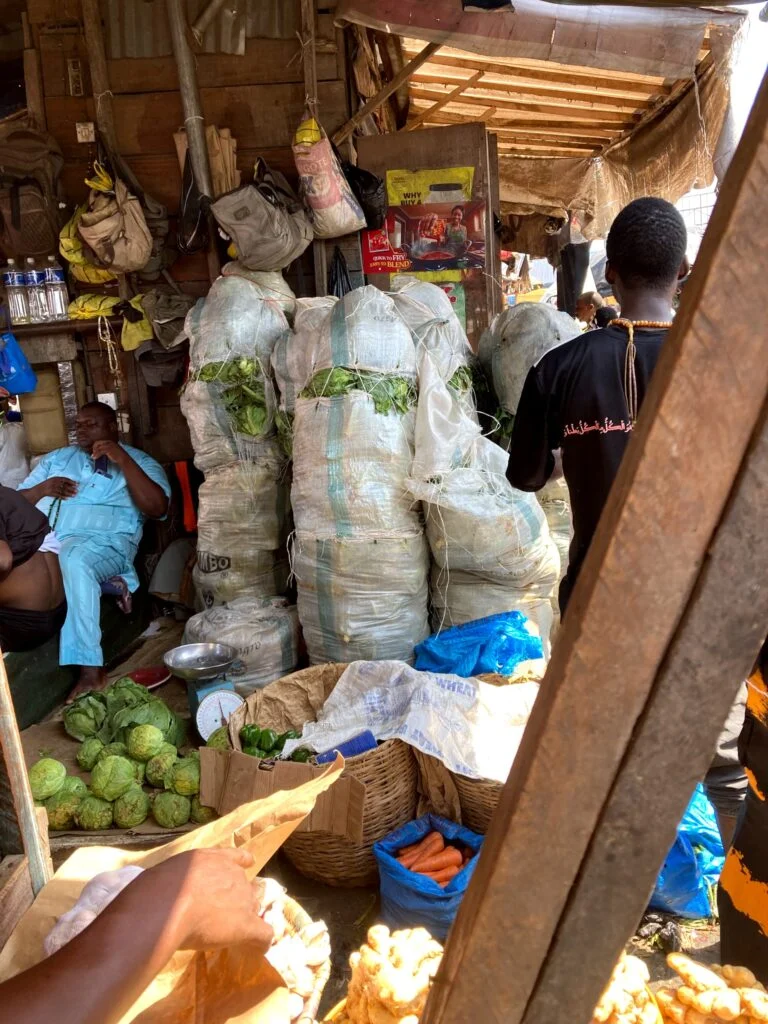
A visit to the markets showed traders displaying fresh produce, including carrots, cucumbers, watermelons, cabbage, bananas and leafy vegetables, while some kept their goods under tables to shield them from sunlight.
Mr Taiwo Abdulhamid, a trader at Iddo Terminus Market, said he sometimes lost two to three kilogrammes of carrots from every 10 kilogrammes purchased.
Abdulhamid said the losses could cost him between N20,000 and N30,000, forcing him to discard spoilt produce or increase prices to recover part of his money.
Similarly, Mrs Mistura Olawale, a banana and pawpaw seller, said she lost about 10 per cent of her goods to spoilage before they reached the market.
Olawale attributed the losses to bad roads, poor transportation and overripe produce, calling for improved feeder roads and refrigerated transit vans.
At Mile 12 Market, Mr Rafiu Olamide, a seller of ugu and waterleaf, said more than 15 per cent of his vegetables sometimes spoilt within one or two days.
Olamide said vegetables worth about N80,000 could result in losses exceeding N10,000, adding that she sometimes sold slightly damaged produce at reduced prices.
Mrs Blessing Sunday, a banana seller at Balogun Market, Eko Idumota, said she sometimes lost bananas worth about N100,000 from a batch.
Sunday, who spends N300,000 or more purchasing bananas in batches, said intense sunlight contributed to spoilage and could take one to two weeks to sell her stock.
She said selling groundnuts alongside bananas helped cushion the losses, adding that she hesitated to complain to suppliers about damaged fruits for fear of losing their patronage.
Mr Shuaibu Tukur, a carrot seller at Carrot Site, Mile 12, said transportation challenges affected the quality of supplies sourced from Ivory Coast, Cameroon, Bauchi, Jos and Sokoto.
He said journeys from Sokoto to Lagos could take about 20 hours under favourable conditions but extend to two days, depending on road conditions.
Mr Aminu Usman, a tomato seller at Mile 12 Market, said overcrowding during transportation caused tomatoes to press against one another and break.
Usman said carefully selected tomatoes sold for about N45,000, while damaged or less visually appealing ones, locally called “Eesha”, sold for about N19,000.
He called for improved transportation and handling practices to reduce breakages and financial losses.
Beyond traders’ losses, consumers said spoilage often forced them to discard food purchased with money they could ill afford to waste.
Mrs Yusuf Halima said she could lose between N15,000 and N25,000 worth of fruits and vegetables monthly, particularly tomatoes and leafy vegetables.
“Sometimes, I buy N5,000 tomatoes hoping they will last me for two weeks if I blend and store them, but if there is no light for two days, my freezer defrosts and everything spoils,” she said.
Halima said she now bought produce in smaller quantities, adding that traders sometimes raised prices to recover losses from damaged goods.
Another consumer, Mr Joshua Edward, said he discarded between 20 and 30 per cent of the fruits and vegetables he purchased weekly.
“If I buy vegetables or fruits for N10,000 weekly, at least N2,000 to N3,000 worth goes to the bin because it wilted, grew mould or started smelling,” he said.
Edward said the experience had reduced his bulk purchases, in spite of additional transportation costs from visiting markets more frequently.
Ms Precious Taiwo, a consumer at Gate 3, Mile 12, said she had lost about N6,000 to spoilt mangoes and bananas, discouraging her from buying fruits as frequently.
Ms Eunice Tosin, a student interviewed at Agboju Market, Festac, said tomatoes and bananas sometimes spoilt shortly after purchase, forcing her to cut off affected portions.
Mrs Onoseme Paulina, a consumer at Iyana Oba, said carrots sometimes deteriorated by the following day, causing losses of about N500 on some occasions.
Paulina expressed concern that some sellers concealed deteriorating carrots beneath fresh ones, adding that she discarded affected produce because of safety concerns.
Mr Eddy Oloye, an engineer and farmer with a personal farm in Lusada, Agbara, said inadequate storage, poor transportation and ineffective preservation methods contributed to post-harvest losses.
Oloye said discarded produce also created environmental nuisance but could be reused as animal feed or processed into other products through effective recycling systems.
He called for government and private-sector support for improved transportation, preservation facilities and training in proper produce handling.
Ms Ebube Agbim, a vegetable seller on Joseph Lambo Street, Costain, said poor packaging and storage contributed to the deterioration of scent leaf, ugu and waterleaf.
Agbim estimated that affected vegetables could be worth about N3,000 daily, although her actual loss was approximately N1,500.
Mr Jubril Useni, a trader at Small Garage, Mile 12, said heat, overcrowded vehicles and prolonged journeys sometimes damaged pepper, green pepper, ground beans and spring onions before they reached the market.
The traders and consumers called for improved transportation, better storage and affordable preservation facilities to reduce waste, protect earnings and make fresh produce last longer. (NAN)(www.nannews.ng)
===========
Edited by Chinyere Joel-Nwokeoma









A Fulani advocacy group, "The Fulani Defenders", has vehemently kicked against the newly inaugurated Forest Guards by the Plateau State government, arguing that the initiative is aimed at targeting herdsmen and Fulani pastoralist communities.
The government had on Saturday, November 28, unveiled the first batch of 1,000 Forest Guards who were deployed across the state in its bid to combat the lingering insecurity.
During the graduation ceremony held in Jos, Gov. Caleb Mutfwang said the newly trained personnel are expected to boost security operations through intelligence gathering, surveillance and monitoring of forests and vulnerable communities, particularly areas affected by recurring attacks.
Mutfwang stated that the Forest Guards will also support existing security agencies in tackling security threats, protecting lives and property, and restoring confidence among residents of troubled communities.
But in a swift reaction to the security set-up, the Fulani Defenders said the composition of the guards was such that Fulani people were denied the opportunity of being part of the outfit which to them makes it clear that they are the target.
In a statement issued on Sunday by its coordinator, Ahmad Abba, the group said it rejects the security outfit and called on the government to immediately disband them and set up a broad outfit that would accommodate every tribe and ethnic group in the state.

"The inauguration of the Forest Guards by the Plateau State Government on Saturday, November 28, 2026, should have been a laudable project following years of insecurity and violence in the state," the statement began.
"But as a Fulani advocacy group, we are really worried about the composition of the Forest Guards because there are fears that they have been set up to target innocent Fulani herders and communities.
"And the observed anomalies have further raised questions on the non-inclusion of Fulani people in the security outfit.
"Our questions are: Is the Forest Guard security system an ethnic or religious body? Was there transparency and openness during the recruitment process? Why were Fulani people denied the opportunity of being recruited into the outfit?
"If their mandate includes forest surveillance, intelligence gathering and supporting conventional security agencies against terrorists, bandits, kidnappers and other criminal elements, wouldn't it have been beneficial to include Fulani people who know the forests better?
"From our observations, the Forest Guards were set up to target Fulani pastoralists and communities. We therefore demand the immediate disbandment of the security outfit while a fresh, transparent and all-inclusive recruitment process be conducted to accommodate every tribe, ethnic group and religion."

The Nigerian Ports Authority (NPA) has urged journalists to rely on accurate data and evidence in reporting on the maritime sector, saying credible journalism is essential to improving Nigeria’s trade competitiveness and investor confidence.
The General Manager of the Authority’s Corporate Affairs Division, Ikechukwu Onyemekara, said this on Wednesday at the opening of a two-day Data-Driven Business and Maritime Reporting Training organised in partnership with the Premium Times Training Academy in Ikeja GRA, Lagos.
Mr Onyemekara said accurate reporting helps businesses, investors and policymakers make informed decisions, while careless reporting could create uncertainty and undermine confidence in the country’s ports.
“Good journalism is part of the environment in which trade happens. It does not dredge a channel or berth a ship, but it shapes the confidence that brings ships and cargo in the first place,” he said.
The training was designed to strengthen journalists’ understanding of the maritime economy and improve their ability to interpret data and explain its implications to the public.
Ports’ operations
Mr Onyemekara, who spoke on behalf of the Authority’s Managing Director and Chief Executive Officer, Abubakar Dantsoho, said Nigeria’s total merchandise trade reached about N41.4 trillion in the second quarter of 2026, representing a 5.6 per cent increase compared with the corresponding period of 2025.


According to him, a significant share of the country’s trade, including crude oil, refined products, machinery, food and industrial inputs, passes through its seaports and terminals.
“When our ports work well, that trade costs less and moves faster. When they do not, households and businesses pay for it, often without knowing why,” he said.
Citing the NPA’s 2025 Operational Performance Report, the official said cargo throughput across Nigerian ports increased by 24.8 per cent, from about 103.6 million metric tonnes in 2024 to 129.3 million metric tonnes in 2025.
He added that cargo throughput reached 68.2 million metric tonnes in the first half of 2026, up 12.2 per cent from 60.8 million tonnes recorded in the corresponding period of 2025.
The ports also received 2,300 ships during the period, up from 2,152 a year earlier.
The official said outward cargo accounted for 41.9 per cent of total throughput in the second quarter of 2026, which the Authority described as evidence of improved export performance.
He said the figures reflected the activities of port workers, marine crews, haulage operators, clearing agents, warehouse staff and traders whose livelihoods depend on port operations.
The NPA official also highlighted the growing contribution of Lekki Deep Sea Port, which handled nearly 40 per cent of cargo through Nigerian ports in the first half of 2026.
He said more than three-quarters of Lekki’s cargo traffic was linked to refinery operations, illustrating how industrial investments were reshaping Nigeria’s trade flows.
“The headline figure tells you how big Lekki has become. The breakdown tells you why, and what to watch as other cargo grows. That is the difference between reporting a number and explaining it,” Mr Onyemekara said.
Landlord port model
Explaining the Authority’s role in port operations, he said Nigeria had operated a landlord port model since the concession of port terminals in 2006.
Under the model, the NPA owns and administers port land and waters, while private terminal operators manage cargo-handling operations within their terminals.
He said the Authority provides marine services, including pilotage, towage, dredging and navigational aids; maintains common-user facilities; monitors terminal operators’ concession obligations; and plans long-term port development.
Reporting maritime
Mr Onyemekara, however, urged journalists to distinguish the responsibilities of the various agencies operating within the port system when reporting delays or operational challenges.
According to him, cargo delays could result from terminal operations, documentation, customs examinations, truck movements or road conditions, making it necessary for journalists to establish where a failure occurred before assigning responsibility.
The official said the NPA was pursuing port modernisation, digitalisation, export facilitation and sustainability as part of efforts to improve efficiency.
He disclosed that the Federal Government had secured £746 million in UK-backed financing to modernise the Lagos Port Complex, Apapa, and Tin Can Island Port.
READ ALSO: PREMIUM TIMES Editor-in-Chief, 23 others earn PhDs as Baze University graduates 1,079 students
He also said the Authority was rehabilitating ports in the eastern region, including Onne, Warri and Calabar, while supporting promoters of new deep seaports.
On digitalisation, he said the Federal Government’s National Single Window became operational in March 2026, providing a common platform for trade documentation and payments across government agencies.
He said the NPA was also deploying a Port Community System, with support from the International Maritime Organisation, to link terminal operators, shipping lines, government agencies and freight forwarders.
The official added that the Authority’s electronic truck call-up system, Eto, was intended to improve truck movement and reduce congestion around the ports.
He urged journalists to consult primary sources, compare data across equivalent periods, provide the baseline behind percentages and give all parties a fair opportunity to respond.
“My charge to you is simple. Let evidence lead your stories. Let context shape them. Let fairness guide them. When rumour and data disagree, follow the data. When the data is incomplete, say so and ask for more.
“We do not ask you for praise; we ask for accuracy. Where we fall short, report it. Where we make progress, report that too, with the same discipline,” Mr Onyemekara said.
The two-day training brought together journalists and resource persons to strengthen reporting on business and maritime issues using data and open-source information.
At the training, media experts, including Musikilu Mojeed, Editor-in-Chief at PREMIUM TIMES; Idris Akinbajo, Managing Editor at PREMIUM TIMES; and Ray Echebiri, Editor-in-Chief at NextMoney, exposed participants to open-source data and resources for Nigerian maritime industry reporting, as well as techniques for analysing data and reports to produce enterprising journalism.
Discover more from Premium Times Nigeria
Subscribe to get the latest posts sent to your email.
-

 Events4 days ago
Plateau Govt Backs AGNN’s PENIEL 2026, Says Unity Among Christians Critical to Peace
-
Events4 days ago
PENIEL 2026: AGNN Calls for Deeper Encounter with God, Unity and National Transformation
-
News3 days ago
‘The Righteous Are Not on the Throne, That Is Why Nigerians Are Suffering’ — SDP’s Adewole Adebayo Fires the APC While Speaking to Press at Jos Conference
-
Business2 days ago
Plateau Government, BOI, PLASMIDA Back Young Innovators at YAI Bootcamp in Jos