Connect with us

News

India’s Airbound bags $37M to take on trucks with rocket-like drones

info

Published

on

Airbound drone.jpg

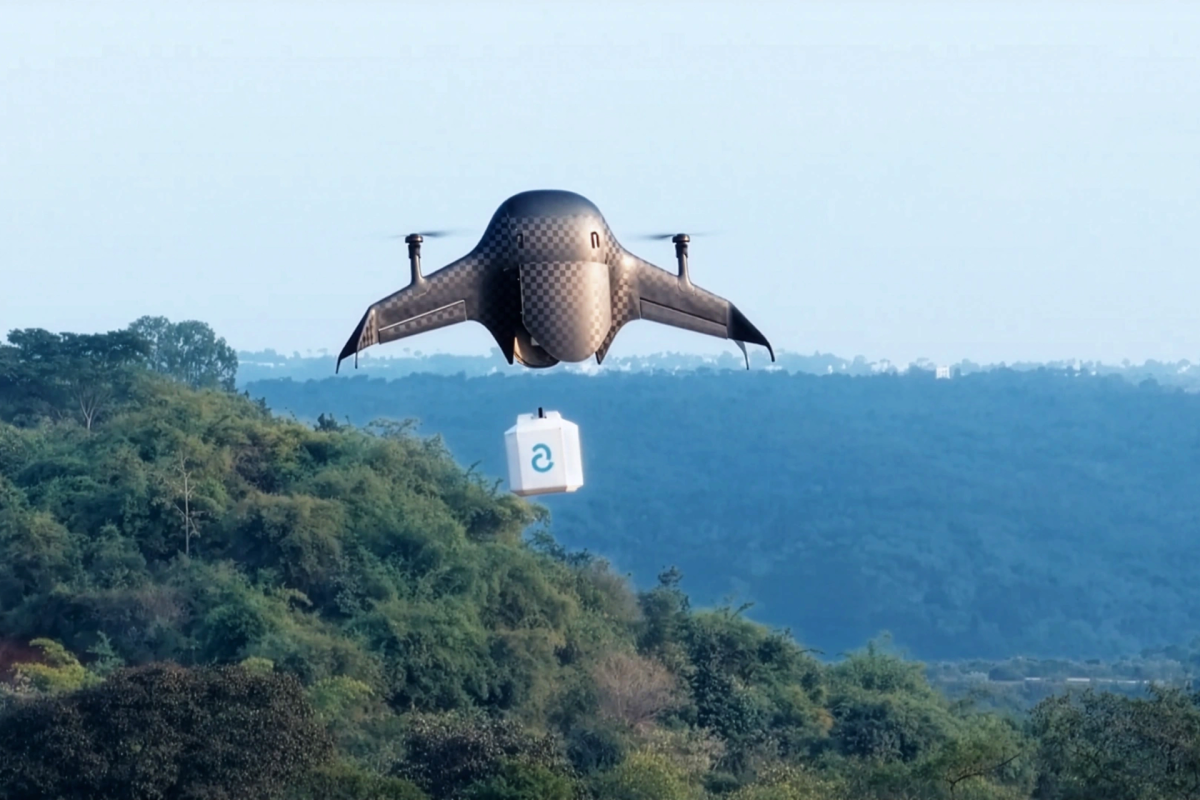
Airbound, an Indian startup building autonomous drones, has raised $37 million in fresh capital as it pushes to make moving goods through the air as cheap as trucking them by road.

The Series A round, led by Greenoaks with participation from DoorDash, Lachy Groom, Lightspeed, and Humba Ventures, comes less than a year after Airbound raised an $8.65 million seed round. With this funding, the three-year-old startup has raised nearly $50 million.

Airbound, and other startups in this nascent sector, argue that drones can move certain goods faster and cheaper than vehicles on the road. And while there have been successful deployments, drone delivery is still far from matching the scale and versatility of trucking.

Airbound is trying to close that gap by redesigning the aircraft to make it more competitive with ground transportation.

Conventional aircraft spend a lot of energy carrying their own weight rather than the payload, making flight expensive, particularly for moving smaller loads. Airbound’s answer is to build vertical-flight drones designed to weigh less than the cargo they carry, founder and CEO Naman Pushp said in an interview.

Airbound’s current drone, called TRT, weighs about 3.3 pounds and can carry around 2.2 pounds of payload. Its next version, currently under development, is expected to weigh about 6.6 pounds and be able to carry up to 11 pounds, Pushp told TechCrunch.

The startup uses a rocket-like, tail-sitter design for its drones, which takes off and lands vertically in an upright position before transitioning to horizontal flight. Pushp said Airbound intends to retain vertical takeoff and landing even as it develops larger aircraft to avoid dependence on runways.

“We want to build towards a world where everything has cost parity with trucking,” he said.

Founded in 2023, Airbound has completed more than 13,000 autonomous flights across the southern Indian cities of Bengaluru and Guntur, Pushp said. That includes more than 1,000 flights with the Indian hospital network Narayana Health, where its drones transport diagnostic samples between healthcare facilities.

The startup uses a single active drone on the Narayana route, flying diagnostic samples about 2.5 miles in around seven minutes. The same samples can take three to five hours to be transported by two-wheelers when factoring in the time spent waiting for enough samples to be bundled for road transport, according to Pushp.

That partnership is expanding to include Narayana’s new Banashankari hospital in Bengaluru, which was designed without an on-site diagnostic lab or blood bank and will instead rely on Airbound’s drones to connect with centralized facilities.

Three-city drone network

Airbound has set its sights on a far larger ambition to create a drone delivery network that connects three cities in the state of Andhra Pradesh. The startup has sign an agreement with the state government with an eventual target of 10,000 flights a day for retail, e-commerce, and healthcare deliveries. That daily flight target will require between 250 and 1,000 aircraft, depending on route lengths, though Pushp expects the number to be closer to 250.

The agreement does not involve a government contract or subsidy, Pushp said, adding that the Andhra Pradesh government is working with Airbound on the regulatory framework needed to enable the network. The startup expects to generate business from companies using it for deliveries.

Indian startups including Skye Air Mobility and TSAW Drones are already building aerial logistics businesses, while other Indian drone makers such as Garuda Aerospace have also explored delivery use cases. Nonetheless, Pushp argues that Airbound wants to build the aircraft that other logistics networks could eventually use rather than just trying to become the largest delivery operator.

“That’s the Boeing role — the aircraft airlines everywhere rely on, not the airline itself,” he said.

Airbound designs and manufactures its aircraft in a 43,000-square-foot facility in Bengaluru, where it keeps work on the airframe and other core systems in-house. While Pushp declined to disclose its production capacity or how many aircraft the startup has built so far, he said manufacturing would not be the bottleneck as Airbound scales.

The bigger bottleneck, Pushp noted, is regulation, particularly securing approvals for beyond visual line of sight (BVLOS) operations, a certification that allows drones to fly beyond the direct sight of an operator and is critical to operating delivery networks at scale.

Those regulatory constraints have also limited Airbound’s ability to turn its flights into meaningful commercial revenue. Moreover, the startup remains broadly pre-revenue despite having a team of more than 150 employees.

“The goal is to be a giant in a few decades, not to make revenue as soon as we can,” Pushp said.

When you purchase through links in our articles, we may earn a small commission. This doesn’t affect our editorial independence.

Continue Reading
Click to comment

Leave a Reply

Your email address will not be published. Required fields are marked *

News

Desmond Elliot kneels before Gbajabiamila, apologises over APC primary fallout

info

Published

on

By

Desmond Elliot 1.jpg

Lagos State House of Assembly member, Desmond Elliot, has apologised to the Chief of Staff to President Bola Tinubu, Femi Gbajabiamila, over his conduct during the last All Progressives Congress (APC) primary election in Lagos.

Elliot was seen in a video circulating on social media kneeling before Gbajabiamila and asking for forgiveness, while also appealing to be accepted back into the APC fold in Lagos.

“I’m sorry, I have no excuse. I have nothing other than to say I’m deeply sorry, and I am hoping to be cultured in the future,” Elliot said.

His apology followed a disagreement with the party leadership over the APC primary conducted in May to select its candidate for the Surulere Constituency I seat.

Recommended

Elliot had withdrawn from the primary, alleging that his supporters were subjected to intimidation and political pressure during the exercise.

He later rejected the outcome of the election and vowed to challenge the process through the party’s appeal mechanism.

The former actor ultimately lost the APC ticket to Barakat Odunuga-Bakare, who was widely believed to have the backing of Gbajabiamila.

Odunuga-Bakare secured 11,385 votes in the primary, defeating Elliot, who polled 270 votes.

Continue Reading

News

VIDEO: I Travelled Alone as Governor to Cut Costs — Obi

info

Published

on

By

Incollage 20260907 1104451934437778925969412215 1200x675.jpg

The presidential candidate of the Nigeria Democratic Congress (NDC), Peter Obi, has revealed how he reduced the cost of governance while serving as governor of Anambra State.

According to the politician, he deliberately avoided unnecessary spending and travelled without the large entourage usually associated with public officials.

Obi disclosed this on Monday while speaking in Washington, D.C., United States, where he discussed measures he adopted to reduce government expenditure during his tenure as governor.

The former Anambra State governor said he rejected inflated budgets for the renovation of his official facilities, explaining that projects were completed for significantly less than the amounts originally provided for in the budget.

“When I was governor, the budget for refurbishing my office was ₦298 million, but I did everything with ₦48 million. There was also a budget of ₦486 million to refurbish my house, but I completed everything with ₦81 million,” Obi said.

He also spoke about the cost associated with official travels, saying he refused to travel with the number of people that could ordinarily accompany a governor on official trips.

“As a governor, you are supposed to travel with 30 people to several places. Over the years I was governor, I didn’t use 16 percent of my travel allowance because I wasn’t travelling with anybody. I was the only person invited; nobody invited them,” he said.

The NDC candidate has repeatedly argued that Nigeria’s limited resources should be directed towards productive sectors capable of improving the living conditions of citizens.

The former governor recently travelled to Germany and the United Kingdom for a series of engagements focused on issues including democracy, electoral integrity, poverty, education, corruption and healthcare.

Obi disclosed the European trip in a statement on his social media platforms after returning to Abuja from visits to Benue and Plateau states.

“After returning to Abuja on 8th September 2026, following our visits to Benue and Plateau States, I travelled to Europe, first to Germany and then to the United Kingdom,” he stated.

According to Obi, his discussions with international partners centred on practical steps that could contribute to Nigeria’s development, with particular attention to education.

He said he was encouraged by the willingness of international partners to support Nigeria, especially in the education sector.

Obi described education as the most important investment Nigeria could make in its citizens, stressing that sustainable national development would remain difficult without building the knowledge, skills and capabilities of the country’s people.

He also renewed his call for a change in the direction of Nigeria’s economy, urging the country to move away from excessive consumption and dependence.

“We must intentionally transition Nigeria from consumption to production, from dependence to productivity, from wasteful practices to responsible resource management, and from division to a common national purpose,” he said.

The NDC presidential candidate said his broader objective was to build a country where children would have access to quality education, democracy would reflect the wishes of voters, healthcare would be accessible and public resources would be managed responsibly.

He added that every Nigerian should have a fair opportunity to live a dignified and productive life.

Obi’s latest engagements come as political activities intensify ahead of the 2027 general elections, with major presidential contenders increasingly stepping up consultations and engagements within and outside Nigeria.

The presidential candidate of the African Action Congress, Omoyele Sowore, has also travelled to the United States and Canada as part of a North American tour connected to his 2027 campaign.

The AAC said Sowore’s absence from Nigeria would not affect the #Sowore2027 campaign, maintaining that its activities would continue to focus on what it described as revolutionary transformation, equal rights and justice.

President Bola Tinubu has also travelled to Europe, with the Presidency saying the President departed Abuja for a three-week vacation as part of his annual leave.

His Special Adviser on Information and Strategy, Bayo Onanuga, said Tinubu’s first destination was London, United Kingdom, and that he would return to Nigeria at the end of the working vacation.

The political movements are taking place against the backdrop of preparations for the 2027 presidential and National Assembly elections. The Independent National Electoral Commission commenced the official campaign period on August 19, while the elections are scheduled for January 16, 2027.

Continue Reading

Trending