Connect with us

News

Ebola Outbreak Worsens As Death Toll Rises – Africa CDC

info

Published

on

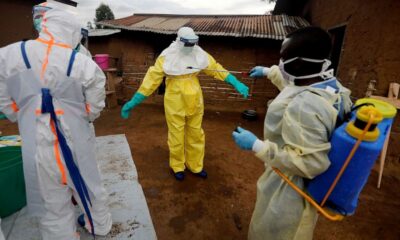
The Director-General of the Africa Centres for Disease Control and Prevention (Africa CDC), Dr Jean Kaseya, says the worsening Ebola outbreak recorded 89 deaths in one week.

He said the development had raised concerns over treatment capacity and the growing level of community transmission.

Kaseya spoke on Thursday during an online media briefing on Ebola, warning that treatment centres were already operating at 95 per cent bed occupancy.

He said the situation required a dual response involving expansion of treatment facilities and earlier detection of cases to reduce the number of patients requiring hospital admission.

“Authorities must build more treatment capacity while detecting cases sooner. Early detection prevents patients from needing hospital admission.

“Bunia, Gwampara, Mugwalu and Nyankunde remain the main hotspots. Katwa, Benin and Butimbo in North Kivu are also active.

“South Kivu has not recorded new confirmed cases recently. Officials are monitoring to confirm if the plateau holds,” he said.

According to him, five health zones in Ituri and one in North Kivu account for more than 85 per cent of reported cases, making targeted interventions critical to controlling the outbreak.

Kaseya said Uganda had recorded 19 cases in total, including one new case reported last week, while five infections involved local contacts of travellers from the Democratic Republic of Congo (DRC).

He said that Uganda previously monitored about 800 contacts linked to 19 cases and had gradually discharged most of them, leaving only nine active contacts under 100 per cent follow-up.

“Rural areas average 20 contacts per case, while urban areas average 40. That ratio will be updated with new data.

“Current data shows 8,000 contacts listed, but 40,000 are expected based on averages. Only 77 per cent are monitored daily, below the 95 per cent target.

“Just 30 per cent of new confirmed cases come from known contacts. That means 70 per cent originate from community spread, a critical concern.

“Africa CDC is zooming in on contact tracing to stop community transmission. Strong surveillance is key to reaching and confirming the peak,” he said.

According to him, plans are underway to deploy 20,000 local youths as community response teams to help identify and trace missing contacts.

Kaseya warned that after 35 days, the outbreak had already grown 3.6 times larger than comparable outbreaks in Uganda and West Africa in 2014, and could become the largest Ebola outbreak on record if left unchecked.

He said that a colleague who had worked in Turin tested positive for Ebola after returning to France without symptoms, adding that Africa CDC and European partners were intensifying technical and financial cooperation.

“The government decided people flying from Ituri to Kinshasa must avoid further travel for 21 days. The move aims to prevent cross-border spread.

“The approved response plan was 518 million dollars. Pledges reached 910 million dollars, but only 13 per cent has been released as actual funding.

“Sixty-nine camps in Ituri and North Kivu house about 1.15 million people, in addition to one million returnees. These camps remain difficult areas for case detection and contact tracing.

“With humanitarian needs added, the required budget rose to 1.4 billion dollars. Without it, the outbreak will expand and cost more in the long term,” he said.

Kaseya said the DRC had received an antiviral treatment, while MDP-134 was expected to arrive on Friday night.

He added that Obel-Dezivir for post-exposure prophylaxis was already in the country and clinical trials would begin next week in Bunia.

The Africa CDC chief said four candidate vaccines were under consideration, including MVA Ebola developed by Amina Pharma.

According to him, Phase 1 trials will commence shortly, with hopes of having at least one vaccine available before the end of the year.

Kaseya further stated that Africa CDC was leading the laboratory response pillar, having delivered 52 diagnostic machines and 130,000 testing cartridges.

“Plans include 100 more machines and tests for DRC, Uganda and other at-risk countries.

“All platforms in Ituri will use DHIS2. Africa CDC deployed 150 Starlink units and is digitalising points of entry for cross-border data sharing.

“Officials will present weekly updates on cases, contacts and response indicators, while journalists will continue to receive briefings on therapeutics and vaccine development,” he said.(NAN)(www.nannews.ng)

Edited by Abiemwense Moru


Continue Reading
Click to comment

Leave a Reply

Your email address will not be published. Required fields are marked *

Business

NIA Commends NAICOM on Recapitalization Exercise

info

Published

on

By

The Nigerian Insurers Association (NIA) has commended the National Insurance Commission (NAICOM) for its fair, transparent and structured implementation of the minimum capital requirements under the Nigerian Insurance Industry Reform Act (NIIRA) 2025.

In an official statement released today, the Chairman of the NIA, Mrs. Ebelechukwu Nwachukwu, praised NAICOM’s structured approach — highlighting that clear regulatory guidelines, systematic verification, defined timelines, and rigorous supervisory oversight provided operators with a credible framework to navigate the recapitalisation exercise successfully.

Mrs. Nwachukwu noted that the exercise underscores NAICOM’s commitment to regulatory fairness and orderly market development, marking a pivotal milestone in bolstering the financial capacity, stability, and global competitiveness of the Nigerian insurance sector.

The post NIA Commends NAICOM on Recapitalization Exercise appeared first on Business Today NG.

Continue Reading

News

OpenAI’s new AI smart speaker will reportedly sell for between $300 and $400

info

Published

on

By

OpenAI logo in Seoul.jpg

More details continue to trickle out about OpenAI’s mysterious new hardware device — described previously as an AI-fueled smart speaker that will be the “physical manifestation” of ChatGPT.

Bloomberg now reports that the device will be “donut-shaped,” designed thusly to allow users to carry it around their home and place it in different locations, like a bedside table or a kitchen counter.

It will be constructed from “high-quality metal,” have a “premium look,” and (in a detail that mystifies) will have distinct “moving parts,” sources told Bloomberg.

It also could be slightly more expensive than your average smart speaker, perhaps $300 to $400 per unit, according to this report. For comparison, most of Amazon’s smart home speakers range in price from $40 on the low end to $240 on the high end.

So, to sum up: an expensive talking AI donut that has … moving parts? OpenAI releasing a smart home device has a certain logic to it, in that it would further integrate ChatGPT into users’ lives. However, historically speaking, smart speakers have not always been profitable and may prove a difficult market to break into. The potentially high price point also might not help.

The device, which is being developed in partnership with LoveFrom, the design studio founded by famous former Apple developer Jony Ive, will likely be released at some point in 2027, Bloomberg writes.

The company’s attempt to enter the hardware market has not gone off without a hitch. OpenAI is being sued by the current king of hardware, Apple, which has accused the AI lab of stealing trade secrets. OpenAI has denied wrongdoing.

Continue Reading

Trending