Connect with us

News

Amaechi 2027 presidential posters surface across Bauchi streets

info

Published

on

IMG 20260515 WA0115.jpg

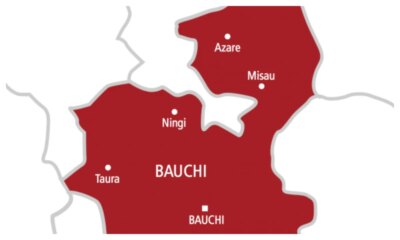
Posters projecting former Minister of Transportation, Rotimi Chibuike Amaechi, as a presidential candidate for the 2027 general election have surfaced across major streets in Bauchi State.

The posters, branded with the inscription, “Amaechi for President 2027: Move Nigeria Forward,” alongside the logo of the African Democratic Congress (ADC), were spotted at strategic locations within the Bauchi metropolis.

Amaechi, who holds the traditional title of Dan Amanar Kasar Hausa of Daura, previously served as Speaker of the Rivers State House of Assembly, Governor of Rivers State, and later Minister of Transportation.

The campaign posters were mounted on electric poles, billboards and major roundabouts across the state capital, drawing the attention of residents and commuters.

Some of the areas where the posters were sighted include Ahmadu Bello Way, Awalah Roundabout, Wunti Flyover, Jos Road Roundabout, Bauchi Club axis, Nasarawa Gate Roundabout and Emir’s Palace Roundabout.

The posters were also displayed along Railway Road, Sabon Titin Karofi and Kofar Dumi streets, among other locations.

The posters attracted considerable public attention, with several motorists and pedestrians slowing down to observe them, particularly around Awalah Roundabout.

DAILY POST reports that the former Rivers governor, Amaechi, contested the presidential primary of the All Progressives Congress, where he emerged runner-up to President Bola Ahmed Tinubu in 2022.

Continue Reading
Click to comment

Leave a Reply

Your email address will not be published. Required fields are marked *

Health

Drug-resistant bacterial infections kill one million people annually – WHO

info

Published

on

WhatsApp Image 2026 05 18 at 21.41.48.jpeg

The World Health Organisation (WHO) says drug-resistant bacterial infections kill about one million people globally every year, calling for coordinated action across human, animal, food and environmental sectors to curb the growing threat.

Jean-Pierre Nyemazi, Acting Director of the AMR Department at WHO Headquarters, said this at a virtual media conference marking an exhibition at the European Parliament on AMR and its human impact.

The virtual conference preceded the exhibition, “AMR: The Human Stories Behind a Silent Pandemic,” being held at the European Parliament from 28 September to 2 October and featuring stories of people affected by AMR across Europe.

“AMR is taking many lives. One million people die every year due to drug-resistant bacteria alone – that is, two people every minute die of bacterial AMR,” Mr Nyemazi said.

He said the scale of deaths meant that AMR should no longer be treated as a “silent pandemic”, stressing that “we know what works” to prevent and control the threat.

“Preventing infections is the number one priority. This can be done through better vaccination, infection prevention and control, Water, Sanitation and Hygiene (WASH), and improved animal husbandry,” he said.

PT WHATSAPP CHANNEL
Dangote Refinery AD

“All of these work and can prevent AMR.”

Mr Nyemazi said strengthening surveillance, responsible use of antimicrobials, access to quality medicines and diagnostics, and reduction of environmental contamination could also make a difference.

“The tools exist, and the evidence is there, but the cost of inaction is rising. The longer we delay action, the higher the cost becomes,” he said.

He said the One Health approach, which recognises the links between human, animal, plant and environmental health, was essential because drug-resistant pathogens could move across sectors and borders.

According to him, parliamentarians have a critical role in ensuring that national AMR commitments are supported by legislation, financing and accountability.

“The media also plays an indispensable role. Journalists help bring AMR out of scientific circles and into public debate,” he said.

“They raise awareness, combat misinformation, and ensure that AMR remains visible to decision-makers and the public alike.”

He said WHO Member States approved an updated Global Action Plan on AMR at the World Health Assembly in May, providing a framework for combating AMR over the next 10 years through a One Health approach.

Mr Nyemazi said the updated plan placed stronger emphasis on prevention, governance, behavioural change and measurable targets, and that the four Quadripartite organisations developed it jointly.

He said the organisations comprised the Food and Agriculture Organisation (FAO), United Nations Environment Programme (UNEP), WHO and World Organisation for Animal Health (WOAH).

“What is new about the updated Global Action Plan on AMR for the next 10 years is that it is truly multi-sectoral – a genuine One Health plan.

“The previous plan was heavily focused on human health; this time the four Quadripartite organisations worked together and engaged all sectors,” he said.

Mr Nyemazi said a 10 per cent reduction in AMR was achievable through infection prevention and control, vaccination and improved access to quality antimicrobials, with better coordination, education and surveillance capable of delivering further gains.

He also called for investment in new antibiotics, antifungals, phage therapy and other technologies, while stressing the need to preserve existing medicines.

He said there was also a major access problem, with many regions unable to obtain even existing antibiotics.

A member of the European Parliament, Martin Häusling, said excessive antibiotic use in food-producing animals was contributing to the problem, particularly through mass treatment.

“When it comes to food-producing animals, we still use far too many last-resort antibiotics, and we must get away from that,” Mr Häusling said.

He said AMR was a global issue that could affect anyone, adding that it could destroy families and livelihoods.

To tackle it, the parliamentarian said it was important to create public awareness so that parliaments could address the issue properly, adding that the issue was still not taken as seriously as a future challenge should be.

Rob Purdie, an AMR survivor and member of the WHO Task Force of AMR Survivors, said his experience demonstrated the consequences of delayed diagnosis and treatment.

Mr Purdie said an infection that began with a headache eventually progressed to fungal meningitis after he received antibiotics for a condition that had not been properly diagnosed.

READ ALSO: Four Super Eagles stars who could decide Nigeria’s AFCON Qualifier against Guinea-Bissau

He said he eventually spent about $250,000 on hospital costs and had been unable to work for about five years.

“My ability to earn a living was eliminated for about five years in a single-income household where I provided for my wife and two children,” he said.

Mr Purdie said his experience underscored the need to keep AMR visible in public discussions.

“That is why it is so important for those of us who have survived and can speak, to remove the word ‘silent’ from the ‘silent pandemic’,” he said.

(NAN)


Discover more from Premium Times Nigeria

Subscribe to get the latest posts sent to your email.

Continue Reading

News

PDP supporters attacked in Calabar, many injured, vehicles damaged

info

Published

on

Pdp.jpg

Several supporters of the Peoples Democratic Party, PDP, were injured while vehicles belonging to members of the party were damaged during the party’s consultative tour of Calabar South Local Government Area of Cross River State on Thursday.

The PDP governorship candidate, Sir Arthur Jarvis-Archibong, said the first attack occurred at the palace of the Paramount Ruler of Calabar South, Etubom Nyong Edet Okon I, where gunmen allegedly disrupted the meeting and injured three persons.

He said the victims were taken to hospital for treatment, adding that the violence later escalated at the African Club along Calabar Road, where another meeting was scheduled.

According to him, hoodlums allegedly shot at the party’s convoy and damaged vehicles belonging to members of the consultative team.

Recommended

Jarvis-Archibong said about 3,000 supporters attended the exercise and that the party had notified the police ahead of the tour, expecting adequate security.

He said the party restrained its supporters from retaliating and instead moved its convoy to the Commissioner of Police for protection.

The candidate said the PDP would petition the Inspector-General of Police, the Department of State Services (DSS) and other relevant security agencies over the incidents.

He warned that continued attacks on political activities could undermine the democratic process and lead to a breakdown of law and order as preparations for the 2027 elections intensify.

The PDP State Publicity Secretary, in a separate statement, condemned the attacks and urged security agencies to identify and prosecute those responsible.

The party said it had reported the incidents to the Commissioner of Police, Cross River Command, and appealed to its members to remain calm and avoid retaliatory actions.

However, the state chapter of the All Progressives Congress (APC) denied responsibility for the incident.

The APC Publicity Secretary, Emmanuel Inyang, said the PDP should look elsewhere for those responsible, adding that the party was focused on its own political activities.

The Cross River State Police Command confirmed the incidents and said personnel had been deployed to the affected locations.

The command’s spokesman, ASP Sunday Eitokpah, said police were verifying reports of gunfire, injuries and damage to property, adding that the situation was under control.

He advised residents to remain calm, avoid affected areas where necessary and refrain from circulating unverified information, while assuring that police presence and monitoring had been strengthened to maintain peace and public order.

Continue Reading

Trending