News
Is Jensen Huang’s bad behavior more commonplace than it seems?









The African Export-Import Bank (Afreximbank) has committed a $75 million finance facility to the Development Bank of Nigeria (DBN) to expand access to finance for Nigerian small and medium-sized enterprises (SMEs), including eligible businesses in the creative economy.
The facility was announced during CANEX WKND 2026 in Lagos, reflecting the event’s focus on linking creative enterprises with finance, investment and markets, Afreximbank said in a joint statement with DBN on Wednesday.
Kanayo Awani, Executive Vice President, IntraAfrican Trade and Export Development, Afreximbank, and Tony Okpanachi, CEO of DBN, led the ceremonial signing on behalf of their institutions.
Ms Awani said the collaboration with DBN extends beyond providing capital, noting that Afreximbank is taking an integrated approach that combines finance with capacity building, export-readiness support and access to markets.
“Our objective is to help Nigerian SMEs build productive capacity, strengthen their competitiveness and make the transition from promising local businesses to sustainable exporters,” she said.
Ms Awani said the bank will team up with participating financial institutions to strengthen their capacity to understand finance better and support SMEs throughout their growth journey.


According to her, combining finance with practical support will help businesses prepare for export markets and connect with buyers across Africa and beyond.
“For creative enterprises, that advances CANEX’s ambition to turn African talent and ideas into sustainable businesses that can compete internationally,” she said.
Mr Okpanachi said the partnership combines DBN’s wholesale lending network with Afreximbank’s trade finance expertise, capacity building and market access support, strengthening local financial institutions’ ability to serve export-oriented SMEs.
According to him, the partnership with Afreximbank shows another significant step in DBN’s commitment to expanding access to finance for Nigerian MSMEs and enabling them to build resilient, competitive and sustainable businesses.
“The $75 million facility will provide much-needed financing through our Participating Financial Institutions, while creating greater opportunities for businesses, particularly those in the creative and export-oriented sectors, to strengthen their productive capacity and access new markets,” Mr Okpanachi said.
Beyond financing, the DBN chief executive said the partnership’s capacity-building and market-access components are particularly important to stakeholders.
By strengthening financial institutions’ ability to support export-ready businesses and connecting Nigerian enterprises to wider African and international markets, the DBN CEO said the development bank is helping MSMEs advance from local businesses to competitive participants in regional and global value chains.
“This aligns strongly with DBN’s mandate to address financing constraints and support inclusive and sustainable economic growth in Nigeria”, Mr Okpanachi added.
DBN will route the loan through its partner financial institutions to fund eligible small businesses.
The facility will support working capital, asset acquisition, pre-export, post-export, and supply chain activities, with businesses in fashion, film, music, design, and the wider creative industries among the intended beneficiaries.
It will also equip beneficiaries with the skills, tools, and market knowledge needed to develop their businesses, become export-ready, and access regional and international markets.
READ ALSO: COP31: Climate activists reject carbon capture, marine geoengineering as ‘false solutions’
Alongside the financing, Afreximbank and DBN will jointly develop a capacity-building programme to strengthen PFIs’ ability to support export-oriented SMEs.
Afreximbank plans to also provide access to its trade platforms, including MANSA, TRADAR, PAPSS and ATEX, and support market access through the Africa Buyer Programme, ATDC and the Intra-African Trade Fair.
Afreximbank, a Pan-African multilateral financial institution, is mandated to finance and promote intra- and extra-African trade.
Working with the African Continental Free Trade Agreement (AfCFTA) Secretariat and the AU, the bank has set up a $10 billion Adjustment Fund to support countries that participate effectively in the AfCFTA.
At the end of December 2025, Afreximbank’s total assets and contingencies stood at over $48.5 billion, while its shareholder funds totalled $8.4 billion.
DBN is a wholesale development finance institution established to address the major financing constraints MSMEs face in Nigeria.
DBN provides long-term financing and risk-sharing support through eligible participating financial institutions, enabling them to extend appropriate, sustainable financing to MSMEs across key sectors of the Nigerian economy.
Discover more from Premium Times Nigeria
Subscribe to get the latest posts sent to your email.
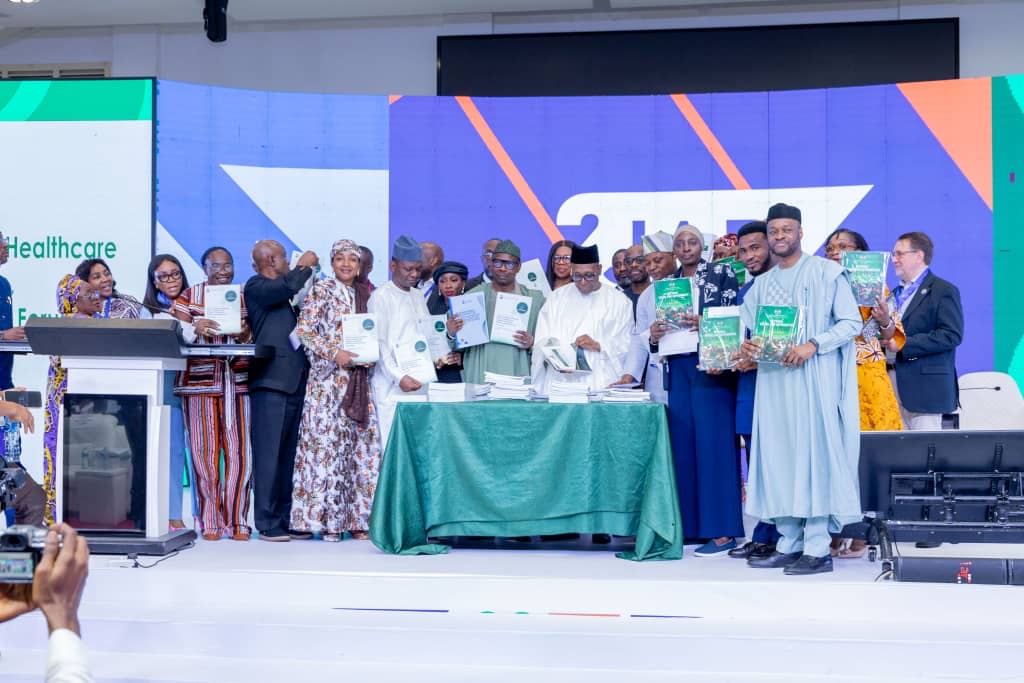
Seven private sector and philanthropic organisations have proposed commitments worth more than $65 million to strengthen maternal and newborn healthcare services in Nigeria.
The commitments, announced on Wednesday during the 2026 Joint Annual Review of the health sector in Abuja, are expected to support interventions in 172 local government areas (LGAs) identified as having a high burden of maternal deaths.
According to a statement issued following the event, the organisations submitted letters of intent under the Maternal and Neonatal Mortality Reduction Innovation Initiative (MAMII) Private Sector Compact, a government-led framework designed to coordinate investments and technical support for maternal and newborn healthcare.
The seven organisations are DP World, Bayer, UNICEF, dsm-firmenich, Nestlé Nutrition Institute, Roche and Ferring Pharmaceuticals.
The proposed contributions include financial resources, medical products, technical expertise, supply chain support and other services intended to address gaps in maternal and newborn healthcare delivery.
Nigeria’s maternal mortality burden
The announcement comes as Nigeria continues to record high numbers of preventable maternal and newborn deaths.
According to estimates contained in the statement, approximately 40,000 women and 300,000 newborns die annually in Nigeria, representing more than 100 maternal deaths and 800 newborn deaths every day.
These estimates highlight persistent challenges in access to skilled birth attendants, emergency obstetric services, essential medicines and timely referrals, particularly in underserved communities.
MAMII, launched in November 2024, prioritises 172 LGAs across 33 states, which account for more than half of Nigeria’s maternal deaths, according to the programme’s targeting analysis.
The initiative focuses on improving emergency obstetric and newborn care, strengthening referral systems, providing emergency transport and increasing access to essential medical supplies and trained health workers.
Speaking at the event, Coordinating Minister of Health and Social Welfare Muhammad Pate said reducing preventable maternal and newborn deaths remained a national priority.
“Through the Nigeria Health Sector Renewal Investment Initiative and our Sector-Wide Approach, we are bringing federal and state governments, the private sector and development partners together around a common national plan, with particular attention to the 172 local government areas where the burden of maternal mortality is greatest,” Mr Pate said.
He described the commitments as an important step towards improving healthcare delivery and an important expression of confidence in Nigeria’s reform agenda.
“Our responsibility is to ensure that every commitment is aligned with national priorities, every investment is accounted for, and every intervention contributes to measurable improvements in the lives of Nigerian women and children,” he said.
Partners pledge technical support
The Nigeria Country Director of the Gates Foundation, Uche Amaonwu, said the partnership would help coordinate resources and expertise towards reducing preventable deaths.
Mr Amaonwu said the burden of maternal mortality continues to affect too many Nigerian families.
“The MAMII compact brings focus to this challenge, coordinating public, private and philanthropic efforts to reduce preventable maternal and newborn deaths,” he said.
He said the foundation was working with partners, including MSD for Mothers, MTN Group Foundation and the World Economic Forum’s Global Alliance for Women’s Health, to strengthen maternal and newborn healthcare.
Similarly, MTN Foundation Executive Director Odunayo Sanya said the organisation would support the initiative through connectivity, artificial intelligence and digital solutions.
“MTN believes technology has its greatest value when it removes real barriers to essential services,” she said.
Ms Sanya said the partnership would help provide women, frontline health workers and healthcare facilities with information and digital tools to improve maternal health outcomes.
The Head of the Centre for Health and Healthcare at the World Economic Forum, Shyam Bishen, said private sector participation could contribute more than financial support.
Mr Bishen said businesses could provide products, technology, supply chains and expertise needed to improve healthcare delivery, particularly in underserved communities.
The Executive Director of Social Impact and Sustainability at MSD for Mothers, Jacquelyn Caglia, said the organisation would invest in the Training for Emergency Action, Management and Workflows in Midwifery, Obstetrics and Neonatal Care (TEAM OB/NEO).
The programme is designed to equip health workers with the skills needed to manage life-threatening complications during pregnancy, childbirth and newborn care, including severe bleeding, infections and breathing difficulties in babies.
Ms Caglia said the company had spent 15 years supporting efforts to reduce maternal deaths, including in Nigeria, through its MSD for Mothers initiative.
“By investing in TEAM OB/NEO as part of the MAMII Compact, we reaffirm our commitment to Nigeria and to collaborating with other private sector partners to pool resources, expertise and innovation aligned to the national effort to expand access to quality maternity care services for women across Nigeria,” she said.
READ ALSO: Maternal case fatality rate drops by 60% in supported health facilities FG
Platform to track investments
The government also unveiled a digital platform designed to coordinate and monitor contributions under the MAMII Private Sector Compact.
The platform, developed through the SWAp Coordination Office, is expected to show the geographical distribution of interventions, partner contributions and outstanding healthcare gaps across participating states and LGAs.
It is also intended to help prevent the concentration of donor-funded projects in some locations while other communities remain underserved.
However, the platform is still at the prototype stage, with its operational and reporting arrangements yet to be finalised.
The MAMII National Lead at the SWAp Coordination Office, Dayo Adeyanju, said the platform would support better coordination and investment decisions.
“It shows clearly where the gaps are and which delivery partners are supporting which LGAs,” Mr Adeyanju said.
He added that the platform would help prevent the duplication of interventions and improve resource allocation, with information expected to support partner decisions from December 2026.
The government said the next phase of the Compact would involve agreeing on implementation milestones, deploying resources to priority areas and monitoring progress against maternal and newborn health outcomes.
Discover more from Premium Times Nigeria
Subscribe to get the latest posts sent to your email.
-

 News2 days ago
Troops Arrest Suspected Gunrunner, Neutralise Two Terrorists in Plateau
-
News3 days ago
Makinde Visits COCIN Headquarters in Jos, Urges Christians to Shape Nigeria’s Political Future
-
News3 days ago
Makinde Unveils Four-Pillar Agenda to Reset Nigeria, Advocates State Police and National Unity Government
-
News1 day ago
APM holds Presidential Campaign in Plateau, Pledges Security and Economic Reset