News
Lagos traders, consumers lament losses from spoilt fruits, vegetables

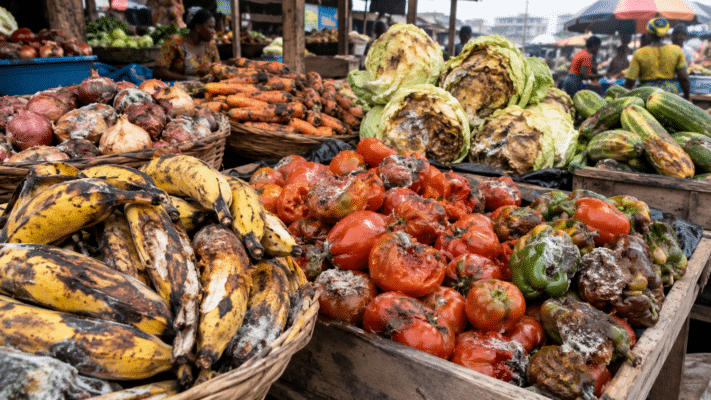
Traders and consumers in Lagos have expressed concern over financial losses from spoilt fruits and vegetables, blaming heat, poor transportation and inadequate storage.
They spoke in separate interviews with journalists at Iddo Terminus, Mile 12, Balogun and Agboju markets.
A visit to the markets showed traders displaying fresh produce, including carrots, cucumbers, watermelons, cabbage, bananas and leafy vegetables, while some kept their goods under tables to shield them from sunlight.
Taiwo Abdulhamid, a trader at Iddo Terminus Market, said he sometimes loses two to three kilogrammes of carrots from every 10 kilogrammes purchased.
Mr Abdulhamid said the losses could cost him between N20,000 and N30,000, forcing him to discard spoilt produce or increase prices to recover part of his money.
Similarly, Mistura Olawale, a banana and pawpaw seller, said she lost about 10 per cent of her goods to spoilage before they reached the market.
Ms Olawale attributed the losses to bad roads, poor transportation and overripe produce, calling for improved feeder roads and refrigerated transit vans.
At Mile 12 Market, Rafiu Olamide, a seller of ugu and waterleaf, said more than 15 per cent of his vegetables sometimes spoilt within one or two days.
Mr Olamide said vegetables worth about N80,000 could result in losses exceeding N10,000, adding that she sometimes sold slightly damaged produce at reduced prices.
Blessing Sunday, a banana seller at Balogun Market, Eko Idumota, said she sometimes loses bananas worth about N100,000 from a batch.
Ms Sunday said selling groundnuts alongside bananas helped cushion the losses, adding that she hesitated to complain to suppliers about damaged fruits for fear of losing their patronage.
Shuaibu Tukur, a carrot seller at Carrot Site, Mile 12, said transportation challenges affected the quality of supplies sourced from Ivory Coast, Cameroon, Bauchi, Jos and Sokoto.
He said journeys from Sokoto to Lagos could take about 20 hours under favourable conditions but extend to two days, depending on road conditions.
Aminu Usman, a tomato seller at Mile 12 Market, said overcrowding during transportation caused tomatoes to press against one another and break.
Mr Usman said carefully selected tomatoes sold for about N45,000, while damaged or less visually appealing ones, locally called “Eesha”, sold for about N19,000.
He called for improved transportation and handling practices to reduce breakages and financial losses.
Beyond traders’ losses, consumers said spoilage often forced them to discard food purchased with money they could ill afford to waste.
Yusuf Halima said she could lose between N15,000 and N25,000 worth of fruits and vegetables monthly, particularly tomatoes and leafy vegetables.
“Sometimes, I buy N5,000 worth of tomatoes hoping they will last me for two weeks if I blend and store them, but if there is no light for two days, my freezer defrosts, and everything spoils,” she said.
Another consumer, Joshua Edward, said he discarded between 20 and 30 per cent of the fruits and vegetables he purchased weekly.
“If I buy vegetables or fruits for N10,000 weekly, at least N2,000 to N3,000 worth goes to the bin because it wilted, grew mould or started smelling,” he said.
Precious Taiwo, a consumer at Gate 3, Mile 12, said she had lost about N6,000 to spoilt mangoes and bananas, discouraging her from buying fruits as frequently.
Eunice Tosin, a student interviewed at Agboju Market, Festac, said tomatoes and bananas sometimes spoil shortly after purchase, forcing her to cut off affected portions.
Paulina Onoseme, a consumer at Iyana Iba, said carrots sometimes deteriorated by the following day, causing losses of about N500 on some occasions.
Ms Onoseme said some sellers concealed deteriorating carrots beneath fresh ones, adding that she discarded affected produce because of safety concerns.
Eddy Oloye, an engineer and farmer with a personal farm in Lusada, Agbara, said inadequate storage, poor transportation and ineffective preservation methods contributed to post-harvest losses.
Mr Oloye said discarded produce also created environmental nuisance but could be reused as animal feed or processed into other products through effective recycling systems.
He called for government and private-sector support for improved transportation, preservation facilities and training in proper produce handling.
Ebube Agbim, a vegetable seller on Joseph Lambo Street, Costain, said poor packaging and storage contributed to the deterioration of scent leaf, ugu and waterleaf.
Ms Agbim estimated that affected vegetables could be worth about N3,000 daily, although her actual loss was approximately N1,500.
Jubril Useni, a trader at Small Garage, Mile 12, said heat, overcrowded vehicles and prolonged journeys sometimes damaged pepper, green pepper, ground beans and spring onions before they reached the market.
The traders and consumers called for improved transportation, better storage and affordable preservation facilities to reduce waste, protect earnings and make fresh produce last longer.
(NAN)










The woman who tested positive for Ebola in Nigeria and was evacuated to Switzerland for treatment has been discharged from hospital after making a full recovery.
She was discharged from Geneva University Hospitals on Wednesday, after medical personnel confirmed her recovery, Reuters reported on Thursday, quoting a statement from the hospital.
“After the medical team confirmed her full recovery, the cantonal physician authorised the patient being treated for Ebola virus disease to leave the Geneva University Hospitals (HUG) on 11 November 2026,” the hospital said.
The Uganda-born woman and her husband, a Swiss diplomat, were evacuated from Nigeria to Switzerland on 26 October. Her evacuation was confirmed by the Minister of Health and Social Welfare, Muhammad Pate.
The patient had returned to Abuja from Uganda on 3 October. She developed symptoms days later and was admitted to a private health facility before the Nigeria Centre for Disease Control and Prevention (NCDC) was notified. Laboratory tests confirmed the infection on 20 October.
Nigeria continues Ebola surveillance
The NCDC’s latest Ebola situation dashboard, updated on 12 November with data as of 11 November, lists one confirmed case, no deaths and seven negative cases.


It also shows that 62 contacts linked to the confirmed case have been identified. Of these, 52 have completed their mandatory 21-day follow-up, while 10 remain under monitoring.
The NCDC said its response includes contact tracing, investigation of reported alerts, laboratory testing, infection prevention and control measures, and surveillance at the country’s points of entry.
On 11 November, NCDC disclosed that Nigeria recorded no additional confirmed Ebola cases since the imported infection was confirmed.
The agency has urged healthcare workers to remain vigilant, ask patients about their travel and exposure histories, and promptly report suspected cases to public health authorities.
READ ALSO: Ebola: Nigeria records no new cases 21 days after imported infection – NCDC
Regional outbreak continues
The situation in Nigeria is part of a wider outbreak of Bundibugyo virus disease affecting parts of Africa.
In its latest situation update published on 6 November, the World Health Organisation (WHO) said the DRC had recorded 10,668 confirmed cases and 5,198 deaths as of 3 November, across 67 health zones in eight provinces.
Kenya had recorded nine confirmed cases and two deaths, while Nigeria had reported one imported case. WHO said there had been no new confirmed cases in Kenya or Nigeria since its previous update.
Discover more from Premium Times Nigeria
Subscribe to get the latest posts sent to your email.
News
‘INEC must explain why ADC judgment is being ignored’ — Atiku’s aide demands answers from Amupitan

Paul Ibe, media aide to the presidential candidate of the African Democratic Congress, ADC, Atiku Abubakar, has challenged the Independent National Electoral Commission, INEC, to explain why it has yet to clarify its position on a Federal High Court judgment upholding the David Mark-led ADC leadership, despite its assurance that it would obey court orders ahead of the 2027 presidential election.
Ibe’s reaction followed INEC Chairman, Professor Joash Amupitan’s statement that the commission would comply with court decisions concerning Atiku’s participation in the 2027 presidential race.
In a statement on X, while describing obedience to court orders as a legal duty, Ibe argued that the chairman’s assurance left unanswered questions about a July 2, 2026 judgment delivered by Justice Musa Liman, which upheld the emergence of the David Mark-led ADC leadership.
He questioned whether the judgment had been set aside and demanded that INEC identify the specific orders it considers binding, particularly those affecting the ADC leadership and its candidates.
“INEC therefore owes Nigerians a clear explanation of how it intends to reconcile the two decisions—not merely a general declaration that it will obey the judiciary,” Ibe said.
He maintained that his demand was not for INEC to disregard any court ruling but for the commission to account for both judgments and leave any conflict between them to the appropriate appellate court.
Ibe warned against what he described as selective treatment of court decisions, insisting that judgments favourable to the opposition should receive the same consideration as those that do not.
“INEC must demonstrate that its guiding principle is the law—not the political convenience of the outcome,” he added.
‘INEC must explain why ADC judgment is being ignored’ — Atiku’s aide demands answers from Amupitan
-

 News3 days ago
APM holds Presidential Campaign in Plateau, Pledges Security and Economic Reset
-
News4 days ago
APC Legacy Assembly Expresses Confidence in Tinubu Ahead of 2027 Election
-
News19 hours ago
UNIJOS Appoints Patricia Lar as First Female Vice-Chancellor
-
News4 days ago
Nigeria’s ntel wins international MVNO pitch competition in Spain – Technology Times