News
IGP Disu declares jungle justice murder, orders nationwide crackdown








Some residents of Plateau State have expressed anger over hunger and insecurity by burning campaign items distributed by the All Progressives Congress (APC) during President Bola Tinubu’s presidential campaign rally in Jos on Saturday.
In a video circulating on social media, some residents were seen gathering and setting ablaze the crested caps and brooms they received at the rally, saying they needed food, jobs and security rather than campaign materials.
The residents accused the ruling party of making empty promises, insisting that their immediate concerns were the economic hardship and insecurity affecting the state.
“We are hungry. We don’t need caps and brooms. We need food, jobs and security,” one of the residents said in the video.
Another resident accused the APC of failing the people of Plateau, particularly in the aftermath of recent attacks that left several families homeless.
The burning of the campaign materials came amid an alleged unfriendly reception for Tinubu at the rally, as some members of the crowd reportedly booed the President shortly after his arrival.
In videos shared on social media, some residents were heard shouting, “We don’t want you” and “Ba ma yi”, a Hausa expression meaning “We don’t want you”.
Others were seen waving their hands and turning their backs as the President’s convoy moved through the rally ground.
The chants reportedly continued for several minutes, prompting security operatives to intervene and control the crowd.
However, some APC supporters attempted to drown out the chants with songs in support of the President when he mounted the podium.
“It was embarrassing. People were shouting Ba Ma Yi. They said they are tired of hunger and insecurity,” an eyewitness said.
While addressing the party’s supporters, Tinubu promised to rebuild communities affected by violence in Plateau State and facilitate the return of residents displaced by attacks.
He also appealed to residents to forgive him for failing to visit the affected communities during his previous trip to the state in April.
The President acknowledged that his previous visit was limited to the airport, but said he had seen the devastation caused by the attacks and received reports from Governor Caleb Mutfwang.
“When I last visited the other time, I was limited to the airport. Forgive me if you didn’t see me in the hinterland, but I saw the devastation. I got the report from the governor. I saw horror in the faces of our people,” he said.
Tinubu assured displaced residents that the Federal Government would support the reconstruction of their communities and facilitate their return.
“But since then, that has changed. We are forging together. It is now that we can rebuild and I assure those displaced that we will rebuild your communities.
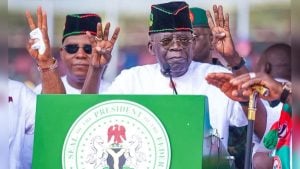
“We will rebuild your communities, and we will bring you back to your community. I have directed all the security agencies to take decisive action and sustain peace and stability on the Plateau,” he added.
He also called on residents to embrace unity, insisting that ethnic and linguistic differences should not divide them.
“We are one single family created by the same God Almighty. We are just living in different rooms, speaking different languages and behaving any way we want.
“But living in different rooms and speaking different languages does not make us enemies of one another. We have to live together. We have to farm together.
“We have to build this Plateau and this country together. It is our responsibility to tie our horns, behave as brothers and sisters, belonging to the same God Almighty,” Tinubu said.
The President’s remarks came about seven months after his visit to Plateau State following the March 29 attack on Angwan Rukuba community in Jos North Local Government Area, which left at least 27 people dead.
During the April visit, Tinubu met with victims’ families, community leaders, traditional rulers and other stakeholders at a facility near the Yakubu Gowon Airport in Heipang.
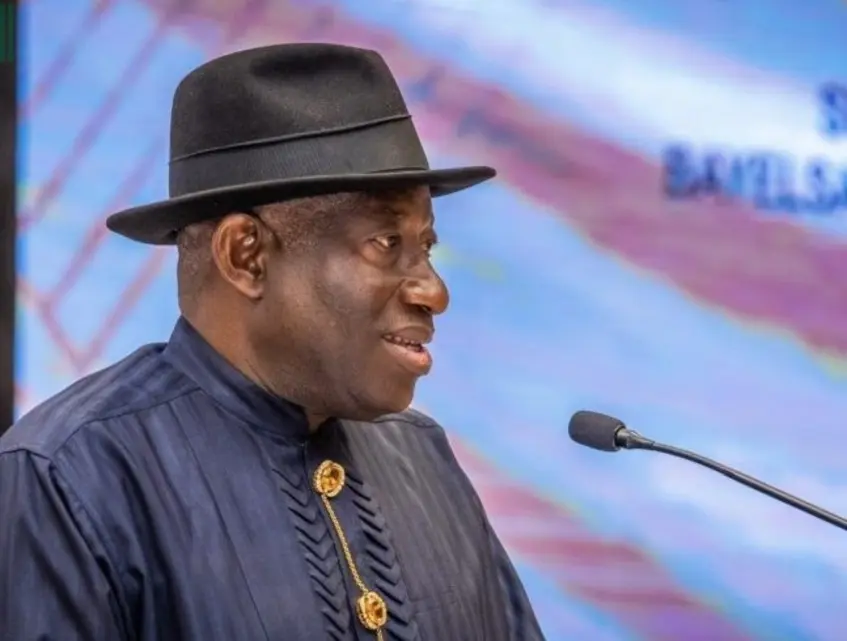
Former President Goodluck Jonathan has said Nigeria’s development will remain hindered unless the country abandons what he described as primitive methods of selecting its leaders.
Jonathan made the remarks while speaking on the occasion of the 162nd anniversary of the birth of nationalist leader Herbert Macaulay.
Speaking at a memorial colloquium organized by the Macaulay Heritage Foundation in Lagos, Jonathan urged Nigerians to prioritize competence and merit over religious, ethnic and linguistic considerations when choosing political leaders.
He warned that the country's enormous human and natural resources would remain underutilized if political decisions continued to be influenced by primordial sentiments.
The former president also identified leadership failures, corruption, weak institutions, policy inconsistency, inadequate infrastructure, insecurity and overdependence on raw material exports as major obstacles to Nigeria's development.
Jonathan called for comprehensive democratic reforms, stronger institutions, functional education and research-driven universities to accelerate national development.
He further described Nigeria's democratic system as opaque and amorphous, stressing the need for reforms that would guarantee popular participation, respect for human rights, judicial independence, accountability and the rule of law.
Comparing Nigeria's development with that of South Korea, India and Singapore, Jonathan questioned why the countries had recorded significant progress in industrialization, technology, education and healthcare while Nigeria continued to struggle.
He challenged Nigerian leaders to consider the kind of country they intend to build ahead of the nation's 100th independence anniversary in 2060.
According to him, "the country needs a national development agenda with clear objectives, measurable targets, timelines and defined responsibilities.”
Jonathan also urged young Nigerians to contribute to nation-building through innovation, enterprise, civic participation and accountability.
Nigeria’s development doomed until primitive leadership selection ends – Jonathan
-

 News3 days ago
UNIJOS Appoints Patricia Lar as First Female Vice-Chancellor
-
News4 days ago
NiYA: Nigeria Awards ₦49m grants to 17 young entrepreneurs – Technology Times
-
News17 hours ago
Tinubu (APC) in Jos: Promises to restore peace in the State and Nigeria
-
News2 days ago
Democrats launch Nvidia investigation, write scathing letter on Huang’s ‘scheme’ with Trump