News
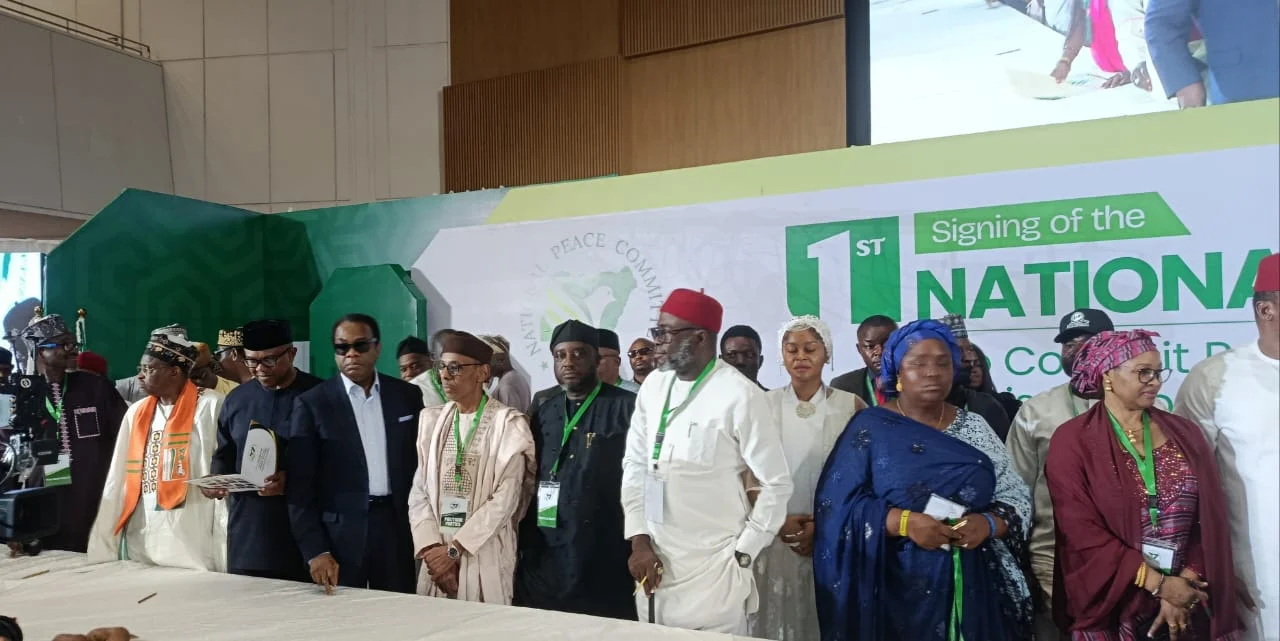
2027: Presidential, Governorship, NASS Candidates, Sign Peace Accord In Abuja









Nasarawa State Governor Abdullahi Sule has identified Kwara, Benue and Nasarawa as three states where internal disagreements are causing concern for the All Progressives Congress (APC) ahead of the 2027 general elections.
Sule raised the issue during a meeting of the North Central Grassroots Mobilization Network held at the office of the Secretary to the Government of the Federation, SGF, in Abuja.
The gathering was attended by APC National Chairman, Prof. Nentawe Goshwe Yilwatda; SGF, Senator George Akume; Minister of Information and National Orientation, Mohammed Idris; former Kogi State governor, Idris Wada; former Plateau State governor, Simon Lalong; the deputy governor of Plateau State; National Coordinator of the North Central Grassroots Mobilization Network, Arch. Sonny ST. Echono, and other party stakeholders.
According to Sule, the APC is facing internal challenges in the three states, although he noted that efforts were being made to resolve the disputes before they affect the party’s electoral prospects.
He said the disagreements were largely connected to competition for elective positions and differences over preferred candidates for the 2027 elections.
The governor urged APC leaders and members to manage their differences responsibly and avoid public comments capable of worsening divisions within the party.
Sule said many APC members remained committed to President Bola Tinubu, but warned that disputes over other candidates could reduce the party’s ability to secure votes across the various levels of the election.
“The bigger challenge is the one within the party, where you have people who are holding positions within the party, and they are now saying that we will vote for the president, but we will not vote for this, we will not vote for that, we will not vote for you,” Sule said.
He explained that such declarations could create frustration among supporters whose preferred candidates were not backed by party leaders.
“The people are saying, why are we going to vote for the president if you are also not going to support our own candidate?” he said.
The governor advised party members with reservations to exercise restraint, saying public confrontations could harm the APC’s interests ahead of the polls.
“My idea is that even if that’s what those kind of people want to do, please make less noise about it, because it’s going to affect us if we continue to make too much noise with a lot of bragadocio,” he said.
Sule also said voters could support Tinubu for different reasons, including personal loyalty, an assessment of his performance or the influence of candidates they support at other levels.
“But believe it or not, there are people who will vote for the president because their candidate is saying we are going to vote for the president,” he said.
He stressed that APC leaders must recognise the connection between support for the President and support for candidates contesting governorship, National Assembly and state assembly seats.
The governor commended the APC national leadership for promoting reconciliation, particularly the decision by the national chairman and other senior officials to attend the North Central meeting.
The North Central Grassroots Mobilization Network said it would hold a grand rally on October 10 in Lafia, Nasarawa State, as well as a medical outreach in Benue State, grassroots advocacy tours and town hall meetings across the six states in the zone and the Federal Capital Territory.
The network said the programmes were aimed at strengthening grassroots mobilisation and securing a strong turnout for Tinubu in the presidential election scheduled for January 2027.
In September, the governor also reacted to the political coalition being promoted by Minister of the Federal Capital Territory, Nyesom Wike. He said he was relieved that Wike had not listed him among APC governors allegedly opposed to the coalition.
Sule made the statement during an interview with TVC while discussing the disagreement between Wike and some APC governors over the minister’s political activities.
“Thank God I’m not on that list. I feel relieved that I’m not on Wike’s list of APC governors fighting the Rainbow Coalition,” Sule said.
He questioned the arrangement involving Wike, who remains a member of the Peoples Democratic Party, PDP, while serving in an APC-led administration.
“Wike is one of the ministers in this administration, and if he says he wants to support President Tinubu from another party, remember he’s not an APC member,” he said.
“What’s the whole essence of an alliance? I think the Governors’ Forum message was misunderstood.”
Wike had earlier named Imo State Governor Hope Uzodimma, Kwara State Governor AbdulRahman AbdulRazaq and Ogun State Governor Dapo Abiodun as three APC governors he claimed were opposed to his political activities.
The minister has maintained that the Rainbow Coalition is intended to mobilise support for Tinubu’s re-election across party lines and is not designed to weaken the APC.
The APC Governors’ Forum, however, rejected political arrangements that could undermine the party or its candidates in the forthcoming elections.
Wike has argued that voters can support different parties at different levels, citing the 2023 elections as an example.
“What I said and stand for is that I will mobilise support for the re-election of the President. I never promised anyone that PDP will not field candidates to contest governorship, National Assembly and House of Assembly elections,” Wike said.
The minister has continued to insist that the coalition is not a substitute for the APC but a platform for politicians from different parties to support Tinubu’s presidential campaign.

As more women consider menstrual cups as an option for managing their periods, questions have emerged about whether using them can affect the hymen or a woman’s virginity.
Some people fear that inserting a menstrual cup could “break” the hymen, cause a woman to lose her virginity or permanently make the vagina “loose”.
Speaking with PT Health Watch, Elizabeth Adewale, a Certified Holistic Sex Educator and Public Health Professional, said many of these concerns stem from misconceptions about the hymen and what it means medically to be a virgin.
Hymen changes
According to Ms Adewale, inserting a menstrual cup can stretch the hymen and, in some cases, may cause a small tear, but “this does not mean that a woman has lost her virginity.”
She explained that the hymen is a thin, elastic fold of tissue around the vaginal opening that varies in shape, thickness and elasticity from woman to woman.
“If it were a seal, menstrual blood and normal vaginal discharge wouldn’t be able to come out,” she said.


Ms Adewale said the hymen can also change for reasons unrelated to sexual intercourse, including physical activities such as cycling, gymnastics and other exercise. She added that some women may have very little hymenal tissue, while in others it may be difficult to see.
The American College of Obstetricians and Gynaecologists (ACOG) also explains that the hymen is a thin membrane that partially covers the entrance to the vagina and can be stretched or torn through tampon use, sports activities or medical procedures. It also says the presence or absence of the hymen does not indicate “virginity”.
Virginity marker
Ms Adewale said the belief that every woman is born with a hymen that remains intact until her first sexual experience is incorrect.
“The hymen is not a virginity marker,” she said.
She explained that the hymen does not simply disappear after sexual intercourse and can still be present afterwards, although its appearance may have changed.
According to the expert, this means that looking at a woman’s hymen cannot establish whether she has had sex.
The World Health Organisation (WHO) says there is no scientific or clinical examination that can prove whether a woman or girl has had vaginal intercourse. It also states that the appearance of the hymen cannot prove whether someone has had sexual intercourse or is sexually active.
Vaginal elasticity
Another concern is that inserting a menstrual cup could permanently stretch the vagina and make it “loose”.
Ms Adewale said there is no medical basis for this belief.
“The vagina is an elastic, muscular canal,” she said, noting that it can relax, expand and contract depending on what is happening.
She said inserting or removing a menstrual cup does not permanently stretch the vagina.
“Your vagina isn’t going to suddenly become a wide-open hole because you’ve used a menstrual cup,” she said.
However, Ms Adewale noted that vaginal insertion can be painful or difficult for some women.
She explained that women with vaginismus, for instance, may experience involuntary tightening of the vaginal or pelvic floor muscles, making the insertion of a menstrual cup, tampon, finger or penis painful or difficult.
“It’s not because their vagina is too small,” she said.
According to ACOG, vaginismus is an involuntary tightening of the muscles at the opening of the vagina that can make penetration painful or difficult.
Using menstral cup
For women who choose to try a menstrual cup, Ms Adewale advised first-time users not to rush the process.
READ ALSO: Group calls for reusable pads as menstrual stigma, access gaps persist
She recommended relaxing before insertion, washing the hands and cleaning the cup properly, finding a comfortable position and following the manufacturer’s instructions on how to fold and insert the cup.
A woman can squat, sit on the toilet or stand with one leg raised on a stool, she said, adding that taking slow, deep breaths can also help.
“Once you’ve successfully inserted it, allow it to open properly and create a seal, but don’t force it. If you experience significant pain, stop, don’t have to force it,” she said.
She added that first-time users may need time to become comfortable with the process and understand what works best for them.
Ms Adewale said the choice of menstrual product is personal and women should not feel pressured to use a menstrual cup if it does not work for them.
Discover more from Premium Times Nigeria
Subscribe to get the latest posts sent to your email.
-

 News2 days ago
PLASU Opens Doors to Global Investors at 2nd Inaugural Lecture
-
News2 days ago
Plateau Specialist Hospital Celebrates Nigeria at 66, Salutes Mutfwang’s Health Initiatives
-
News2 days ago
Nigeria At 66: Rotjimwa Yilyok Salutes President Tinubu, APC Leadership and Plateau Government
-
Health18 hours ago
Plateau: Medical Women Association of Nigeria Marks Older Persons Day with Free Outreach